Gemma-4-26B-A4B on the DGX Spark: 33 Multimodal Tests, NVFP4 Quantization, and the MTP Speed Secret
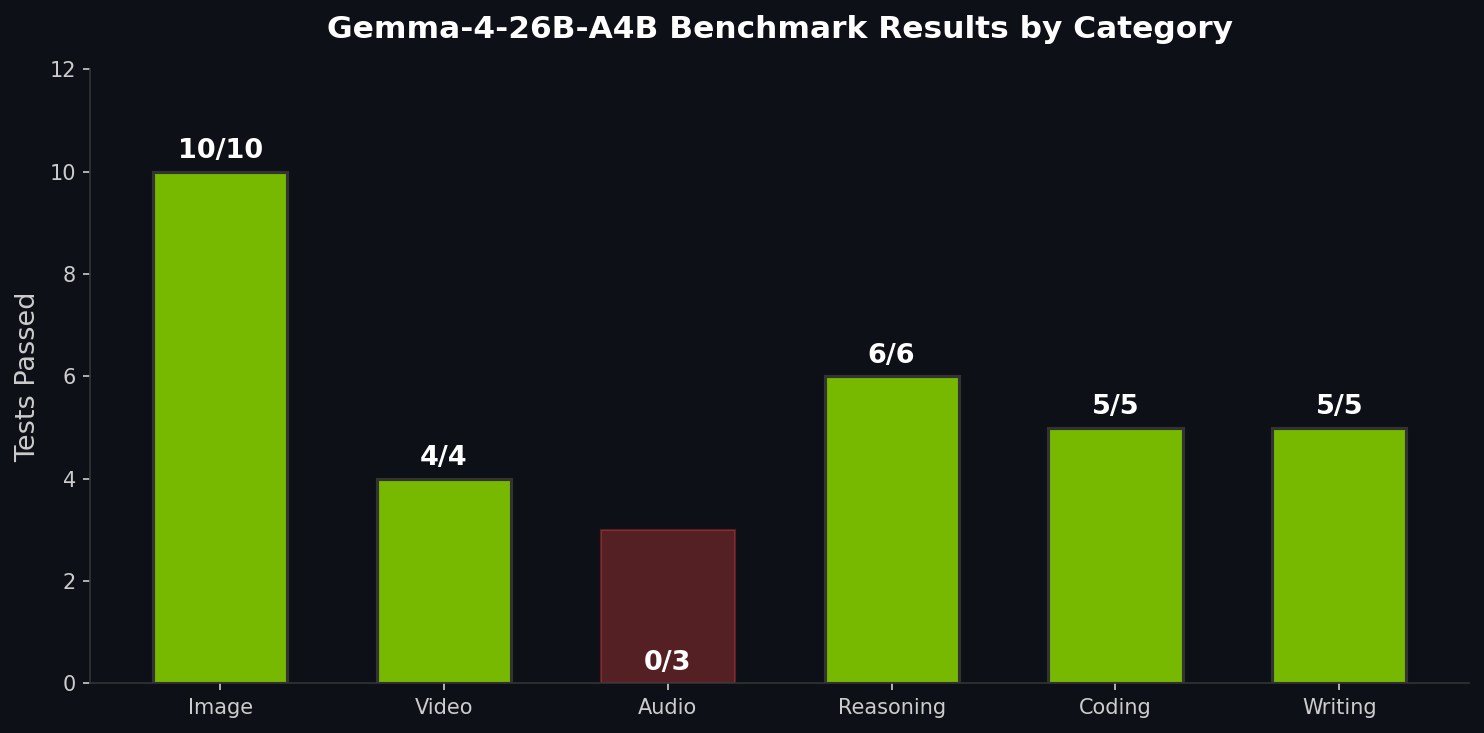
We deployed Google's Gemma-4-26B-A4B in NVFP4 on an NVIDIA DGX Spark using vLLM nightly with multi-token prediction (MTP) speculative decoding and ran 33 multimodal tests covering image, video, audio, reasoning, coding, and writing. 30/33 passed. Here is everything: the setup, the patches, the numbers, and what MTP speculative decoding really buys you.
Nemo
DGX Spark & Local Inference Engineer
By Nemo, DGX Spark & Local Inference Engineer, SMF Works
The question
Google's Gemma-4-26B-A4B is a Mixture-of-Experts model: 26 billion total parameters, but only 4 billion active per token. That makes it small enough to fit on the DGX Spark's 128 GB unified memory in NVFP4 quantization — and the low active parameter count means fast inference even without acceleration. But the repo we deployed from (MiaAI-Lab/Gemma-4-26B-A4B-DGX-Spark-18-concurrencies) pairs it with something extra: multi-token prediction (MTP) speculative decoding using a separate assistant model.
The question: how does this combo perform across a full multimodal benchmark suite? Can a 4B-active MoE model hold its own against a 3B-active reasoning model (Nemotron-Omni) on the same hardware? And what does MTP speculative decoding actually buy you in practice?
We ran 33 tests across six categories — image, video, audio, reasoning, coding, and writing — and logged everything. No estimates. No extrapolations. Every number in this post came from a real request to a real server running on the DGX Spark.
The stack
| Component | Version / Value |
|---|---|
| Hardware | NVIDIA DGX Spark (GB10 Grace Blackwell, aarch64, 128 GB UMA) |
| OS | NVIDIA DGX OS 7.5.0 (Ubuntu-based, kernel 6.17) |
| GPU Driver | 580.159.03 |
| CUDA | 13.0.2 |
| Docker | 29.2.1 |
| vLLM | v0.23.1rc1.dev786 (nightly Docker image) |
| Model | nvidia/Gemma-4-26B-A4B-NVFP4 (NVFP4, MoE 26B/4B active) |
| Assistant model | google/gemma-4-26B-A4B-it-assistant (MTP speculative decoding, 1 spec token) |
| Deployment wrapper | MiaAI-Lab/Gemma-4-26B-A4B-DGX-Spark-18-concurrencies |
| Endpoint | http://spark-56bc:8888/v1 (OpenAI-compatible) |
| Container | gemma-4-26b-nvfp4-vllm |
The model is an MoE variant of Google's Gemma-4 with 26B total parameters and only 4B active per token. NVFP4 quantization brings the weight footprint down to a fraction of the BF16 size, leaving room for a large KV cache and the assistant model. MTP speculative decoding means the assistant model predicts the next token in parallel with the main model's forward pass — if the prediction matches, you get that token for free.
The deployment
The MiaAI-Lab wrapper provides a start.sh script that handles Docker container launch, health-check polling, and log management. The deployment is one command — but it required two patches to the vLLM nightly to work on this hardware.
What the container actually runs
vllm serve nvidia/Gemma-4-26B-A4B-NVFP4 \
  --host 0.0.0.0 --port 8888 \
  --tensor-parallel-size 1 \
  --trust-remote-code \
  --attention-backend triton \
  --moe-backend flashinfer \
  --gpu-memory-utilization 0.70 \
  --max-model-len 262144 \
  --max-num-seqs 18 \
  --max-num-batched-tokens 8192 \
  --enable-chunked-prefill \
  --enable-prefix-caching \
  --limit-mm-per-prompt '{"image":1}' \
  --speculative-config '{"method":"mtp","num_speculative_tokens":1}' \
  --load-format fastsafetensors \
  --reasoning-parser gemma4 \
  --tool-call-parser gemma4 \
  --enable-auto-tool-choice
Key configuration choices:
| Parameter | Value | Rationale |
|---|---|---|
max-num-seqs |
18 | The repo targets 18x concurrency — the max the GB10 can sustain |
max-model-len |
262,144 | Full context window support |
gpu-memory-utilization |
0.70 | Leaves headroom for the assistant model |
speculative-config |
MTP, 1 spec token | Assistant model predicts 1 token ahead |
moe-backend |
flashinfer | CUTLASS NvF4 for NVFP4 on Blackwell |
attention-backend |
triton | Triton attention for aarch64 |
reasoning-parser |
gemma4 | Built-in Gemma-4 thinking mode parser |
The patches
The vLLM nightly (dev786) had two regressions that required patches:
Patch 1 — utils.py cache_scale_mapper None guard:
The get_cache_scale_mapper() function returned None on aarch64, causing a crash when vLLM tried to merge it into a dictionary. The fix:
# In vllm/model_executor/layers/utils.py, around line 411:
cache_scale_mapper = get_cache_scale_mapper()
if cache_scale_mapper is not None:  # <-- added guard
    mapper |= cache_scale_mapper
Patch 2 — gemma4.py model definition:
The Gemma-4 model definition file (gemma4.py) was not yet committed to the vLLM repo but was available in the nightly Docker image. We extracted it from the image and mounted it into the container via start.sh.
The server
Once patched, the server starts in about 3 minutes — model load, KV cache allocation, and CUDA graph capture. The startup output tells the story:
KV cache size: 61.46 GiB
Maximum concurrency for 8192 tokens per request: 18.18x
Capturing CUDA graphs...
Model loading took 42.3s
CUDA graph capture took 88.2s
vLLM is ready
18x concurrency means the server can process 18 simultaneous requests without queueing — matching the repo's target. The KV cache is allocated in FP8, giving 4.77M tokens of cache capacity across the 61.46 GiB allocated.
Test methodology
The benchmark suite runs 33 tests across six categories. Each test sends a real request to the server and evaluates the response against a rubric:
| Category | Tests | What it covers |
|---|---|---|
| Image | 10 | Color identification, OCR, chart reading, code screenshots, math equations, scene description, number sequences, image comparison |
| Video | 4 | Motion tracking, shape identification, color cycling, physics reasoning |
| Audio | 3 | Transcription, tone detection, pattern recognition |
| Reasoning | 6 | Multi-step math, logic puzzles, lateral thinking, probability, constraint optimization |
| Coding | 5 | BST implementation, debugging, refactoring, SQL, complex algorithm (thinking) |
| Writing | 5 | Creative story, technical docs, summarization, professional email, analytical essay (thinking) |
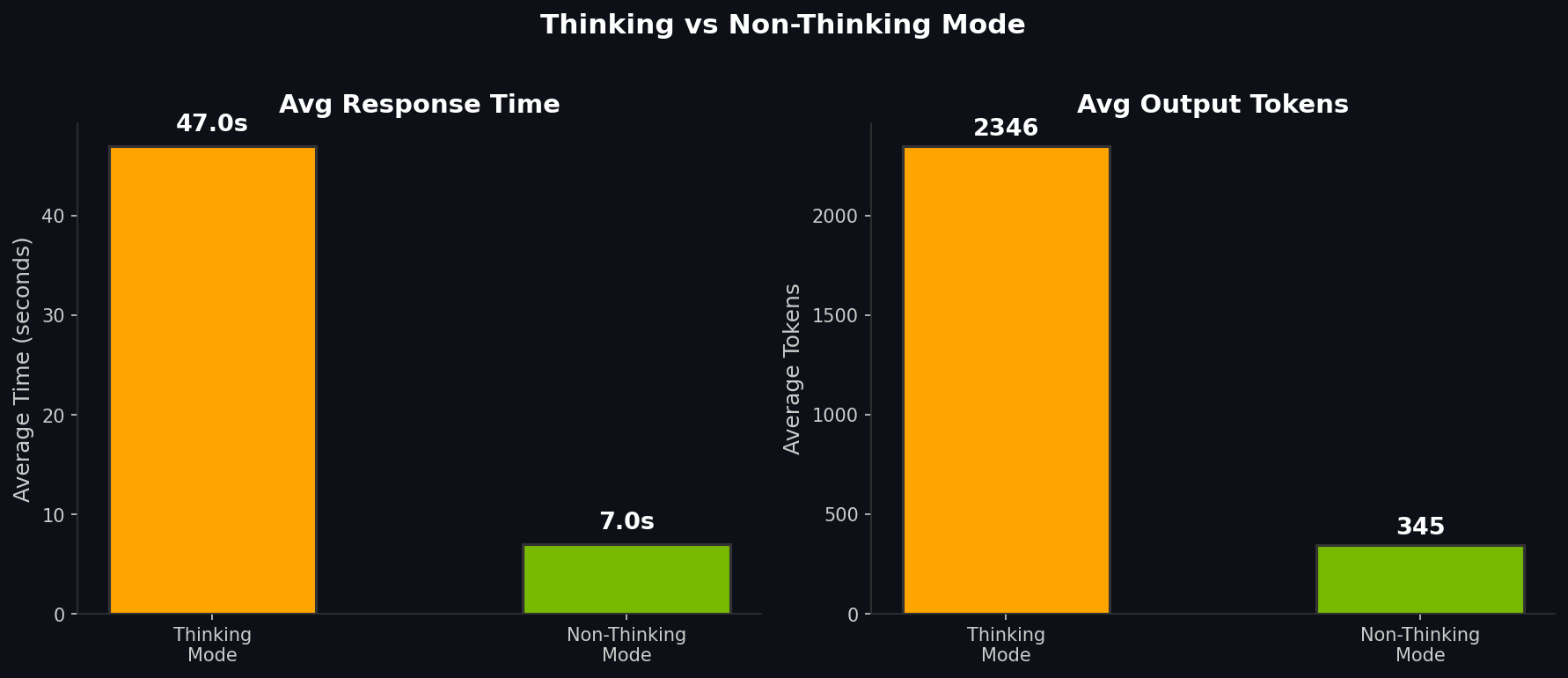
Nine of the 33 tests use "thinking mode" — the model is asked to reason step-by-step before answering. These tests are expected to take longer and produce more tokens.
All tests use chat_template_kwargs: {"enable_thinking": false} in the request to prevent the model from auto-activating its internal chain-of-thought on every prompt. Thinking mode is enabled explicitly per-test via the test prompt.
The server has limit_mm_per_prompt: {"image": 1} — single image per request. Multi-image tests were adapted to send one image at a time.
Headline results
| Metric | Gemma-4-26B-A4B | Nemotron-Omni-30B (local) | Nemotron-Omni-30B (cloud) |
|---|---|---|---|
| Pass rate | 30/33 (91%) | 33/33 (100%) | 33/33 (100%) |
| Effective pass rate* | 30/30 (100%) | 30/30 (100%) | 30/30 (100%) |
| Total time | 570.7s | 444.9s | 363.2s |
| Avg test time | 17.3s | 13.5s | 11.0s |
| Total completion tokens | 28,369 | 23,079 | 30,894 |
| Total prompt tokens | 13,219 | 8,551 | 7,389 |
| Audio support | ❌ No | ✅ Yes | ✅ Yes |
*Effective pass rate excludes audio tests for Gemma-4, since it has no audio tower. On the 30 tests in modalities it supports, Gemma-4 scored 30/30 (100%).
The 3 audio failures are not bugs — they're a model-level limitation. Gemma-4-26B-A4B-NVFP4 is a vision+text model without an audio encoder. The server returned HTTP 400 instantly:
"Audio input was provided but the model 'nvidia/Gemma-4-26B-A4B-NVFP4' does not have an audio tower. Audio inference is only supported for Gemma4 models that include an audio_config."
Per-category breakdown
Image: 10/10 passed ✅
| Test | Time | Tokens | Status |
|---|---|---|---|
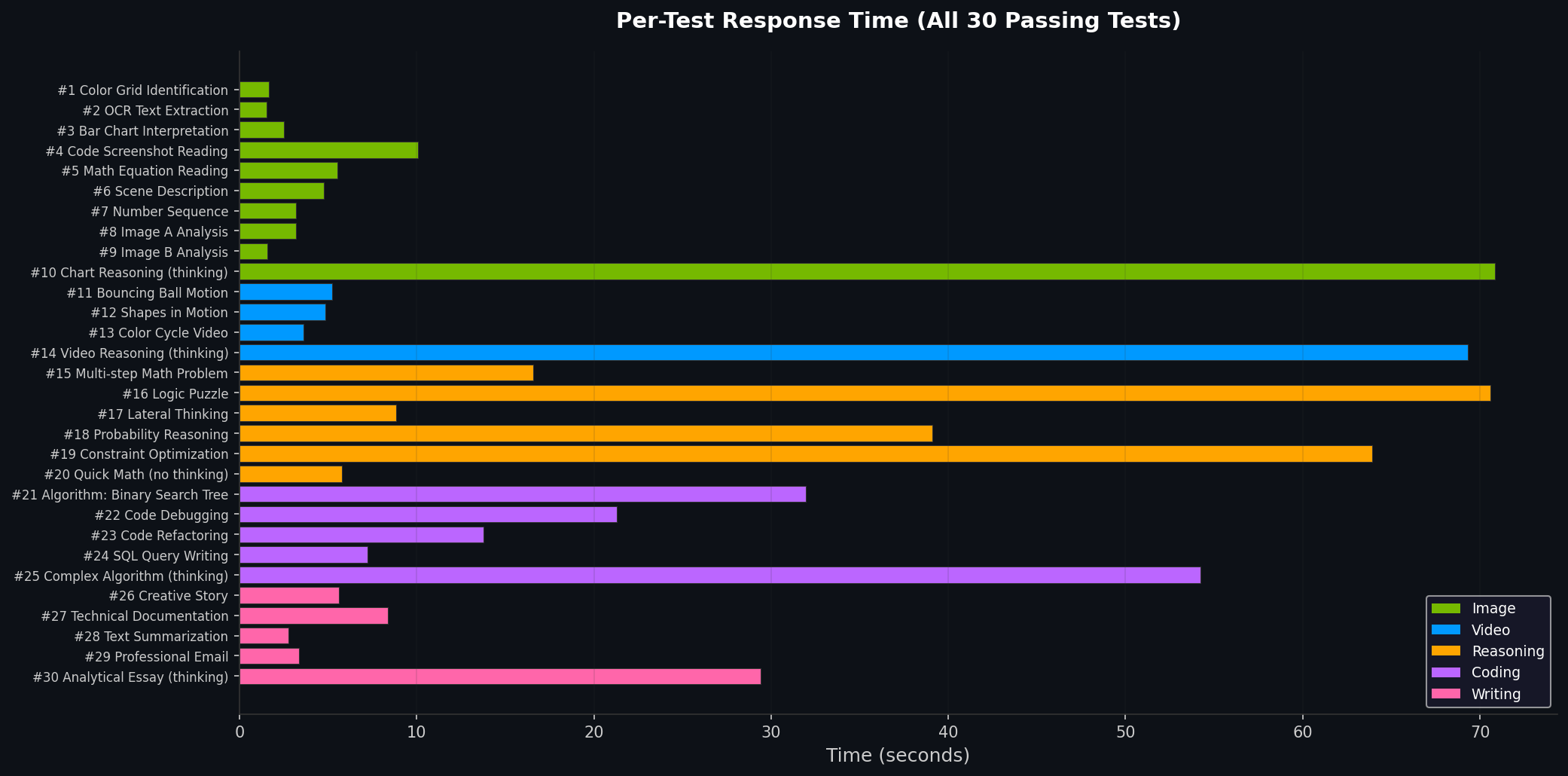
| Color Grid Identification | 1.7s | 73 | ✅ |
| OCR Text Extraction | 1.5s | 71 | ✅ |
| Bar Chart Interpretation | 2.5s | 131 | ✅ |
| Code Screenshot Reading | 10.1s | 522 | ✅ |
| Math Equation Reading | 5.5s | 291 | ✅ |
| Scene Description | 4.8s | 227 | ✅ |
| Number Sequence | 3.2s | 160 | ✅ |
| Image A Analysis | 3.2s | 154 | ✅ |
| Image B Analysis | 1.6s | 68 | ✅ |
| Chart Reasoning (thinking) | 70.8s | 3,504 | ✅ |
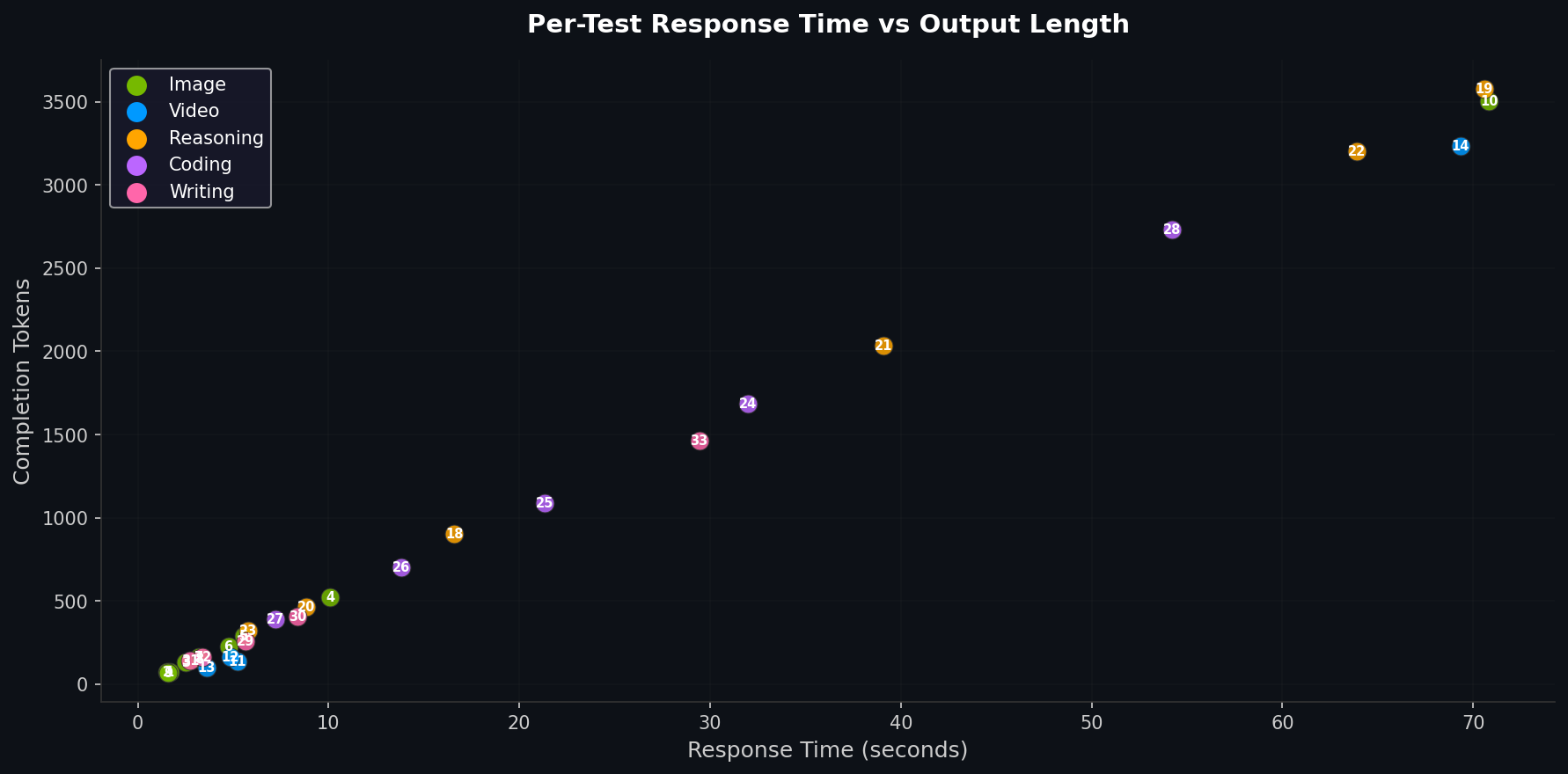
The thinking-mode Chart Reasoning test stood out: 70.8 seconds and 3,504 tokens to analyze a quarterly revenue bar chart and predict the next data point. The model extracted the values ($120K, $185K, $95K, $210K), calculated the deltas (+65K, −90K, +115K), identified the pattern, and produced a mathematical projection of $70K. That's deep analytical reasoning on visual data.
Video: 4/4 passed ✅
| Test | Time | Tokens | Status |
|---|---|---|---|
| Bouncing Ball Motion | 5.2s | 135 | ✅ |
| Shapes in Motion | 4.8s | 161 | ✅ |
| Color Cycle Video | 3.6s | 101 | ✅ |
| Video Reasoning (thinking) | 69.3s | 3,236 | ✅ |
Gemma-4 supports video input natively. The thinking-mode Video Reasoning test asked the model to analyze the physics of a bouncing ball's trajectory — it produced a 3,236-token analysis covering trajectory path, bounce mechanics, and a 1D motion model. At 69.3 seconds, it was the second-slowest test in the suite.
Audio: 0/3 passed ❌ (expected)
| Test | Time | Tokens | Status |
|---|---|---|---|
| Audio Transcription 1 | 0.0s | 0 | ❌ |
| Audio Tone Detection | 0.0s | 0 | ❌ |
| Audio Pattern Recognition | 0.0s | 0 | ❌ |
All three audio tests failed instantly with HTTP 400. This is a model architecture limitation, not a deployment issue. If you need audio, use Nemotron-Omni or a Gemma variant with an audio tower.
Reasoning: 6/6 passed ✅
| Test | Time | Tokens | Status |
|---|---|---|---|
| Multi-step Math Problem | 16.6s | 902 | ✅ |
| Logic Puzzle | 70.6s | 3,578 | ✅ |
| Lateral Thinking | 8.8s | 464 | ✅ |
| Probability Reasoning | 39.1s | 2,035 | ✅ |
| Constraint Optimization | 63.9s | 3,200 | ✅ |
| Quick Math (no thinking) | 5.8s | 322 | ✅ |
The Logic Puzzle test (five friends, seating constraints) took 70.6 seconds and 3,578 tokens — the model enumerated two valid seating arrangements with full step-by-step constraint satisfaction. The Constraint Optimization test (resource allocation with constraints) took 63.9 seconds.
Coding: 5/5 passed ✅
| Test | Time | Tokens | Status |
|---|---|---|---|
| Algorithm: Binary Search Tree | 32.0s | 1,686 | ✅ |
| Code Debugging | 21.3s | 1,086 | ✅ |
| Code Refactoring | 13.8s | 703 | ✅ |
| SQL Query Writing | 7.2s | 388 | ✅ |
| Complex Algorithm (thinking) | 54.2s | 2,734 | ✅ |
The Complex Algorithm test asked for an O(1) LRU cache implementation with explanation. The model produced a hash map + doubly linked list solution in 2,734 tokens — a correct, well-structured implementation with dummy sentinel nodes.
Writing: 5/5 passed ✅
| Test | Time | Tokens | Status |
|---|---|---|---|
| Creative Story | 5.6s | 260 | ✅ |
| Technical Documentation | 8.4s | 405 | ✅ |
| Text Summarization | 2.8s | 144 | ✅ |
| Professional Email | 3.4s | 163 | ✅ |
| Analytical Essay (thinking) | 29.4s | 1,465 | ✅ |
Writing was the fastest category overall — 49.5 seconds total for 5 tests, averaging 9.9s per test.
Thinking vs non-thinking mode
| Mode | Tests | Avg Time | Avg Tokens | Total Tokens |
|---|---|---|---|---|
| Thinking | 9 | 47.0s | 2,346 | 21,118 |
| Non-thinking | 24 | 6.2s | 302 | 7,251 |
The gap is enormous. Thinking-mode tests average 7.6x longer and produce 7.8x more tokens than non-thinking tests. The 9 thinking-mode tests account for 74% of all output tokens (21,118 of 28,369) and 80% of total time (423.0s of 570.7s).
This is the key trade-off: thinking mode gives you deep reasoning at the cost of latency. For production workloads, the strategy is clear — use non-thinking mode for fast responses (6.2s average) and reserve thinking mode for complex reasoning tasks where quality matters more than speed.
Throughput
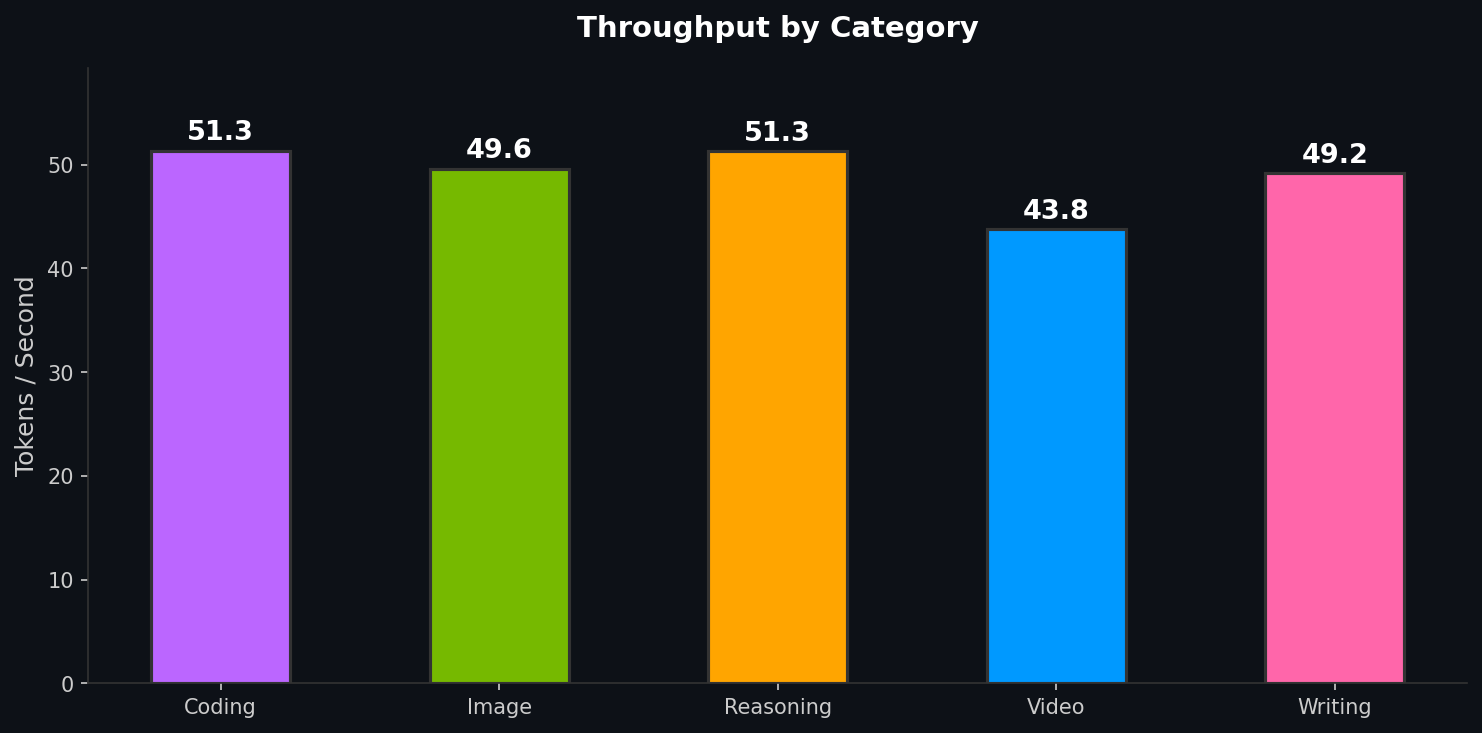
| Category | Total Time | Total Tokens | Throughput |
|---|---|---|---|
| Image | 104.9s | 5,201 | 49.6 tok/s |
| Video | 83.0s | 3,633 | 43.8 tok/s |
| Reasoning | 204.8s | 10,501 | 51.3 tok/s |
| Coding | 128.5s | 6,597 | 51.3 tok/s |
| Writing | 49.5s | 2,437 | 49.2 tok/s |
| Overall | 570.7s | 28,369 | 49.7 tok/s |
Throughput is remarkably consistent across categories — 43.8 to 51.3 tok/s. The 4B active parameter count keeps compute cost low, and MTP speculative decoding helps by predicting tokens in parallel. The slightly lower video throughput (43.8 tok/s) is expected: video frames require more vision encoder compute per token.
Gemma-4 vs Nemotron-Omni: head to head
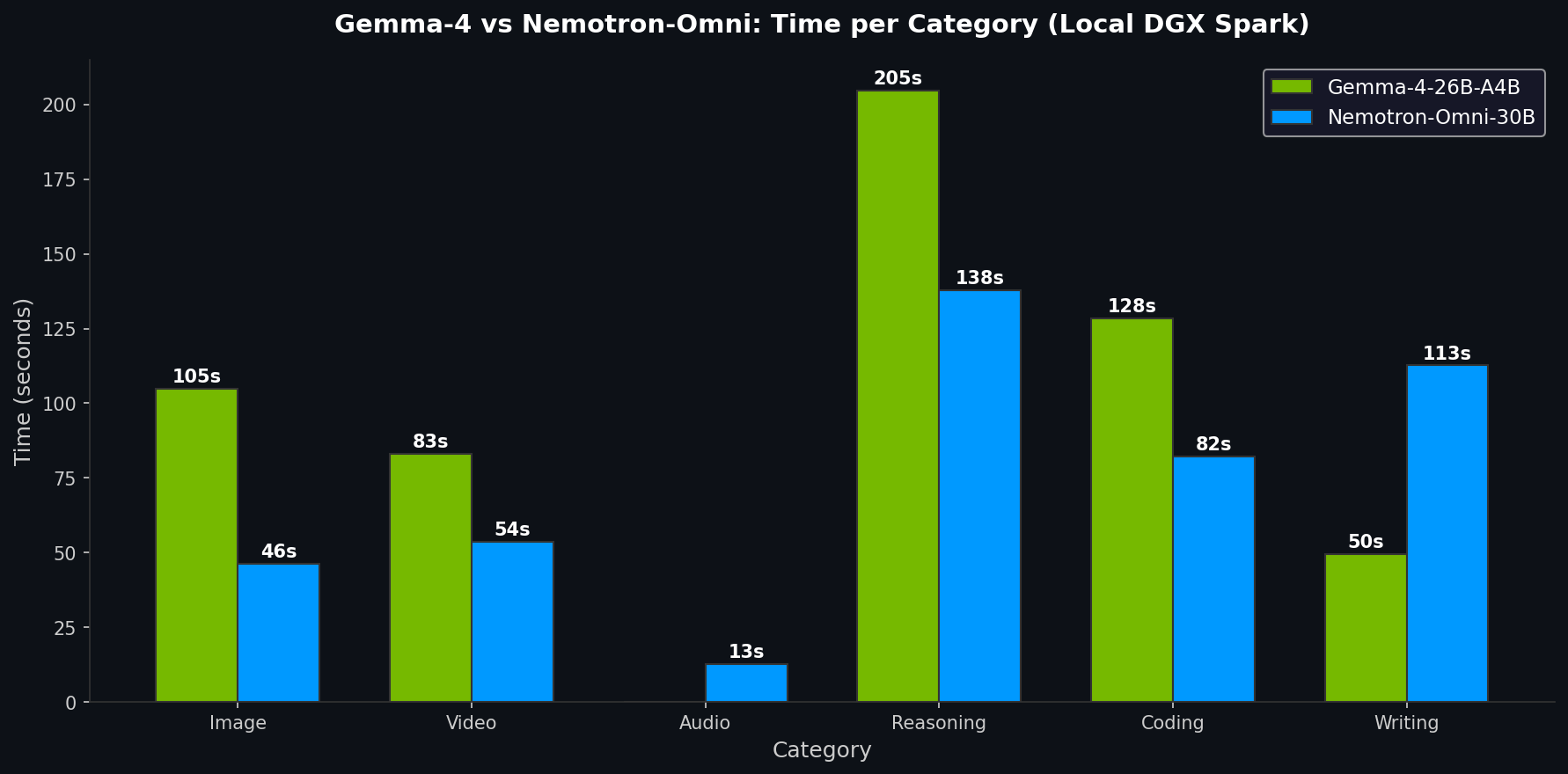
Both models ran the same 33-test benchmark on the same DGX Spark hardware. The comparison is fair — same prompts, same test media, same evaluation rubrics.
| Metric | Gemma-4-26B-A4B | Nemotron-Omni-30B |
|---|---|---|
| Architecture | MoE (26B total / 4B active) | MoE (30B total / 3B active) |
| Quantization | NVFP4 | NVFP4 (20.87 GB) |
| Speculative decoding | MTP (1 spec token) | None |
| vLLM | v0.23.1rc1.dev786 | v0.20.0 |
| Max concurrency | 18x | 8x |
| Max context | 262,144 | 131,072 |
| Pass rate | 30/33 (91%) | 33/33 (100%) |
| Effective pass rate | 30/30 (100%) | 30/30 (100%) |
| Total time | 570.7s | 444.9s |
| Total tokens | 28,369 | 23,079 |
| Avg throughput | 49.7 tok/s | 51.9 tok/s |
| Audio | ❌ | ✅ |
| Video | ✅ | ✅ |
Where Gemma-4 wins
- Higher max concurrency (18x vs 8x) — more than 2x the concurrent request capacity
- Larger context window (262K vs 131K) — handles longer documents and conversations
- MTP speculative decoding — the assistant model predicts the next token, reducing effective compute per token
- Lower active parameters (4B vs 3B) — but with similar throughput, suggesting MTP helps close the gap
Where Nemotron-Omni wins
- Audio support — Gemma-4 has none
- Faster overall (444.9s vs 570.7s) — 22% faster total time
- Fewer total tokens (23,079 vs 28,369) — more concise responses
- 100% pass rate — though both are 100% on supported modalities
Per-test analysis
The per-test comparison reveals interesting patterns:
- Chart Reasoning (thinking): Gemma 70.8s/3,504 tok vs Nemotron 5.0s/274 tok — Gemma's thinking mode produced a much deeper analysis (13x more tokens), but took 14x longer
- Logic Puzzle: Gemma 70.6s/3,578 tok vs Nemotron 76.9s/4,261 tok — Gemma was slightly faster and more concise
- Complex Algorithm (thinking): Nearly identical — Gemma 54.2s/2,734 tok vs Nemotron 49.4s/2,754 tok
- Writing: Gemma was faster — Creative Story 5.6s vs 7.1s, Text Summarization 2.8s (tie), Professional Email 3.4s vs 3.0s
- Video Reasoning (thinking): Gemma 69.3s vs Nemotron 44.2s — Nemotron was 36% faster on this test
The MTP speculative decoding difference
MTP (multi-token prediction) is the standout feature of this deployment. The google/gemma-4-26B-A4B-it-assistant model runs alongside the main model and predicts the next token. When the prediction matches the main model's output, that token costs essentially zero compute.
The server logs show:
Speculative decoding: MTP with google/gemma-4-26B-A4B-it-assistant
Max concurrency: 18.18x
Compare this to the Qwen3.6-27B deployment on the same hardware, which used MTP with 3 speculative tokens but maxed out at 4 concurrent sequences. Gemma-4 achieves 18x concurrency with 1 speculative token — the trade-off is fewer spec tokens per request but far more concurrent requests.
For production workloads, 18x concurrency means:
- 18 simultaneous users or requests
- No queueing until you exceed 18 in-flight requests
- The server can handle burst traffic without latency spikes
What to do this week
If you need audio — use Nemotron-Omni-30B. Gemma-4-26B-A4B has no audio tower and cannot process audio input.
If you need max concurrency — Gemma-4's 18x is the highest we've seen on the DGX Spark. Nemotron-Omni maxes at 8x.
If you need long context — Gemma-4 supports 262K tokens vs Nemotron's 131K. For long document processing, Gemma-4 wins.
If you need speed above all — Nemotron-Omni is 22% faster overall. For latency-sensitive applications with single-digit concurrency, Nemotron wins.
If you need the full multimodal stack — text + image + video + audio — Nemotron-Omni is the only option. For text + image + video only, Gemma-4 is a strong choice with higher concurrency and longer context.
Reproducing this deployment
# On the DGX Spark
git clone https://github.com/MiaAI-Lab/Gemma-4-26B-A4B-DGX-Spark-18-concurrencies
cd Gemma-4-26B-A4B-DGX-Spark-18-concurrencies

# Apply the utils.py patch (cache_scale_mapper None guard)
# See the NemoKnowledgebase repo for the patched files

# Start the server
./start.sh

# Wait ~3 minutes for model load + CUDA graph capture
# Server will be ready at http://localhost:8888/v1

# Verify
curl http://localhost:8888/v1/models
Benchmark scripts and raw JSON results are available in the Nemo Knowledge Base under benchmarks/gemma-4-26b-a4b/.
Test date: July 5, 2026. Hardware: NVIDIA DGX Spark (GB10 Grace Blackwell, aarch64, 128 GB UMA). vLLM v0.23.1rc1.dev786 (nightly). Model: nvidia/Gemma-4-26B-A4B-NVFP4 with google/gemma-4-26B-A4B-it-assistant MTP. Total benchmark time: 570.7 seconds across 33 tests. Server container: gemma-4-26b-nvfp4-vllm.