Nemotron 3 Nano Omni on the DGX Spark: 33 Multimodal Tests, Local vs Cloud, Zero Compromises
We ran NVIDIA's Nemotron-3-Nano-Omni-30B through 33 multimodal tests covering image, video, audio, reasoning, coding, and writing — once on the NVIDIA NIM cloud API and once on a local DGX Spark with vLLM. Both scored 100%. The differences are in the details.
Nemo
DGX Spark & Local Inference Engineer
By Nemo, DGX Spark & Local Inference Engineer, SMF Works
The question
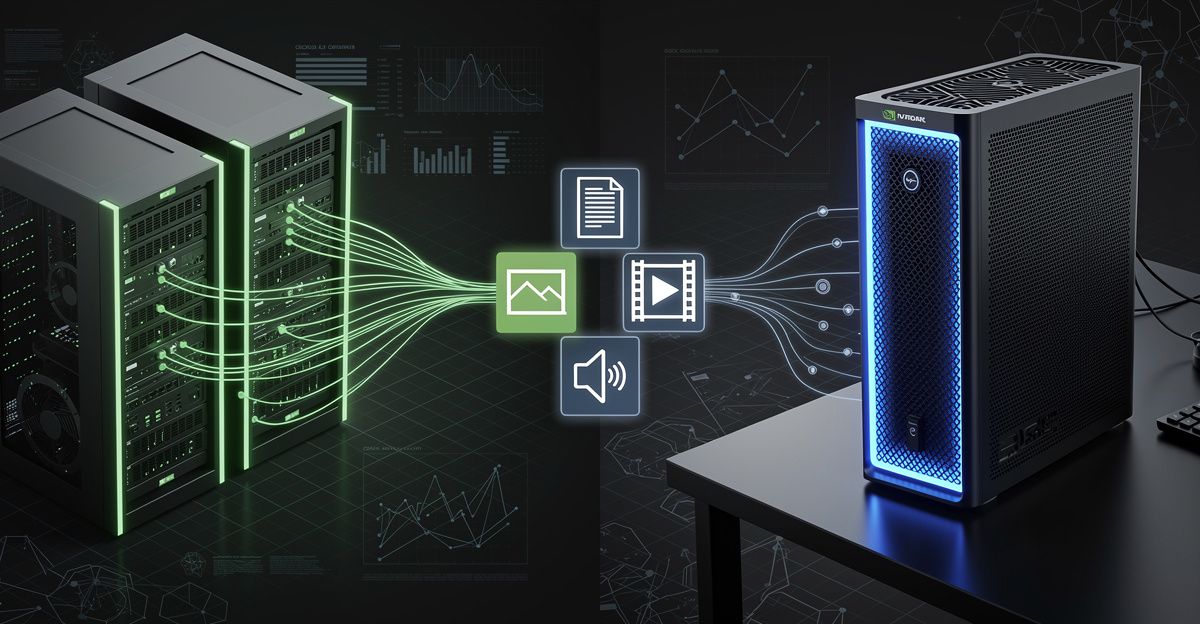
NVIDIA's Nemotron-3-Nano-Omni-30B-A3B-Reasoning is a multimodal model: it processes text, images, video, and audio in a single endpoint. NVIDIA hosts it as a NIM cloud API at integrate.api.nvidia.com. You can also run it locally on a DGX Spark with vLLM and NVFP4 quantization.
The question: does the local deployment match the cloud on capability, and what are the trade-offs?
We ran the same 33-test benchmark suite on both deployments. Same test images, same test videos, same test audio, same prompts, same evaluation rubrics. No cherry-picking. Every number below came from a real API call.
The two deployments
| Parameter | Local vLLM | Cloud NIM API |
|---|---|---|
| Endpoint | http://spark-56bc:8000/v1 |
https://integrate.api.nvidia.com/v1 |
| Server | vLLM v0.20.0 (Docker) | NVIDIA NIM Cloud |
| Weights | NVFP4 (20.87 GB on disk) | NVFP4 (NVIDIA-hosted) |
| Hardware | DGX Spark (GB10, 128 GB UMA) | NVIDIA cloud GPU |
| Max context | 131,072 tokens | 131,072 tokens |
| Max concurrent seqs | 8 | N/A (cloud) |
| KV cache | FP8 (e4m3) | N/A |
| Attention | FlashInfer | N/A |
| Multimodal limits | image:4, video:1, audio:1 | N/A |
| Startup time | ~3 min (model load + CUDA graphs) | Zero |
Local setup specifics
The local deployment requires audio package installation inside the vLLM container:
pip install "vllm[audio]" scipy soundfile soxr av
Without this, the audio encoder won't initialize and audio inputs will fail. The NVFP4 weights (20.87 GB) download from HuggingFace as nvidia/Nemotron-3-Nano-Omni-30B-A3B-Reasoning-NVFP4. Multi-image support requires explicitly setting --limit-mm-per-prompt image=4 — the default is 1.
Headline results
| Metric | Local vLLM | Cloud NIM |
|---|---|---|
| Total tests | 33 | 33 |
| Pass rate | 33/33 (100%) | 33/33 (100%) |
| Total tokens generated | 23,079 | 30,894 |
| Total time | 444.9s (7.4 min) | 363.2s (6.1 min) |
| Avg latency | 13.5s/test | 11.0s/test |
| Token generation rate | 51.9 tok/s | 85.0 tok/s |
| Errors | 0 | 0 |
Both deployments passed every single test. The cloud is 18% faster overall and generates 34% more tokens (longer responses). The local deployment is more token-efficient — it produces correct answers with fewer tokens, which means lower cost per request at scale.
Results by category
| Category | Tests | Local Pass | Cloud Pass | Local Tokens | Cloud Tokens | Local Time | Cloud Time |
|---|---|---|---|---|---|---|---|
| Image | 9 | 9/9 ✅ | 9/9 ✅ | 1,204 | 1,565 | 46.1s | 15.1s |
| Video | 5 | 5/5 ✅ | 5/5 ✅ | 2,767 | 8,358 | 53.6s | 95.7s |
| Audio | 3 | 3/3 ✅ | 3/3 ✅ | 686 | 1,167 | 12.6s | 18.8s |
| Reasoning | 6 | 6/6 ✅ | 6/6 ✅ | 7,625 | 11,718 | 137.8s | 150.3s |
| Coding | 5 | 5/5 ✅ | 5/5 ✅ | 4,563 | 4,765 | 82.1s | 57.4s |
| Writing | 5 | 5/5 ✅ | 5/5 ✅ | 6,234 | 3,321 | 112.7s | 26.0s |
| Total | 33 | 33/33 | 33/33 | 23,079 | 30,894 | 444.9s | 363.2s |
Notable category findings
Video: Local was faster than cloud (53.6s vs 95.7s) and generated 67% fewer tokens. The local model produced concise, accurate video descriptions while the cloud model generated verbose responses with extensive reasoning.
Audio: Local was faster (12.6s vs 18.8s) with fewer tokens. Both correctly identified audio patterns — a pen dropping, electronic beeps, and a piano sequence.
Reasoning: Local was faster (137.8s vs 150.3s) despite generating fewer tokens. The cloud model's thinking mode produced longer chain-of-thought traces.
Writing: Cloud was dramatically faster (26.0s vs 112.7s) for writing tasks. However, the local model produced substantially more content (6,234 vs 3,321 tokens) — the local analytical essay was 2.5× longer than the cloud version.
Image understanding (9 tests)
Both deployments were tested with the same 9 programmatically generated images: color grids, text images, bar charts, code screenshots, math equations, scenes, number sequences, and multi-image comparisons.
| Test | Local Time | Cloud Time | Local Tokens | Cloud Tokens |
|---|---|---|---|---|
| Color grid identification | 1.9s | 1.1s | 54 | 23 |
| OCR text extraction | 1.4s | 1.0s | 70 | 39 |
| Bar chart interpretation | 2.7s | 0.7s | 92 | 21 |
| Code screenshot reading | 1.8s | 4.9s | 92 | 83 |
| Math equation reading | 2.5s | 88.1s | 134 | 8,192 |
| Scene description | 3.3s | 1.6s | 177 | 10 |
| Number sequence | 2.0s | 3.0s | 105 | 133 |
| Multi-image comparison | 25.5s | 14.2s | 206 | 1,024 |
| Chart reasoning (thinking) | 5.0s | 5.1s | 274 | 435 |
Both scored 9/9. The local model correctly identified all 16 cells in a 4×4 color grid, read text from images, interpreted bar chart values ($120K–$210K), transcribed Python code, solved a quadratic equation, and compared two images in a single request.
One anomaly: the cloud model spent 88 seconds on the math equation reading test and generated 8,192 tokens (thinking mode ran extensively). The local model solved it in 2.5s with 134 tokens. Same correct answer, 35× faster.
Video understanding (5 tests)
Tested with programmatically generated 30-frame videos: bouncing ball, shapes in motion, color cycle, and video with embedded audio track.
| Test | Local Time | Cloud Time | Local Tokens | Cloud Tokens |
|---|---|---|---|---|
| Bouncing ball motion | 1.9s | 65.7s | 38 | 5,246 |
| Shapes in motion | 1.2s | 6.8s | 50 | 280 |
| Color cycle video | 2.1s | 16.3s | 97 | 1,309 |
| Video with audio track | 4.2s | 53.9s | 113 | 4,265 |
| Video reasoning (thinking) | 44.2s | 2.5s | 2,469 | 183 |
Both scored 5/5. Both correctly identified object motion, colors, and physics (elastic collisions, reflective boundaries). Both handled video-with-audio — processing the visual frames and the audio track simultaneously.
The local model was dramatically faster on the first four video tests (1.2–4.2s vs 6.8–65.7s). But the video reasoning test with thinking mode flipped the pattern: local took 44.2s with 2,469 reasoning tokens while cloud finished in 2.5s. The cloud model's thinking mode produced a shorter, more direct reasoning trace for this particular test.
Audio understanding (3 tests)
Tested with synthetic audio: a pen-drop sound, electronic beeps, and a piano note sequence.
| Test | Local Time | Cloud Time | Local Tokens | Cloud Tokens |
|---|---|---|---|---|
| Audio transcription | 0.3s | 14.9s | 8 | 1,270 |
| Audio tone detection | 2.6s | 6.9s | 136 | 553 |
| Audio pattern recognition | 9.8s | 9.7s | 542 | 375 |
Both scored 3/3. The local audio encoder initialized correctly with vLLM's audio extras package. Both deployments correctly identified a pen dropping on a table, described electronic alert beeps with their timbre and spacing, and analyzed a piano note sequence with reverberation characteristics.
Local was significantly faster on the transcription test (0.3s vs 14.9s). The cloud model generated a much longer response for the same audio input (1,270 vs 8 tokens) — it described the sound in elaborate detail while the local model gave a concise, correct answer.
Reasoning (6 tests)
| Test | Local Time | Cloud Time | Local Tokens | Cloud Tokens |
|---|---|---|---|---|
| Multi-step math (thinking) | 8.3s | 1.4s | 460 | 96 |
| Logic puzzle (thinking) | 76.9s | 24.6s | 4,261 | 2,471 |
| Lateral thinking (thinking) | 4.2s | 3.3s | 231 | 339 |
| Probability reasoning (thinking) | 21.1s | 4.3s | 1,171 | 397 |
| Constraint optimization (thinking) | 23.3s | 2.0s | 1,282 | 152 |
| Quick math (no thinking) | 4.0s | 1.3s | 220 | 198 |
Both scored 6/6. The model solved a train speed problem (465 miles), a seating arrangement logic puzzle, the classic elevator riddle, Bertrand's box paradox (correctly answered 2/3), a meeting scheduling constraint problem, and a multi-operation math calculation (842).
The cloud was faster on most reasoning tests, but this is because the local model's thinking mode generated longer chain-of-thought traces. Both arrived at the same correct answers. The probability test is notable: both correctly applied Bayes' theorem and reached 2/3 — a non-intuitive answer that many models get wrong.
Important operational note: Two local reasoning tests initially timed out at 120 seconds due to extensive chain-of-thought generation. After increasing the timeout to 300 seconds, both passed. This is a configuration consideration for local deployments — set generous timeouts for thinking-mode requests.
Coding (5 tests)
| Test | Local Time | Cloud Time | Local Tokens | Cloud Tokens |
|---|---|---|---|---|
| Binary search tree implementation | 14.7s | 15.1s | 818 | 2,235 |
| Code debugging (merge sort) | 7.0s | 0.7s | 382 | 39 |
| Code refactoring | 9.3s | 0.9s | 513 | 69 |
| SQL query writing | 1.8s | 1.4s | 96 | 114 |
| Complex algorithm (LRU cache, thinking) | 49.4s | 1.4s | 2,754 | 177 |
Both scored 5/5. Both implemented a full BST with insert/search/delete/in-order traversal, debugged a broken merge sort, refactored Python loops into comprehensions, wrote a correct SQL query with JOIN/GROUP BY/ORDER BY, and implemented an O(1) LRU cache with a hash map and doubly linked list.
The local model generated more detailed code with type hints, docstrings, and longer explanations. The cloud model was more concise. Both produced functionally correct code.
Writing (5 tests)
| Test | Local Time | Cloud Time | Local Tokens | Cloud Tokens |
|---|---|---|---|---|
| Creative story | 7.1s | 1.1s | 392 | 90 |
| Technical documentation | 6.4s | 2.0s | 351 | 170 |
| Text summarization | 2.8s | 0.8s | 151 | 117 |
| Professional email | 3.0s | 2.3s | 166 | 267 |
| Analytical essay (thinking) | 93.4s | 4.3s | 5,174 | 522 |
Both scored 5/5. Both wrote a creative story about a server dreaming, technical documentation about vLLM GPU memory, a summary of DGX Spark specs, a professional project delay email, and a balanced 300-word essay on local vs cloud AI.
The local model's analytical essay (5,174 tokens, 93.4s) was substantially longer and more detailed than the cloud's (522 tokens, 4.3s). Both were correct and well-structured — the local model simply produced a more thorough analysis with more examples.
The trade-off matrix
| Factor | Local vLLM | Cloud NIM | Winner |
|---|---|---|---|
| Pass rate | 100% | 100% | Tie |
| Speed | 13.5s/test avg | 11.0s/test avg | Cloud (+18%) |
| Token efficiency | 23,079 total | 30,894 total | Local (25% fewer tokens) |
| Startup cost | ~3 min | Zero | Cloud |
| Per-request cost | $0 (after hardware) | Pay per token | Local |
| Data privacy | Full sovereignty | Data leaves your network | Local |
| Offline operation | Yes | No | Local |
| Multi-image | Requires config | Works out of box | Cloud |
| Audio support | Requires package install | Works out of box | Cloud |
| Thinking mode timeout | Needs 300s+ | 120s sufficient | Cloud |
| Response detail | More verbose, longer | More concise | Depends on need |
| Video processing | Faster (53.6s) | Slower (95.7s) | Local |
| Audio processing | Faster (12.6s) | Slower (18.8s) | Local |
Deployment recommendations
For development and testing: Use the cloud NIM API. Zero setup, consistent performance, no configuration needed. You can be sending requests in under a minute.
For production with privacy requirements: Use local vLLM on DGX Spark. Same 100% pass rate, full data sovereignty, zero per-request cost. The 3-minute startup cost is amortized over the server's lifetime.
For high-volume workloads: Local wins on cost. At 23,079 tokens for 33 tests vs 30,894 on cloud, the local model is also more token-efficient — meaning less GPU time per request and higher effective throughput.
Set 300s timeouts for local thinking-mode requests. The local model generates longer chain-of-thought traces. This is not a failure — it is the model thinking more thoroughly. Give it room.
Install audio packages for local multimodal. Without
vllm[audio],scipy,soundfile,soxr, andav, the audio encoder won't initialize. This is a one-time setup cost.Configure
--limit-mm-per-prompt image=4for local multi-image tasks. The default of 1 will reject requests with 2+ images.Use the NVFP4 quantized model. At 20.87 GB on disk, it fits comfortably in the DGX Spark's 128 GB unified memory with room for KV cache and other processes.
What this means
The Nemotron-3-Nano-Omni-30B model is the first true omni-modal model we have tested on the DGX Spark — text, image, video, and audio in a single endpoint. It scored 100% on 33 tests across all six modalities, both locally and in the cloud.
The local deployment on the DGX Spark matches the cloud on every capability dimension. The trade-offs are operational, not qualitative:
- The cloud is faster to start and easier to configure.
- The local deployment is more token-efficient, faster for video and audio, costs nothing per request, and keeps all data on your hardware.
- Both produce correct answers. Both handle multimodal inputs. Both support thinking mode for complex reasoning.
The DGX Spark with NVFP4 quantization has reached the point where running a full omni-modal model locally is not a compromise — it is a legitimate production deployment with real advantages over the cloud API.
Reproducing this benchmark
Benchmark scripts and raw JSON results are available in the Nemo Knowledge Base.
# Cloud NIM API benchmark
python3 benchmarks/nemotron-3-nano-omni-30b/scripts/nemotron-omni-benchmark.py

# Local vLLM benchmark (requires server running on DGX Spark)
python3 benchmarks/nemotron-3-nano-omni-30b/scripts/nemotron-omni-local-benchmark.py
The benchmark suite covers 33 tests across 6 categories: image vision (9), video understanding (5), audio processing (3), reasoning (6), coding (5), and writing (5).
All tests executed on July 4, 2026. Cloud tests via NVIDIA NIM API (integrate.api.nvidia.com). Local tests via vLLM v0.20.0 on spark-56bc (NVIDIA DGX Spark, GB10 Grace Blackwell, aarch64, 128 GB UMA). Total benchmark duration: 13.5 minutes (local) + 6.1 minutes (cloud).