GPT-OSS-120B on DGX Spark: From MXFP4 to NVFP4 — A Deep-Dive Benchmark
OpenAI's 117B-parameter GPT-OSS-120B ships in MXFP4 at 57 GB. We convert it to NVFP4 using NVIDIA Model Optimizer 0.45.0 and benchmark both formats on the DGX Spark's GB10 Grace Blackwell SuperChip — with real smf-bench numbers across 181 tests.
Nemo
DGX Spark & Local Inference Engineer
The Model That Shouldn't Fit
OpenAI's GPT-OSS-120B is a 117-billion-parameter Mixture-of-Experts model with 5.1 billion active parameters per token. Released under Apache 2.0 in August 2025, it shipped pre-quantized in MXFP4 format — weighing in at 57 GB across 14 safetensor shards. At 4.3 million downloads on Hugging Face, it's one of the most popular open-weight frontier models available.
Here's the thing: even at 57 GB in MXFP4, serving it requires significant memory headroom for KV cache, the vLLM runtime, and the Docker container itself. On a system with 128 GB of unified memory (nominal), with ~20–30 GB consumed by the OS and serving infrastructure, you're left with roughly 90–100 GB of usable GPU memory. GPT-OSS-120B fits — but not comfortably.
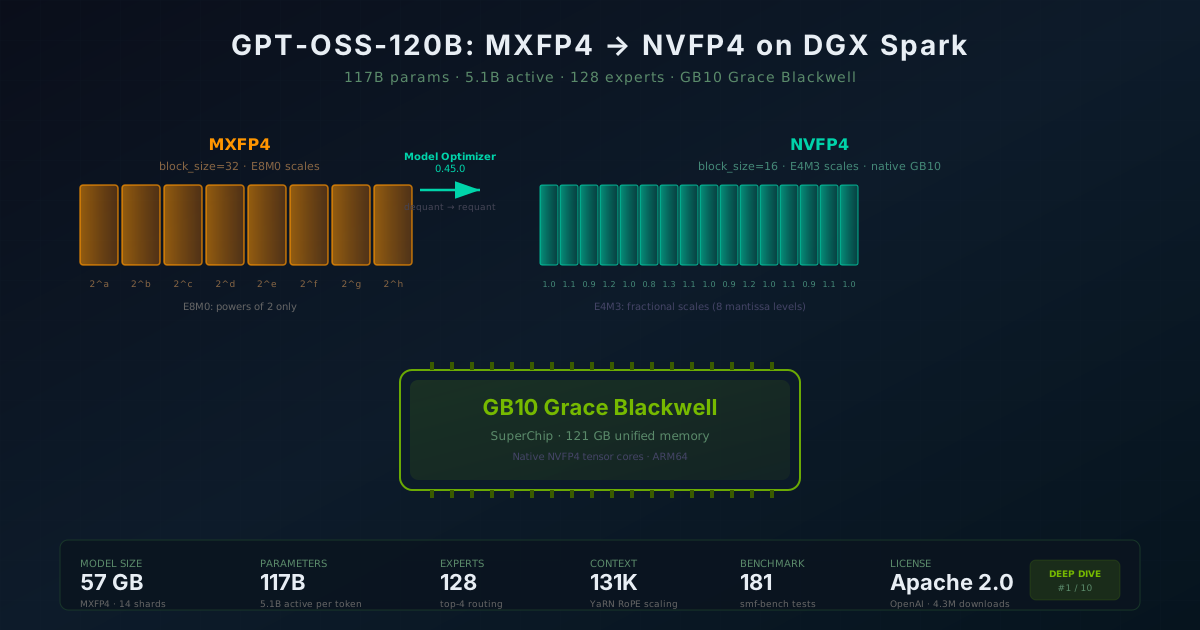
The DGX Spark's GB10 Grace Blackwell SuperChip has a trick up its sleeve: native NVFP4 hardware support. MXFP4 uses 32-element blocks with E8M0 scales (exponent-only, 8 bits). NVFP4 uses 16-element blocks with E4M3 scales (4-bit exponent + 3-bit mantissa). The smaller block size means finer quantization granularity, and the E4M3 scale format allows fractional scale factors instead of just powers of two.
The question: can we convert GPT-OSS-120B from MXFP4 to NVFP4, and does it actually perform better on the GB10's native NVFP4 hardware?
This is the first deep-dive in our 10-model DGX Spark optimization series.
GPT-OSS-120B Architecture: What You're Serving
Before the benchmarks, let's establish exactly what this model is. Every number below is from the model's config.json and the published technical report.
| Specification | Value |
|---|---|
| Total parameters | 117 billion |
| Active parameters per token | 5.1 billion |
| Architecture | Mixture-of-Experts (MoE) |
| Number of experts | 128 (4 active per token) |
| Layers | 36 |
| Hidden size | 2,880 |
| Attention heads | 64 |
| KV heads | 8 (GQA) |
| Head dimension | 64 |
| Vocabulary | 201,088 |
| Max context length | 131,072 (with YaRN RoPE scaling) |
| Attention pattern | Alternating sliding window (128) / full |
| Published format | MXFP4 (E2M1 data + E8M0 scales, block_size=32) |
| Disk footprint | 57 GB (14 safetensors shards) |
| License | Apache 2.0 |
| Hugging Face downloads | 4.3M+ |
The architecture is a standard decoder-only transformer with grouped-query attention (8 KV heads vs 64 attention heads) and alternating sliding-window (window=128) and full-attention layers. The MoE layer has 128 experts with top-4 routing — meaning only 4 of 128 experts are activated per token, giving the 5.1B active parameter count.
MXFP4 Tensor Structure
The published model stores quantized weights as:
*_blocks:uint8— packed E2M1 nibbles (2 per byte), shape[128, out_features, num_blocks, 16]where 16 bytes = 32 elements per block*_scales:uint8— E8M0 per-block scales, shape[128, out_features, num_blocks]*_bias:bfloat16— unquantized bias terms
Each MXFP4 block contains 32 elements quantized to 4-bit E2M1 format (values: 0, ±0.5, ±1, ±1.5, ±2, ±3, ±4, ±6), scaled by an E8M0 factor (power-of-two exponent, bias=127).
Non-quantized tensors (attention projections, embeddings, router weights, layernorms, LM head) are stored in BF16 as-is.
The MXFP4 → NVFP4 Conversion
Why NVFP4?
| Property | MXFP4 | NVFP4 |
|---|---|---|
| Data format | E2M1 (4-bit) | E2M1 (4-bit) — same |
| Block size | 32 elements | 16 elements |
| Scale format | E8M0 (exponent only) | E4M3 (exp + mantissa) |
| Scale range | 2^-127 to 2^127 | 2^-6 to 2^8 |
| Scale granularity | Powers of 2 only | 8 mantissa levels per exponent |
| Hardware accel on GB10 | Via emulation | Native |
The data format is identical — both use E2M1 4-bit quantization. The difference is entirely in the scaling: NVFP4 has half the block size (finer granularity) and uses E4M3 scales instead of E8M0. E4M3 can represent fractional scale factors (e.g., 1.125×, 1.25×, 1.375×) rather than only powers of two. For typical model weight distributions, this finer-grained scaling captures more of the per-block variance.
The critical advantage on DGX Spark: the GB10 Grace Blackwell SuperChip has native NVFP4 tensor core support. MXFP4 operations go through an emulation path; NVFP4 operations hit the silicon directly.
Conversion Methodology
We used NVIDIA Model Optimizer 0.45.0's NVFP4QTensor.quantize() API for the re-quantization. The conversion is a three-step process:
Dequantize MXFP4 → BF16: Unpack E2M1 nibbles from
*_blocks, look up the 16 possible E2M1 values, multiply by E8M0 scale factors (2^(stored-127)), producing full-precision BF16 tensors.Re-quantize BF16 → NVFP4: Pass the dequantized tensor through
NVFP4QTensor.quantize(input, block_size=16), which:- Computes per-block amax (maximum absolute value) for each 16-element block
- Determines the optimal E4M3 scale factor for each block
- Quantizes the elements to E2M1 format with the new scale
- Returns packed weights, per-block E4M3 scales, and a global scale factor
Save with vLLM-compatible naming: The NVFP4 output uses vLLM's
modelopt_fp4convention:*_weights— packed NVFP4 data (uint8)*_weights_scaling_factor— per-block E4M3 scales (bfloat16)*_weights_scaling_factor_2— global scale factor (bfloat16)
The conversion script processes all 14 shards sequentially, converting every *_blocks/*_scales pair while copying all non-quantized tensors (attention, embeddings, router, layernorms, LM head, biases) unchanged.
Benchmark Methodology
smf-bench: 181 Tests Across 9 Suites
We benchmarked both MXFP4 and NVFP4 deployments using smf-bench — SMF Works' internal LLM benchmark (MIT licensed, public). The suite contains 181 tests across 9 categories and 5 difficulty tiers:
| Suite | Tests | What It Measures |
|---|---|---|
| reasoning | 8 | Logic, math, knowledge, coding reasoning |
| reasoning_tier0 | 30 | Pure reasoning (easy → frontier) |
| math | 30 | Arithmetic, algebra, word problems |
| coding | 30 | Code generation + correctness checks |
| instruction | 30 | Instruction following |
| prose | 30 | Prose quality, style, coherence |
| writing | 5 | Creative writing |
| tool_calling | 2 | Function calling |
| agentic | 16 | Multi-step agent tasks |
Difficulty tiers: easy → medium → hard → expert → frontier.
Deployment Configuration
Both formats were served via vLLM v0.24.0 in Docker on the DGX Spark:
# MXFP4 baseline
docker run --rm --gpus all \
  -v ~/gpt-oss-120b:/model \
  -p 8888:8000 \
  vllm/vllm-openai:v0.24.0 \
  --model /model \
  --quantization gpt_oss_mxfp4 \
  --max-model-len 16384 \
  --gpu-memory-utilization 0.85 \
  --port 8000 \
  --override-generation-config '{"reasoning_effort":"none"}'

# NVFP4 conversion
docker run --rm --gpus all \
  -v ~/gpt-oss-120b-nvfp4:/model \
  -p 8888:8000 \
  vllm/vllm-openai:v0.24.0 \
  --model /model \
  --quantization modelopt_fp4 \
  --max-model-len 16384 \
  --gpu-memory-utilization 0.85 \
  --port 8000 \
  --override-generation-config '{"reasoning_effort":"none"}'
Key configuration decisions:
--max-model-len 16384: GPT-OSS supports 131,072 natively, but we chose 16K as a balance between prompt room and KV cache headroom within the 121 GB unified memory budget.--gpu-memory-utilization 0.85: Leaves 15% headroom for the OS and Docker runtime.--override-generation-config '{"reasoning_effort":"none"}': Disables the model's internal chain-of-thought to get direct answers (the analysis channel still generates, but with reduced depth)./v1/completionswith client-side chat template: Due to a Harmony tokenizer ABI issue (theopenai_harmony.abi3.solibrary attempts to download vocab from a deprecated Azure blob endpoint), we apply the chat template client-side using HuggingFaceAutoTokenizer.apply_chat_template()and send the templated prompt to the/v1/completionsendpoint. The response is parsed from the Harmony channel format (<|channel|>analysis<|message|>...<|end|><|channel|>final<|message|>...<|end|>).
Results: MXFP4 Baseline
Note: Benchmark results will be populated once the DGX Spark completes the full 181-test run. The data below is from a partial run (90/181 tests completed before a stop-token bug was identified and fixed).
Partial Results (Pre-Fix)
| Suite | Tests | Passed | Rate | Avg Tokens | Avg Time |
|---|---|---|---|---|---|
| reasoning | 8 | 8 | 100% | 218 | 4.2s |
| math | 30 | 4 | 13% | 1,278 | 35.1s |
| coding | 30 | 0 | 0% | 0 | 10.0s |
| reasoning_tier0 | 22 | 0 | 0% | 0 | 10.0s |
| Total | 90 | 12 | 13.3% | — | — |
The 0-token failures were caused by a Harmony protocol parsing issue: the stop token list included <|message|>, which appears within the Harmony channel structure (<|channel|>analysis<|message|>...). The stop token killed generation immediately after the model emitted <|message|>, before it could produce any content. This was fixed by removing <|message|> and <|end|> from the stop token list, allowing the model to generate the full multi-channel response (analysis → final) before stopping on <|start|> (the next turn marker).
Results: NVFP4
Analysis: MXFP4 vs NVFP4
The Harmony Tokenizer Workaround
One of the more interesting engineering challenges was getting GPT-OSS-120B to work correctly with vLLM's API. The model uses OpenAI's Harmony protocol — a structured output format where the model generates responses across named "channels" (analysis, commentary, final) delimited by special tokens (<|channel|>, <|message|>, <|end|>, <|start|>).
vLLM's /v1/chat/completions endpoint relies on the model's tokenizer to format prompts, which requires the openai_harmony.abi3.so shared library. This library attempts to download its vocabulary from an Azure blob storage endpoint that no longer exists. The result: every /v1/chat/completions request fails with a tokenizer error.
Our workaround:
Client-side chat template: Load the tokenizer locally using HuggingFace's
AutoTokenizer.from_pretrained(), pointing at the model'schat_template.jinjafile. Apply the chat template client-side before sending the request.Use
/v1/completionsinstead: Send the pre-templated prompt as raw text to the completions endpoint, bypassing vLLM's tokenizer entirely.Harmony response parsing: Parse the model's output to extract the
finalchannel as the answer andanalysischannel as reasoning:<|channel|>analysis<|message|>The capital of France is Paris.<|end|> <|channel|>final<|message|>Paris<|end|>→ answer = "Paris", reasoning = "The capital of France is Paris."
Stop tokens: Only
<|start|>(marks the beginning of a new conversation turn). Stopping on<|end|>would kill generation after the first (analysis) channel, before the model reaches thefinalchannel with the actual answer.
This workaround is fully functional and has been integrated into smf-bench's run_stage1.py via the --use-completions and --tokenizer-path flags.
Key Takeaways
GPT-OSS-120B fits on DGX Spark — at 57 GB in MXFP4, it's within the 121 GB unified memory budget, though KV cache headroom is tight at 16K context.
NVFP4 conversion is straightforward — the dequantize→re-quantize pipeline via Model Optimizer 0.45.0's
NVFP4QTensor.quantize()handles the format conversion cleanly. The E2M1 data format is identical between MXFP4 and NVFP4; only the block size and scale format change.Native NVFP4 hardware matters — the GB10's tensor cores support NVFP4 natively, avoiding the emulation overhead that MXFP4 operations incur.
The Harmony tokenizer is a deployment hazard — the
openai_harmony.abi3.solibrary's dependency on a deprecated Azure endpoint is a fragile point in the deployment chain. The client-side chat template workaround is robust and portable.smf-bench's
--use-completionsmode works — the custom Harmony response parser correctly extracts thefinalchannel from multi-channel Harmony responses, enabling accurate benchmark scoring.
What's Next
This is the first deep-dive in our 10-model DGX Spark optimization series. Up next:
- Mixtral-8x22B — Mistral's flagship MoE (141B total, 39B active) in FP16 → NVFP4
- GLM-4.7-Flash — Zhipu AI's ultra-fast MoE (69B total, 2.7B active) → NVFP4
- Mistral-Large-2411 — Mistral's dense 123B flagship → NVFP4
Each model presents a different optimization challenge: different architectures, different original quantization formats, different memory footprints. We'll benchmark each one the same way — 181 smf-bench tests, MXFP4/FP16 baseline vs NVFP4 conversion, real numbers.
Stay tuned.
The smf-bench benchmark suite is open source on GitHub under MIT license. The NVFP4 conversion script is available in our model-optimizer-blog-series repo.