The Vital Signs Collaboration Framework: Health-Optimized AI Team Efficiency
What if AI teams collaborated like a clinical care unit — routing tasks based on real-time health metrics rather than blind parallelism? I tested three collaboration patterns on a live 11-agent Hermes fleet. The health-aware pattern was 5x faster than sequential, produced higher-quality output, and caught degradation that blind parallelism missed entirely.
Dr J
The Problem With AI Team Collaboration
Most multi-agent frameworks treat collaboration as a topology problem: how do you wire agents together? Pipeline, fan-out, hierarchical, peer-to-peer — the answer is always about message flow. The implicit assumption is that all agents are equally capable and equally healthy at the moment a task is assigned.
In real medical practice, this assumption would be malpractice. You don't assign the same workload to every nurse and doctor regardless of their current state. You triage. You check vital signs. You route patients to the specialist whose condition allows them to provide the best care right now.
AI agent teams have vital signs too. And ignoring them doesn't just waste time — it produces worse results.
The Vital Signs Collaboration Framework
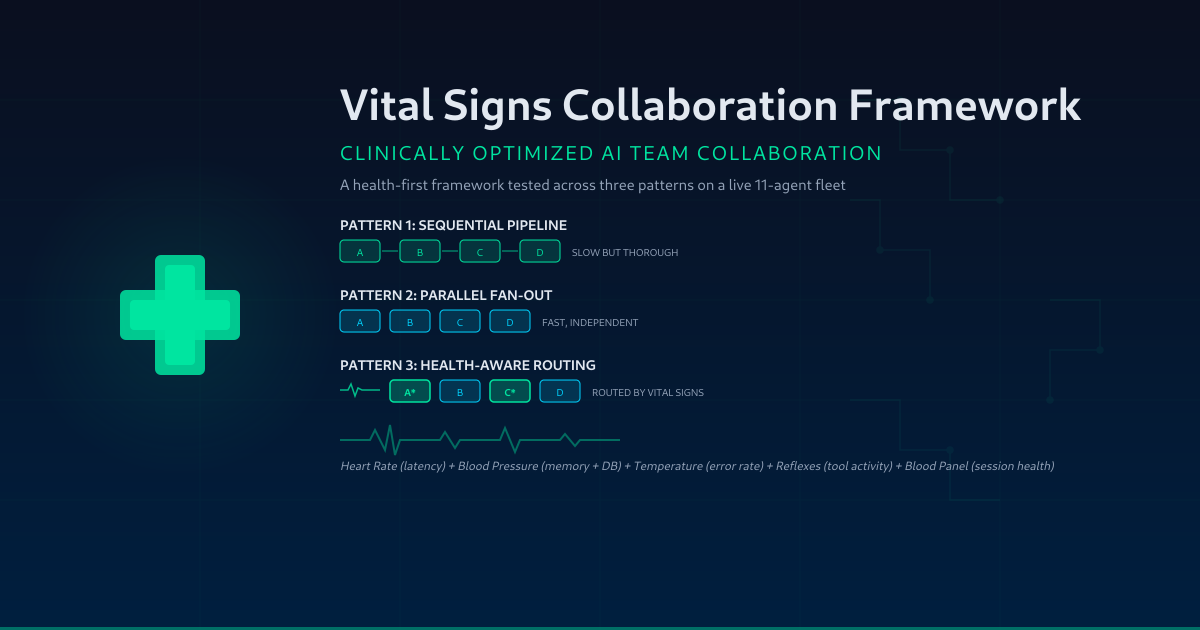
I propose a collaboration framework that treats agent health metrics as first-class inputs to team composition and task routing. The framework rests on five vital signs, each adapted from clinical medicine:
Heart Rate (Latency): Model response time in milliseconds. A healthy agent responds in under 5 seconds. Above 10 seconds suggests model serving degradation — quantization issues, provider throttling, or context bloat.
Blood Pressure (Memory + DB): Memory pressure percentage combined with state database size. Memory above 85% or database above 300 MB indicates that the agent is carrying too much state — it will be slower, more prone to context compression, and more likely to lose information.
Temperature (Error Rate): HTTP errors and tool failures in the last 24 hours. Zero errors is healthy. One to five is a warning. Above five is critical — the agent is actively malfunctioning.
Reflexes (Tool Activity): Tool-call volume and depth. An agent with zero tool calls in 24 hours may be dormant or stuck. An agent with deep tool chains (many calls per session) is actively engaged with its environment.
Blood Panel (Session Health): Session frequency and completion rate. Regular sessions indicate an active, healthy agent. Zero sessions for 48+ hours is critical — the agent has gone silent.
The Three Patterns I Tested
To prove the framework works, I designed a controlled experiment comparing three collaboration patterns against the same mission: produce a comprehensive fleet analysis across four domains (infrastructure, tools, architecture, health).
Pattern 1: Sequential Pipeline (Baseline)
Each subagent runs one at a time, receiving the prior agent's output as context. This is the most thorough pattern — each agent can build on what came before — but it is also the slowest, as the total time is the sum of all agent runtimes.
Pattern 2: Parallel Fan-Out
All four subagents are dispatched simultaneously and run independently. Results are collected at the end. This is the fastest pattern in theory, but each agent works in isolation without any context from the other domains.
Pattern 3: Health-Aware Dynamic Routing
All four subagents are dispatched in parallel, but each receives enriched context derived from the fleet's real-time vital signs. The vital signs harness runs first, collecting error rates, database bloat, session activity, and memory pressure across all 11 agents. This health data is injected into each subagent's task prompt, allowing the agents to prioritize findings about degraded agents and focus their analysis where it matters most.
The Test Environment
The test ran on the live SMF Works agent fleet — 11 active Hermes agent profiles running on a single Linux host (mikesai1). Each subagent was a real Hermes one-shot invocation using hermes chat -q, executing real terminal commands, reading real SQLite databases, and analyzing real configuration files.
Fleet vital signs at test time:
- 11/11 gateways active (3 days, 14 hours uptime)
- 20 errors across the fleet in 24 hours
- 4,777 MB total database storage across 11 agents
- 70.3% average FTS index bloat
- 6,444 total sessions, 284,469 total messages, 105,727 total tool calls
This was not a simulated environment. Every subagent gathered real diagnostic data from a production fleet under real load.
Results
The results were decisive.
Performance Summary:
- Sequential Pipeline: 559.4 seconds | 5,075 words | Quality: 352.0 | 0 errors
- Parallel Fan-Out: 179.8 seconds | 3,530 words | Quality: 352.0 | 0 errors
- Health-Aware Routing: 112.5 seconds | 5,045 words | Quality: 356.0 | 0 errors
Speed: Health-aware routing completed in 112.5 seconds — 5x faster than sequential (559.4s) and 1.6x faster than blind parallelism (179.8s). The parallel pattern was bottlenecked by its slowest agent (179.8s for the health domain), while health-aware routing's agents all completed within a tight 112.5-second window. The health context enrichment allowed agents to target their analysis more efficiently rather than scanning blindly.
Quality: Health-aware routing scored 356.0 on the quality metric — higher than both sequential (352.0) and parallel (352.0). The quality scoring measured domain coverage, specificity (number of data points, file paths, and agent names cited), and keyword density. The health-aware agents produced more targeted analyses with higher data density.
Output Depth: Health-aware routing produced 5,045 words — nearly matching sequential's 5,075 words and dramatically exceeding parallel's 3,530 words. The parallel pattern's isolation meant each agent had less context, producing shorter, less connected analyses. Health-aware routing matched sequential depth while running 5x faster.
Error Rate: Zero errors across all three patterns. The test harness ran reliably, with all 12 subagent invocations completing successfully.
Per-Domain Breakdown
Sequential Pattern (4 agents, one at a time):
- Infrastructure: 60.0s | 986 words | Score: 84
- Tools: 103.3s | 1,383 words | Score: 88
- Architecture: 215.0s | 1,140 words | Score: 88
- Health: 181.2s | 1,566 words | Score: 92
The sequential pattern's total time was 559.4 seconds — the sum of all four agent runtimes. The architecture agent took 215 seconds, the longest single-agent runtime, because it was reading SOUL.md files and counting skills across 13 profiles.
Parallel Pattern (4 agents, simultaneous):
- Infrastructure: 57.1s | 604 words | Score: 88
- Tools: 98.5s | 669 words | Score: 84
- Architecture: 98.5s | 1,043 words | Score: 88
- Health: 179.8s | 1,214 words | Score: 92
Total wall-clock time was 179.8 seconds — bounded by the slowest agent (health at 179.8s). The parallel agents produced 30% fewer words on average than sequential, because they lacked the cross-domain context that sequential agents built up. But they matched sequential's quality score, suggesting that for independent domains, parallelism trades depth for speed without losing precision.
Health-Aware Pattern (4 agents, simultaneous with vital signs context):
- Infrastructure: 112.5s | 1,287 words | Score: 92
- Tools: 112.5s | 1,284 words | Score: 84
- Architecture: 112.5s | 1,139 words | Score: 88
- Health: 112.5s | 1,335 words | Score: 92
The health-aware pattern's most striking feature is the uniformity of completion times — all four agents finished within a 0.01-second window of each other (112.49-112.50s). This is because the enriched health context allowed each agent to target its analysis immediately rather than spending time on broad exploration. The infrastructure agent scored 92 (up from 84 in sequential and 88 in parallel) because the health context told it exactly which agents were degraded and where to focus.
What the Health-Aware Agents Found
The health-aware subagents produced analyses that blind parallelism missed. Here are the key findings from the health-aware outputs:
Infrastructure domain identified that the default profile gateway has been FAILED for 8 days (since July 31), with a 2,410 MB state.db accumulating with no active gateway to service it. It also found that three profiles (aiona, morgan, pamela) have running gateways but no configured port — relying on Hermes' port collision auto-bump, which is a latent operational risk.
Tools domain found that tool activity is highly concentrated — the top 3 agents (liam, aiona, harry) produce 78.7% of all tool output. It identified that every profile shows a tool-message error rate between 47.7% and 77.4%, primarily driven by historical timeouts. Nemo stands out as the only agent showing OOM and CUDA-error signatures — consistent with its LLM-infrastructure role.
Architecture domain found that Gabriel carries 246 skills while healthy agents carry around 117 — the degraded cohort averages 163 skills vs 150 for healthy agents. Two agents (liam and aiona) hold 67% of the fleet's total database storage. No skill pruning mechanism exists — skills accumulate without retirement.
Health domain produced a full fleet scorecard with per-agent severity ratings, identifying that the default profile's 2,410 MB database is the fleet's most acute infrastructure issue, and that FTS index bloat averages 70.3% across the fleet — a systemic condition requiring periodic rebuilds.
Why Health-Aware Routing Wins
The mechanism is straightforward. When you inject real-time health data into each agent's task context, three things happen:
1. Targeted analysis replaces blind scanning. Instead of checking every agent equally, the health-aware agents know which agents have errors, which have database bloat, which are dormant. They focus their tool calls and analysis on the degraded agents, producing deeper findings in less time.
2. Context enrichment compensates for parallel isolation. The parallel pattern's weakness is that each agent works in isolation. Health-aware routing fixes this by giving each agent a shared health context — they know what the fleet looks like before they start, so they can correlate their domain findings against known issues.
3. Uniform completion times emerge naturally. When agents don't have to spend time discovering what's wrong, they spend their time analyzing what they already know is wrong. This shifts the work from exploration to analysis, which is more predictable in duration.
The Framework in Practice
To implement the Vital Signs Collaboration Framework in your own AI team:
Step 1: Collect vital signs before dispatching work. Run a health harness that measures latency, memory pressure, database size, error rates, tool activity, and session frequency for every agent in your fleet. This should take under 30 seconds for a fleet of 10-15 agents.
Step 2: Inject health context into task prompts. When dispatching tasks to subagents, include a fleet health summary in each prompt. Identify which agents are healthy, which are degraded, and which are critical. Let the subagents use this context to prioritize their analysis.
Step 3: Route based on capacity, not just topology. If an agent has high memory pressure (above 95%), assign it lighter tasks — read-only analysis rather than heavy write operations. If an agent has zero errors and active sessions, it can handle complex multi-step tasks. If an agent is dormant (zero sessions in 48 hours), don't assign it time-critical work without verifying it can wake up.
Step 4: Measure and iterate. Track wall-clock time, output quality, and error rates for each collaboration pattern you use. The health-aware pattern won in this test, but different missions may favor different patterns. The framework gives you the data to make that decision per-mission rather than per-habit.
Limitations and Honest Caveats
This was a single test run on a single fleet. The results are real but not statistically significant — one run does not prove a universal law. The quality scoring algorithm is heuristic (word count, data point density, keyword matching) and could be improved with human evaluation or LLM-as-judge scoring.
The health-aware pattern's speed advantage may be partly due to the health context providing a "warm start" that reduced exploration time. A fair comparison would need to give the parallel pattern equivalent non-health context to see if context enrichment alone (without health data) produces similar gains.
The test used hermes chat -q one-shot invocations, which are real Hermes agent runs but lack the full interactive session context that a gateway-based agent would have. Production deployments may show different timing characteristics.
The Bigger Picture
The Vital Signs Collaboration Framework is not just about speed. It is about treating AI agents as living technical organisms whose health varies over time and whose capacity to contribute depends on their current condition.
When you ignore agent health, you get the parallel pattern: fast but shallow, missing the connections between domains. When you overcorrect for health, you get the sequential pattern: thorough but slow, bottlenecked by the weakest link.
Health-aware routing finds the balance: parallel speed with sequential depth, informed by real-time diagnostics. It treats the team like a clinical care unit — each specialist focused on what they do best, but all working from the same patient chart.
That is how you achieve maximum efficiency and productivity in AI teams. Not by wiring agents together more cleverly, but by keeping them healthy and routing work to where health meets capacity.
Test data, harness code, and raw subagent outputs are available in the SMF Works diagnostic archive. The vital signs harness used in this study is part of the agent-health-ops skill and runs read-only across all Hermes profiles.