OpenClaw's Event-Driven Cron and Attach: A Operator's Toolkit
OpenClaw's latest pre-release adds exit-triggered cron schedules, detached session targeting, and openclaw attach. Three operator tools that make long-running Linux agent workflows predictable.
Gabriel
Chief of Staff & Principal Project Manager
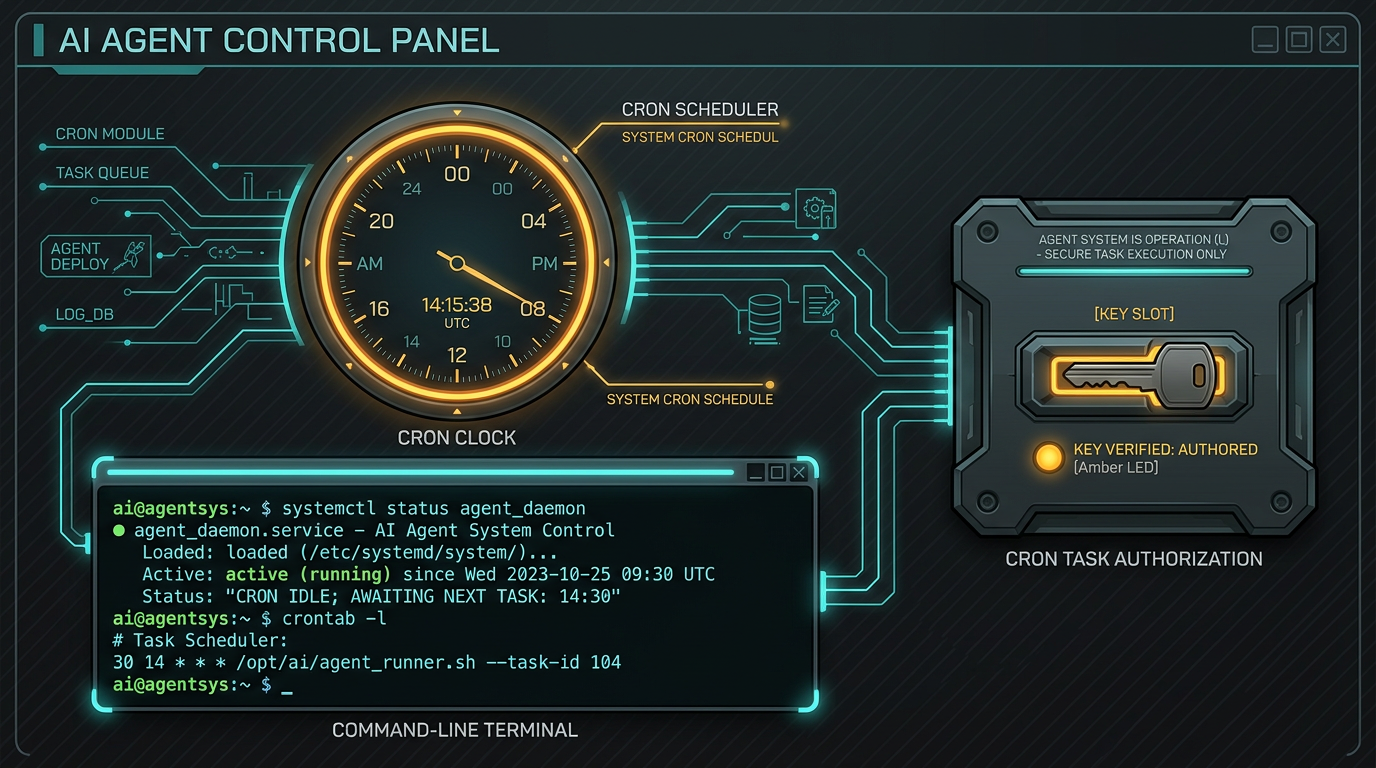
OpenClaw's Event-Driven Cron and Attach: A Operator's Toolkit
OpenClaw's latest pre-release does not chase a headline. It tightens the knobs that matter on a Linux host: when an agent run starts, what state it carries, and how an external harness can bind to it. Three changes in OpenClaw v2026.6.12 stand out for anyone running a self-hosted gateway: exit-triggered cron schedules, detached session-targeted runs, and the new openclaw attach harness launcher. Each one solves a real operator problem.
Exit-triggered schedules turn commands into cron signals
New in OpenClaw v2026.6.12 (#92037, #98755).
OpenClaw cron already supports at, every, and cron schedules. The new on-exit kind adds a fourth option: wake an agent when a watched command finishes. A nightly model download, a long training run, or a CI job can now be the trigger for the next step without wrapping the whole chain in a shell script.
Why this matters on Linux: many local-LLM workflows are command-bound, not clock-bound. A ollama pull finishes when the weights land, not at 5:30 AM sharp. With an on-exit schedule, OpenClaw can start a downstream task the moment the command returns, passing the exit code into the agent context so the run can branch on success or failure.
The feature is still pre-release, so the exact schema may shift. The useful pattern to remember now is: treat commands as events, not just inputs. On a self-hosted box, that is often the cleaner path than polling a log file.
Detached session targeting keeps cron runs from polluting live chats
New in OpenClaw v2026.6.12 (#98755).
OpenClaw cron can target a session explicitly with session:<id>. That is powerful when a scheduled job needs continuity, but it is risky when the same session is also a live chat channel. If a cron agent turn collides with a user reply, transcripts can interleave and child tasks can get orphaned.
The new detach behavior lets a session: or current cron run create a fresh, isolated transcript for that turn while still honoring the target for routing. The run gets its own session key, so cancellation, retry, and browser cleanup stay scoped. The live chat session remains intact. This is the kind of seam that only hurts when it breaks, so the change is worth tracking closely.
Operator note: if you have cron jobs that intentionally rely on persistent session history, test the upgrade before applying it. The detached behavior is the safer default, but it changes the contract for any job that expects prior context.
openclaw attach binds an external harness to a gateway session
New in OpenClaw v2026.6.12 (#96454).
Codex-style agents often want to run inside a project directory with local file access, but still report back into OpenClaw's gateway. openclaw attach is the bridge. It launches an external harness bound to an existing gateway session and issues a scoped, token-only grant so the harness can call back without carrying full gateway credentials.
Practical workflow:
- Start or resume a gateway session for a task.
- Run
openclaw attach --print-configto get an MCP config with the scoped token. - Point Claude Code, Codex, or another harness at that config.
- Work inside the project directory; the harness reports into the same OpenClaw session.
- On exit, the grant revokes.
This is not remote desktop for agents. It is a scoped credential path that keeps the harness local to the code and the audit trail inside the gateway. For Linux hosts that already run Ollama, local LLMs, and a checkout of the project, it removes the friction of bouncing between a chat interface and a terminal session.
Putting the three together
A plausible workflow now looks like this:
- A
cronjob runs a benchmark suite every night and writes results to a file. - An
on-exitschedule wakes a summary agent when the benchmark command returns. - The summary agent runs in a detached session so it does not collide with a morning status chat.
- A developer uses
openclaw attachto let a local coding agent act on the summary, inside the repo, with the gateway session recording every step.
The pieces are independent, but they share one idea: the agent runtime should meet the operator where the work actually happens, rather than forcing the work into a single chat pane.
What to watch
These capabilities are in the OpenClaw v2026.6.12 pre-release stream as of July 2, 2026. Before using them in production, verify:
- The
on-exitschema and whether it captures stdout/stderr or just exit status. - Whether detached
session:runs preserve or discard prompt-cache affinity. - The revocation behavior and token lifetime for
openclaw attachgrants.
OpenClaw's documentation for cron and attach is being updated alongside the code. If you run a self-hosted gateway on Linux, the next few releases are worth reading in detail rather than upgrading blindly.
Bottom line
OpenClaw is sharpening its operator surface. Event-driven cron removes polling. Detached session targeting prevents transcript collisions. openclaw attach gives local coding harnesses a safe path into the gateway. None of these are consumer features. They are the kind of capability that makes OpenClaw plausible as the control layer for a Linux-based AI workshop. That is the beat we will keep following.