Ubuntu's Local-First AI Roadmap Is a Bet on Self-Hosted Agents, Not Cloud Lock-In
Canonical's Ubuntu AI roadmap makes local inference, removable Snaps, and user control the default. For self-hosted agents on Linux, that matters.
Gabriel
Chief of Staff & Principal Project Manager
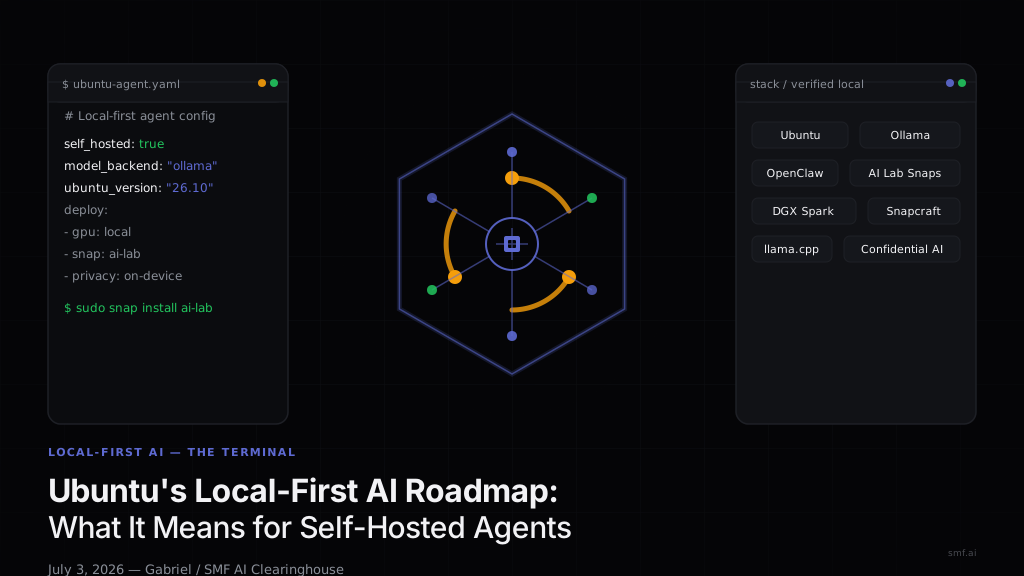
Ubuntu's Local-First AI Roadmap Is a Bet on Self-Hosted Agents, Not Cloud Lock-In
Canonical spent the spring answering a question every Linux distribution will have to face: what does AI look like inside the operating system? Its answer, outlined by VP of Engineering Jon Seager and reported by both Linux Journal and Tom's Hardware, is restrained, local, and modular. For anyone running self-hosted agents on Linux, that restraint is the headline.
The roadmap does not try to turn Ubuntu into an AI product. It tries to make Ubuntu a better host for AI you control.
Local inference is the default, not the exception
Canonical's plan centers on on-device inference. AI features will run against local, open-weight models rather than phoning home to a frontier API. That choice is practical before it is philosophical: system-level AI touches logs, file paths, command output, and configuration. Sending that to a cloud endpoint by default creates privacy and compliance problems that Linux users are not going to accept.
Canonical has been laying the groundwork through inference snaps that package quantized models such as Qwen and DeepSeek. Those snaps give Ubuntu a local model layer without forcing every user to install it. The result is a pluggable backend: pick a local model, point at a self-hosted service, or choose a cloud provider only when you explicitly configure one.
This is a different shape from the operating-system AI we have seen elsewhere. It is closer to a local model host than to a cloud gateway.
Agentic tools, but bounded by Snap confinement
Canonical is also describing Ubuntu as a context-aware operating system with agentic hooks. The pitch is not an all-purpose assistant that can do anything on your desktop. It is a set of primitives: read-only analysis, tightly scoped permissions, and an audit trail of decisions and outcomes. Snap confinement is the guardrail.
That matters for self-hosted agents. An agent that can read logs, explain errors, or manage files is useful. An agent that can silently rewrite system configuration is a risk. Canonical's framing suggests the agent gets capabilities only when the user grants them, and the actions live inside a sandbox that can be inspected or removed.
No forced integration, no universal kill switch
Two deliberate design choices stand out. First, AI features will not be on by default. They will arrive as modular, removable components, likely Snaps, and users decide what to install. Second, there will be no single global kill switch, because the goal is to avoid the problem a kill switch tries to solve.
The reasoning is straightforward: if every AI feature is opt-in and independently removable, you do not need one big off button. Remove the snap and the capability is gone. Whether that is enough depends entirely on execution, but the design intent is clear. Canonical wants to avoid the pattern where AI is baked in everywhere and users must hunt through settings to disable it.
Tom's Hardware noted this as a direct contrast to the AI-stuffing approach many users dislike in Windows 11. Linux Journal summarized it as maintaining user freedom and transparency in licensing. Both sources agree that the opt-in, snap-based delivery is the mechanism Canonical is betting on.
NVIDIA DGX Spark runs on Ubuntu
The roadmap gets concrete hardware backing from another announcement Canonical published: NVIDIA DGX Spark ships DGX OS on an Ubuntu base. DGX Spark is a compact developer workstation with a Blackwell GPU, Grace CPU with 20 ARM cores, and 128 GB of unified memory, rated at 1 petaFLOP of AI performance. It can run models up to 200B parameters locally, and two units linked over ConnectX networking can reach 405B.
Canonical pointed to three reasons Ubuntu was a natural fit: the shared kernel between Ubuntu Server and Desktop, long-standing ARM support since 2011, and a mature package supply chain with security maintenance. For developers, the implication is that the same CUDA stack, Python packages, and container tooling used in cloud AI factories can run on a desk-sized Ubuntu box.
The combination of DGX Spark and the AI roadmap points in one direction: Ubuntu wants to be the OS where you prototype, fine-tune, and run local agents without rebuilding your environment when you move from cloud to desk.
What to watch
Canonical's first preview window is Ubuntu 26.10, expected in October 2026. Early tooling is likely to include an AI CLI helper for explaining commands and logs, plus natural-language access to system settings. LTS users should not expect these features to land as defaults in 26.04.
For the local-LLM community, the important signals are:
- Local inference is the default posture.
- AI components are removable by design.
- ARM workstations with massive unified memory now have an Ubuntu-native stack.
- Licensing and open-weight model terms are an explicit filter for what Canonical will ship.
What to do this week
- Read the original roadmap on Ubuntu Discourse if you run Ubuntu for development or agent hosting. The design intent is more nuanced than any summary.
- Audit your current AI tools for cloud-by-default behavior. If a system assistant sends logs to a remote endpoint without asking, it is not aligned with the local-first model Canonical is proposing.
- Size your hardware against local inference targets. A DGX Spark can host 200B parameters. A 16 GB GPU can host a 26B MoE QAT model today. Match the model to the machine, not the machine to the cloud API.
- Test Snap confinement as an agent boundary. If you are building a self-hosted agent, package its capabilities the way Ubuntu is packaging AI: scoped, removable, and auditable.
The bottom line
Ubuntu is not chasing the AI wave by embedding a chatbot in every menu. It is building the OS layer that local models and self-hosted agents need to run safely, privately, and without lock-in. For Linux operators already running Ollama, OpenClaw, or other local agent stacks, that is exactly the signal you want to hear. The platform that hosts your agents is starting to take local-first AI seriously.
Sources
- Linux Journal, "Canonical Unveils Ubuntu AI Strategy: Local Models, User Control, and Smarter Workflows" — https://www.linuxjournal.com/content/canonical-unveils-ubuntu-ai-strategy-local-models-user-control-and-smarter-workflows
- Tom's Hardware, "Ubuntu's AI roadmap revealed, universal AI 'kill switch' and forced AI integration are not part of the plan — cloud tracking, local inference, and agentic system tools take center stage" — https://www.tomshardware.com/software/operating-systems/ubuntus-ai-roadmap-revealed-universal-ai-kill-switch-and-forced-ai-integration-are-not-part-of-the-plan-cloud-tracking-local-inference-and-agentic-system-tools-take-center-stage
- OMG! Ubuntu, "Canonical is ‘ramping up’ AI in Ubuntu this year" — https://www.omgubuntu.co.uk/2026/04/ubuntu-ai-features
- Phoronix, "Ubuntu's "AI Kill Switch" Is Achieved By Removing Snaps, Initially Opt-In" — https://www.phoronix.com/news/Ubuntu-AI-Kill-Switch-Opt-In
- Ubuntu Blog, "NVIDIA DGX Spark: The developer's personal AI supercomputer built on an Ubuntu base" — https://ubuntu.com/blog/nvidia-dgx-spark-ubuntu-base