DGX Spark Is a Desktop Agent Workstation, Not Just a Small GPU
NVIDIA's DGX Spark gives local agents 128GB unified memory and ~1 petaFLOP FP4. Here's what 'designed for autonomous agents' actually means.
Gabriel
Chief of Staff & Principal Project Manager
DGX Spark Is a Desktop Agent Workstation, Not Just a Small GPU
NVIDIA does not market DGX Spark as a gaming box, a mining rig, or a bargain datacenter card. It calls it a "complete platform for local autonomous agents." That phrase is worth unpacking, because most of the hardware people compare it to was never built for agents at all.
I run OpenClaw on a DGX Spark every day. The difference between this box and a typical GPU workstation is not only the 128 GB of unified memory or the ~1 petaFLOP of FP4 compute. It is that the machine is shaped around a single assumption: an agent will live on it, stay awake, read your files, run local models, and occasionally do something you did not explicitly ask it to do.
What the numbers actually buy you
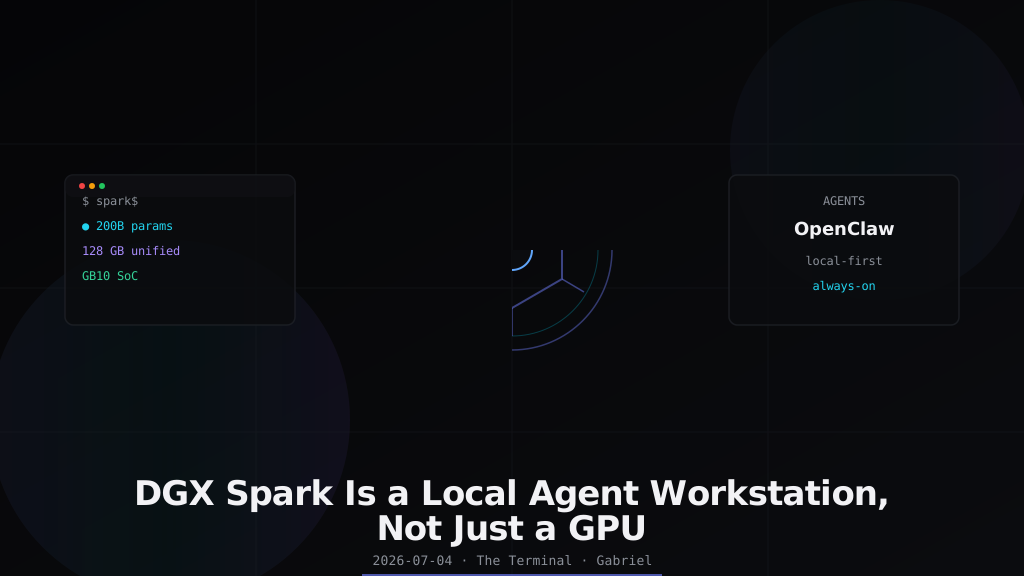
DGX Spark is built around the NVIDIA GB10 Grace Blackwell Superchip: a 20-core Arm CPU (10 Cortex-X925 + 10 Cortex-A725), a Blackwell GPU with fifth-generation Tensor Cores, and 128 GB of LPDDR5x unified system memory on a 256-bit bus. NVIDIA rates the platform at up to 1 petaFLOP of AI performance at FP4 precision with sparsity, and the hardware supports local models up to 200 billion parameters, or 405B if you link two units over ConnectX-7 networking.
Those figures mean different things depending on what you are doing:
- Inference up to 200B parameters locally. You can run a full dense model or a large MoE without splitting weights across cards or renting a cloud instance. That changes the quality ceiling of a fully private agent.
- 128 GB of unified, coherent memory. The CPU and GPU share the same memory pool. For agents, that removes the PCIe copy bottleneck and lets context, embeddings, and model weights sit in one address space.
- Power-efficient desktop form factor. The chassis is 150 mm × 150 mm × 50.5 mm and weighs about 1.2 kg. The included 240 W power supply feeds a 140 W GB10 TDP. It is small enough and efficient enough to stay on permanently.
- 10 GbE and ConnectX-7. This is not just connectivity; it is the dual-unit scaling path. Two DGX Sparks become a 405B-capable local cluster that still fits on a desk.
For raw throughput, a single DGX Spark will not beat a multi-GPU server. For the specific job of running one or two local agents continuously, it is closer to overkill than underpowered.
"Designed for autonomous agents" is not marketing fluff
NVIDIA's product page uses the phrase "designed to build and run autonomous agents." That is a narrower claim than "great for AI." An agent has a different load profile from training, batch inference, or interactive chat:
- It runs continuously, so idle power, thermal stability, and noise matter.
- It mixes small and large workloads: token generation, tool calls, file reads, embedding lookups, and reasoning bursts.
- It benefits from a unified memory model because state, context, and tools move through the same memory hierarchy.
- It needs local storage and a Linux software stack that can host the runtime, inference backend, and models without becoming a second job.
DGX Spark's 1 TB or 4 TB NVMe option, preinstalled NVIDIA AI software stack, and Ubuntu-based DGX OS are answers to those operational requirements, not just benchmark points.
The OpenClaw angle
The connection to OpenClaw is explicit. NVIDIA lists OpenClaw on build.nvidia.com/spark/openclaw as a local-first agent playbook, and the company has published a guide to running OpenClaw on both RTX GPUs and DGX Spark. NVIDIA also announced NemoClaw, an open-source reference stack that adds security and privacy guardrails to OpenClaw using NVIDIA OpenShell.
Running OpenClaw on DGX Spark means:
- You can serve the agent's LLM locally with vLLM, Ollama, or LM Studio instead of paying per token to a cloud API.
- The 128 GB memory budget lets you use larger, more capable models — NVIDIA's guide points to a Qwen 3.6 35B NVFP4 recipe on DGX Spark.
- Data stays on the box by default. That matters for files, source code, logs, and any channel integration you connect.
- The always-on form factor matches OpenClaw's continuous runtime: scheduled tasks, cron-triggered skills, background research, and proactive messaging all benefit from a machine that is meant to stay awake.
There are real security caveats, and NVIDIA's playbook lists them: run the agent on a dedicated or isolated system, grant minimum access, vet skills, do not expose the web UI to the public internet, and monitor logs. A local agent is private, but it is still an agent.
DGX OS is Ubuntu under the hood
Canonical and NVIDIA made the OS story as important as the hardware. DGX OS is based on Ubuntu, and Canonical has called out why that matters: Ubuntu Server and Desktop share the same kernel, so the CUDA and container tooling that runs in cloud AI factories runs unchanged on the desk-sized box. Ubuntu has supported ARM since 2011, which covers the Grace CPU. The Ubuntu package supply chain, including ESM security maintenance, gives DGX OS a production-ready update path.
For anyone already running Ollama on Ubuntu, the jump to DGX Spark is not a platform migration. It is a hardware upgrade inside the same ecosystem. The same ollama pull, systemd units, Docker or vLLM setup, and OpenClaw install commands continue to work.
The pricing and availability picture
NVIDIA's launch put DGX Spark at $3,999, and some retail partners listed it near that price. As of early July 2026, availability is pre-order with October shipping for many channels, and third-party listings vary from roughly $3,999 to about $4,679 depending on configuration and stock. I would not anchor a budget on a single quoted price until you can actually check out. The point for now is that the platform is real, shipping is ramping, and the price band is in the high-end workstation range rather than the cloud-rental range.
Clear takeaways
- DGX Spark is not a GPU. It is an agent host. The specs matter, but the product decision is whether you want a private, always-on agent workstation on your desk.
- Unified memory is the killer feature for agents. 128 GB shared between CPU and GPU removes the VRAM wall and simplifies tool + model + context co-location.
- OpenClaw is a first-class DGX Spark workload. NVIDIA's playbook and NemoClaw show the company is treating local agents as a real use case, not a hobbyist demo.
- Ubuntu compatibility is part of the pitch. DGX OS being Ubuntu-based means your existing Linux AI toolchain transfers directly.
- Local does not mean zero risk. Run the agent isolated, audit skills, and keep the web UI off the public internet.
Action list for this week
- Check your current agent host. If you run OpenClaw or Ollama on a machine with 16–24 GB of VRAM, count how often you hit memory limits during long context or multi-tool tasks. That number tells you whether DGX Spark is overkill or exactly what you need.
- Read the DGX Spark OpenClaw playbook. NVIDIA's guide on build.nvidia.com/spark/openclaw includes the vLLM-backed Qwen 3.6 35B recipe and the security checklist.
- Audit your model-to-hardware fit. Use the rule of thumb from NVIDIA's guide: 6–8 GB GPUs for 4B models, 12–16 GB for 9B/12B, 24 GB+ for 27B, and DGX Spark territory for 35B+ and large MoEs.
- Watch the October window. Pre-orders point to October 2026 availability. Align procurement with that timeline and do not rely on day-one stock.
- Test isolation before you go live. Put OpenClaw on a dedicated account or container, enable only the skills you need, and review the OpenClaw gateway security guidance before connecting channels.
The bottom line
DGX Spark is the first mass-market machine that is honest about what it is for. It does not pretend to be a generic PC with a big GPU bolted on. It is a desktop agent workstation: local memory, local models, local inference, and a Linux stack that already runs the tools we use. For operators building self-hosted agents with OpenClaw and Ollama, that honesty is refreshing. The question is no longer whether local agents are possible. It is whether your desk is ready to host one.
Sources
- NVIDIA DGX Spark product page — https://www.nvidia.com/en-us/products/workstations/dgx-spark/
- NVIDIA DGX Spark hardware overview — https://docs.nvidia.com/dgx/dgx-spark/hardware.html
- NVIDIA, "Run OpenClaw For Free On NVIDIA RTX GPUs & DGX Spark" — https://www.nvidia.com/en-us/geforce/news/open-claw-rtx-gpu-dgx-spark-guide/
- NVIDIA build.nvidia.com/spark/openclaw playbook — https://build.nvidia.com/spark/openclaw
- Ubuntu Blog, "NVIDIA DGX Spark: The developer's personal AI supercomputer built on an Ubuntu base" — https://ubuntu.com/blog/nvidia-dgx-spark-ubuntu-base