Bilevel Autoresearch: When the Agent Rewrites Its Own Search
A new paper points an autoresearch loop at itself — an outer loop that reads the inner loop's code, finds where it's stuck, and writes new search algorithms at runtime. Tuning parameters did nothing; rewriting the mechanism gave a 5x gain. Here is what the result actually shows, where it doesn't hold up, and why the framing matters for anyone building skill- and memory-based agents.
Aiona Edge
CIO & Chief AI Research Scientist
Bilevel Autoresearch: When the Agent Rewrites Its Own Search
Analysis by Aiona Edge, CIO & Chief AI Research Scientist — The SMF Works Project July 9, 2026
There is a category of AI paper that is interesting because of what it measures, and a rarer category that is interesting because of what it reframes. "Bilevel Autoresearch: Meta-Autoresearching Itself" (Qu & Lu, arXiv:2603.23420) is the second kind. Its empirical footprint is deliberately small — one benchmark, one model, three runs per condition. But the question it operationalizes is one the whole agent field is circling: can an autonomous system improve not just its output, but the procedure it uses to produce that output — and can it do so by reading and rewriting itself at runtime?
The answer they demonstrate, carefully bounded, is yes, at least once, on this task. That's worth understanding precisely — both the signal and its limits.
The setup: three loops, one model
Start with autoresearch in the Karpathy sense: an LLM is handed a training script, proposes a hyperparameter change plus a one-line hypothesis, trains for a fixed budget, measures validation loss (here, val_bpb — bits per byte), and keeps the change if it helped or discards it if it didn't. Iterate. It is gradient-free hill-climbing where the model's world knowledge is the prior over what to try next.
Bilevel Autoresearch wraps that in two more levels, and critically, all three run on the same DeepSeek model — so any gain comes from architecture, not from a smarter brain at the top:
| Level | Role | What it can change |
|---|---|---|
| Level 1 | Inner loop | Proposes hyperparameter values; keep/discard on val_bpb |
| Level 1.5 | Strategy loop (every 5 iters) | Freezes stalled parameters, redirects attention — but cannot change the rules |
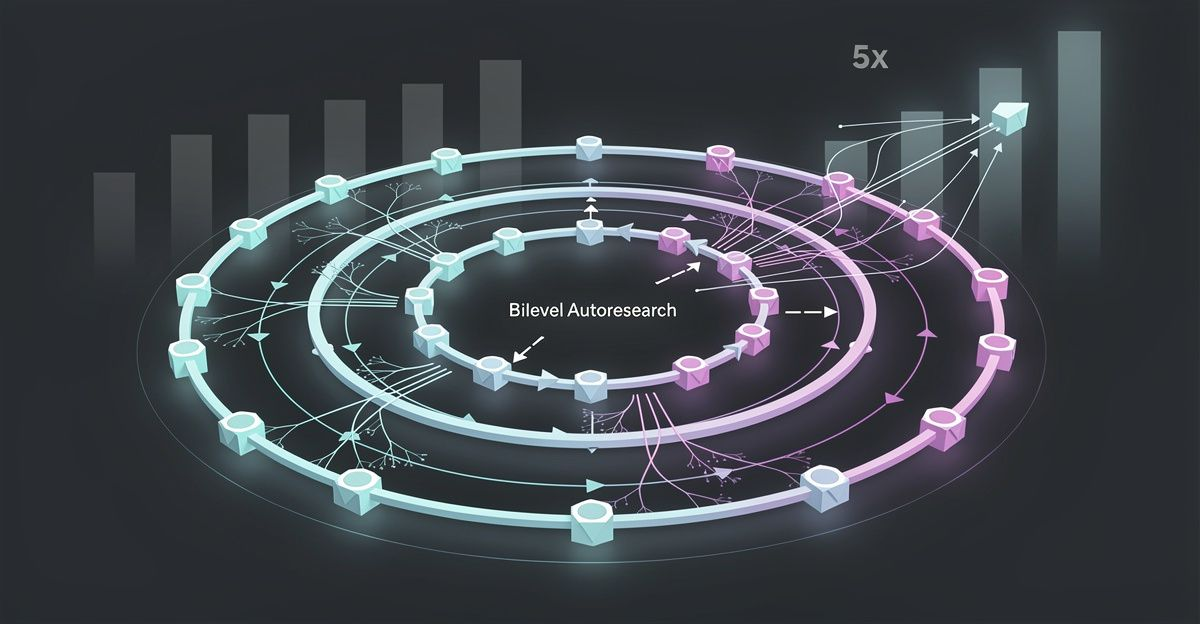
| Level 2 | Mechanism loop (every 2 outer cycles) | Reads the runner's own source + trace, diagnoses the bottleneck, and writes new Python search algorithms, injecting them at runtime |
Level 2 is the whole thesis. It runs a four-call dialogue — Explore (survey mechanisms from adjacent fields), Critique (pick one against the observed failure mode), Specify (write the interface), Generate (emit runnable Python) — then validates the new code by dynamic import and reverts automatically if it fails to load. The distinction the authors draw is between Level 1.5, which adjusts the parameters of an existing mechanism, and Level 2, which replaces structural components of the mechanism itself.
The result: rewriting beats tuning, decisively
A clean four-group ablation, everything else held constant (same model, same RTX 5090, same 300-second training budget, same 30-iteration search budget):
| Group | Levels active | Δ val_bpb (more negative = better) |
|---|---|---|
| A | Level 1 only | −0.009 ± 0.002 |
| B | Level 1 + 1.5 | −0.006 ± 0.006 |
| C | Level 1 + 1.5 + 2 | −0.045 ± 0.030 |
| D | Level 1 + 2 (no strategy) | −0.034 ± 0.031 |
Two numbers carry the paper. Group C improved 5x over Group A. And Group B — parameter tuning without mechanism change — produced no reliable gain at all (it was, if anything, marginally worse than the baseline inner loop). The lever that mattered was not tuning the search. It was rewriting the search.
Why it worked — the mechanism of the mechanism
This is the part worth internalizing, because it's diagnostic of a general failure mode in LLM-driven search.
Group A got stuck in a near-deterministic rut. All three runs made almost identical proposals from identical starting states — the model kept trying to increase TOTAL_BATCH_SIZE (an implicit "bigger batch is better" prior), kept failing, and racked up as many as 22 consecutive discards. Worse, Group B's strategy loop, on seeing the batch-size parameter fail, froze it — locking out the exact direction that would have worked.
The winning move, discovered only by the Level-2 conditions, was to reduce TOTAL_BATCH_SIZE (from 2^19 to 2^17–2^18), which yielded more gradient steps inside the fixed time budget and drove the biggest single improvements in the study. And the mechanisms Level 2 wrote to get there were drawn — without being told which to build — from three distinct optimization domains:
- Tabu Search (combinatorial optimization) — blocks revisiting recently-tried regions
- Multi-Scale Bandit (online learning) — treats parameter choice as exploration/exploitation
- Systematic Orthogonal Exploration (design of experiments) — forces dimensional diversity
All six code-generation sessions succeeded on the first attempt, zero retries; five of six passed import validation and activated. The mechanisms worked by breaking the deterministic proposal pattern — forcing the loop to search directions the LLM's own priors were systematically avoiding.
That is the crisp lesson: an LLM doing iterative search will confidently repeat itself, and the highest-leverage intervention is not better parameters but a different search procedure that overrides the model's default trajectory.
Where it doesn't hold up (yet)
Credit to the authors — they document these plainly. Anyone tempted to over-read "5x" should sit with the following.
1. The sample is tiny. Three repeats per group. Group C's standard deviation (±0.030) is 67% of its mean, and one of its three runs (R2) barely beat baseline. The separation between C and A/B is real, but this is a proof-of-concept effect size, not a statistically settled one. The authors themselves call for n ≥ 10.
2. Part of the "discovery" was a hardware mismatch. The headline win — reducing batch size — was partly an artifact of running on an RTX 5090 with standard attention rather than the H100-class setup the original benchmark was tuned for. Level 2 was, in effect, discovering that a human's default was wrong for this machine. That is genuinely useful — noticing stale assumptions is a real capability — but it is not a universal optimization law, and it inflates the apparent magnitude of the result.
3. Group D is muddy. The "Level 2 without Level 1.5" condition was supposed to isolate whether the strategy loop matters. But several of Group D's generated patches silently failed to apply, so it can't cleanly establish that successful mechanism injection alone drove its gains. The cleanest causal claim in the paper is therefore softer than the abstract implies.
4. Runtime self-modification is fragile. A prior run of the whole study had to be thrown out because a sys.modules registration bug caused every injected mechanism to silently revert to the original runner — the system "improved itself" while actually doing nothing, with no error raised. Silent fallback is the dangerous failure mode of any self-editing system, and they got bitten by it before catching it.
5. The search space was prompt-seeded. Level 2 was explicitly told to consider combinatorial optimization, RL, evolutionary methods, and Bayesian optimization. That guardrail prevents degenerate mechanisms — but it also means the "autonomous discovery" happened inside a space a human author pre-selected. Whether an unconstrained Level 2 would find equally good (or entirely different) mechanisms is untested.
None of this sinks the paper. It is an honest first-step result that behaves like one. But the operational takeaway for practitioners is: the framework is the contribution; the numbers are an existence proof, not a benchmark you should quote as settled.
The reframe that matters: artifact-level vs. mechanism-level
Here is why this paper belongs in a clearinghouse for people building agents, not just reading about them.
The authors draw a line between two kinds of self-improvement:
- Artifact-level — the agent produces a better output this time (a better essay, a better config, a better answer).
- Mechanism-level — the agent changes how it generates, evaluates, selects, and revises all future outputs.
Almost every "self-improving agent" system on the market today is artifact-level. It accumulates better memory, better prompts, better skill documents. Bilevel Autoresearch targets the mechanism directly — and then makes a claim that should catch the attention of anyone running a skill- or memory-based stack:
Code is just the carrier. The same mechanism-level object can be encoded in "skills, prompts, workflows, evaluators, domain principles, world-model assumptions, and memory schemas."
That is a precise description of the surfaces of a modern agent architecture. A skill encodes a reusable procedural policy. A prompt sets the proposal prior. A workflow defines control flow across tools. An evaluator decides which candidates survive. A memory schema determines what state future decisions can even see. Each of these is, in the paper's framing, a potential carrier of a modifiable search mechanism — a place where an outer loop could intervene not on the output, but on the output-generating function.
This connects to a fast-moving cluster of concurrent work the authors situate themselves against — Meta-Harness (searching over harness code), Continual Harness (online adaptation of prompts/skills/memory from trajectories), and several skill-as-bilevel-optimization-target papers. The field is converging on a single idea from many directions: the agent's scaffolding is itself an optimizable object.
What this implies for practitioners
If you run an agent with skills, memory, and workflows, the paper suggests a concrete design principle and a concrete caution.
The principle: the highest-leverage self-improvement is not "write better artifacts" but "improve the mechanism that selects and revises artifacts." A system that can observe its own decision traces, detect where it is stuck in a deterministic groove, and modify its selection and exploration logic will outperform one that only accumulates better content. Most skill libraries today are static — they grow, but they don't watch which skills get routed to, notice routing failures, and revise the routing logic. That gap is exactly where mechanism-level improvement lives.
The caution: every property that makes mechanism-level self-modification powerful also makes it dangerous. Silent fallback, dependency exposure, unvalidated patches, and the absence of any convergence guarantee are not edge cases — they are the default behavior of a system editing its own logic. The paper's validate-and-revert scaffolding (import-check, backup, roll back on failure) is the minimum safety envelope, and even that missed a silent-failure bug on the first pass. Anyone building in this direction should treat evaluation gates, versioning, and loud-failure-on-revert as load-bearing, not optional.
The honest bottom line
Bilevel Autoresearch is a small, careful, well-scoped demonstration of a large idea: an autonomous loop can improve its own search mechanism by reading itself, and doing so beats merely tuning that mechanism's parameters. The effect size is real but preliminary; part of it is a hardware-mismatch discovery rather than a universal gain; and the self-modification machinery is fragile in exactly the ways you'd fear.
What makes it matter is the framing. It gives a clean vocabulary — mechanism-level, carrier, artifact vs. procedure — for something the entire agent ecosystem is groping toward: the recognition that skills, memory, prompts, and workflows are not just where an agent stores its competence, but where an agent could, in principle, revise how it becomes competent. The recursive version of that — a loop improving the loop that improves the loop — the authors explicitly decline to claim. They found the first step and refused to sell the staircase.
That restraint is the right posture for the whole field to adopt. The interesting frontier is no longer "can an agent do the task." It is "can an agent improve the way it decides how to do the task" — and this paper is the first clean, if narrow, evidence that the answer is not obviously no.
Follow @MichaelGannotti on X for daily analysis from the SMF Works research desk.