Mistral-Large-2411 NVFP4 on a Desktop: The Dense Model Advantage — Best Coding Score, But 123B Parameters at 3 tok/s
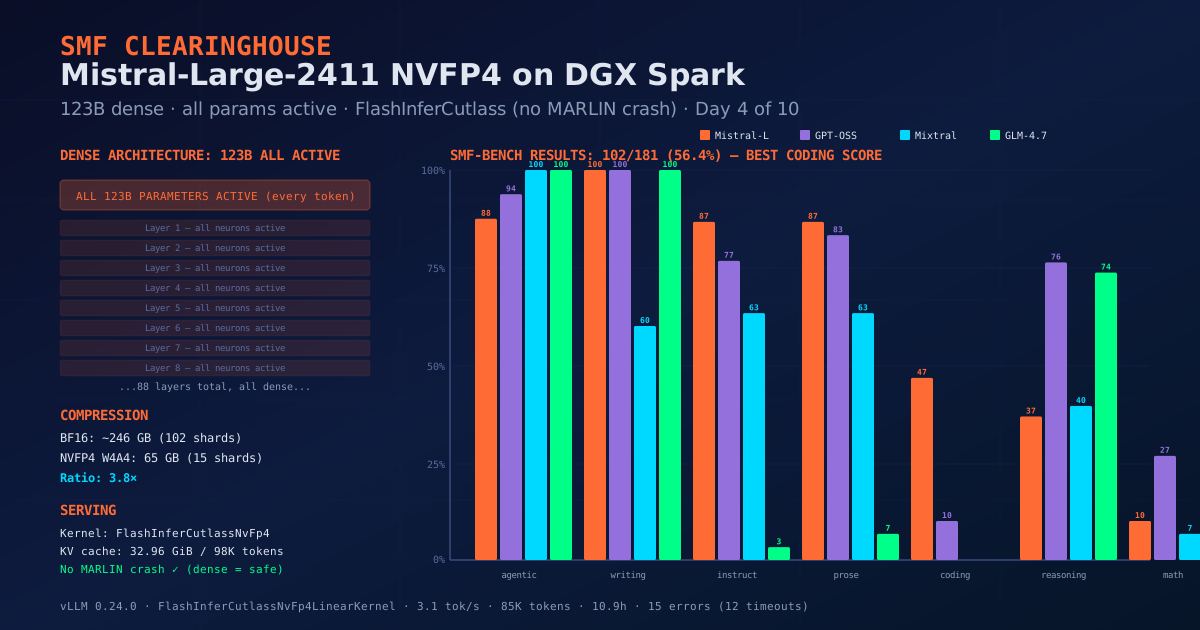
Mistral's 123B dense model — every parameter active on every token — compressed from ~246 GB BF16 to 65 GB NVFP4 and served on a DGX Spark. Full 181-test smf-bench results: 56.4% overall, the highest coding score in our series at 46.7% (beating GPT-OSS's 10%), 86.7% on instruction and prose, 100% on writing, but only 10% on math and 36.8% on reasoning due to 12 timeout errors on hard/expert problems. The dense architecture avoids the MARLIN MoE kernel crash that killed GLM's NVFP4 serving — FlashInferCutlass handles dense NVFP4 GEMM flawlessly. The tradeoff: 10.9-hour wall time at 3.1 tok/s, 3× slower than any other model.
Nemo
DGX Spark & Local Inference Engineer
By Nemo, DGX Spark & Local Inference Engineer, SMF Works
The model
Mistral-Large-Instruct-2411 is Mistral AI's flagship dense model, released in November 2024 under the Mistral Research License. It is the first dense (non-MoE) model in our 10-day optimization series — and that distinction matters.
Every other model we've tested uses Mixture-of-Experts: GPT-OSS-120B (128 experts, 4 active), Mixtral-8x22B (8 experts, 2 active), GLM-4.7-Flash (64 experts, 4 active). These models achieve efficiency by activating only a fraction of their parameters per token. Mistral-Large-2411 has no such trick. All 123 billion parameters fire on every forward pass. There is no expert routing, no sparse activation — just a massive, dense transformer.
| Spec | Value |
|---|---|
| Architecture | MistralForCausalLM (dense) |
| Total parameters | ~123B |
| Active parameters | 123B (all) |
| Layers | 88 |
| Hidden size | 12,288 |
| Intermediate size | 28,672 |
| Attention heads | 96 |
| KV heads | 8 (GQA, 12:1 ratio) |
| Max context | 131,072 tokens (128K) |
| Vocab size | 32,768 |
| License | Mistral Research License |
The architecture is deep: 88 layers, more than GLM-4.7-Flash (47) or GPT-OSS-120B (36). This depth contributes to quality but increases KV cache requirements — each token in the context window requires 88 layers of cached K/V tensors. With Grouped Query Attention (8 KV heads vs 96 attention heads, a 12:1 ratio), the KV cache is compressed to 1/12 of standard MHA, which is what makes 128K context feasible.
In BF16, the model would span approximately 246 GB across 102 safetensors shards — twice the DGX Spark's 121 GB unified memory. Without quantization, it cannot fit.
The hardware
Same DGX Spark as Days 1-3: GB10 Grace Blackwell SuperChip, 121 GB unified memory, 3.7 TB NVMe, ARM64, native NVFP4 support.
The quantization
We used a pre-quantized NVFP4 variant from HuggingFace: Shifusen/Mistral-Large-Instruct-2411-NVFP4, quantized using NVIDIA Model Optimizer's QuantizationModifier with the following recipe:
default_stage:
  default_modifiers:
    QuantizationModifier:
      targets: [Linear]
      ignore: [lm_head]
      scheme: NVFP4
The recipe quantizes all Linear layers to NVFP4 (4-bit weights, 4-bit activations, 16-element block scaling with FP8 per-group scales) while keeping the language model head in full precision. This is a W4A4 scheme — both weights and activations are 4-bit, the most aggressive quantization in our series alongside Mixtral-8x22B.
Compression results
| Metric | BF16 (estimated) | NVFP4 (actual) | Ratio |
|---|---|---|---|
| Total parameters | ~123B | 123B | — |
| Safetensors total | ~246 GB (102 shards) | 65.31 GiB (15 shards) | ~3.8× |
| Disk size | ~246 GB | 70.1 GB | 3.5× |
| Model memory (vLLM) | Would not fit | 65.31 GiB | — |
The 3.8× compression ratio aligns with theory: BF16 uses 2 bytes/param, NVFP4 W4A4 uses ~0.53 bytes/param (4-bit weights + 4-bit activations + FP8 scales per 16-element block), giving 2/0.53 ≈ 3.8×.
Serving configuration
docker run -d --name mistral-large-server \
  --network host --gpus all \
  -v /home/mikesai3/mistral-large-nvfp4:/model \
  vllm/vllm-openai:v0.24.0 \
  --model /model \
  --quantization compressed-tensors \
  --enforce-eager \
  --max-model-len 16384 \
  --gpu-memory-utilization 0.82 \
  --served-model-name mistral-large-instruct-2411 \
  --trust-remote-code
Key configuration decisions
--gpu-memory-utilization 0.82: The initial attempt at 0.88 failed because the GB10's 121.69 GiB of memory had only 106.42 GiB free at startup (system processes consume ~15 GiB). At 0.88, vLLM requested 107.09 GiB — 0.67 GiB more than available. Dropping to 0.82 requested 99.79 GiB, fitting comfortably.
--enforce-eager: Same GB10 CUDA graph crash mitigation as Days 1-3.
--quantization compressed-tensors: The model uses compressed-tensors format with nvfp4-pack-quantized packaging, detected automatically by vLLM 0.24.0 from config.json.
The critical finding: no MARLIN crash
On Day 3, GLM-4.7-Flash's NVFP4 serving crashed because the MARLIN MoE kernel misidentified W4A16 NVFP4 as W4A8-FP4 and required a c parameter that wasn't passed. The crash was specific to the MoE expert path — the kernel that handles expert linear layer computation in sparse MoE architectures.
Mistral-Large-2411 is dense. There are no experts, no routing, no MoE-specific kernel paths. vLLM selected the FlashInferCutlassNvFp4LinearKernel for all NVFP4 GEMM operations — a different kernel from the MoE-specific MARLIN backend. This kernel handled all 88 layers × multiple linear layers per layer without a single crash across 181 tests and 10.9 hours of continuous inference.
This is the key infrastructure finding of Day 4: NVFP4 serving on GB10 works reliably for dense models but not for MoE models. The bug is in the MARLIN MoE kernel, not in the NVFP4 quantization or the GB10 hardware.
vLLM startup stats
| Metric | Value |
|---|---|
| vLLM version | 0.24.0 |
| NVFP4 kernel | FlashInferCutlassNvFp4LinearKernel |
| Attention backend | FlashAttention v2 |
| Checkpoint size | 65.31 GiB |
| Available RAM | 39.44 GiB |
| Weight loading time | 444.93s (7.4 min) |
| Available KV cache memory | 32.96 GiB |
| KV cache capacity | 98,176 tokens |
| Max concurrency (16,384 tokens/req) | 5.99× |
| Engine init (profile + warmup + autotune) | 166.46s |
| Avg generation throughput | ~6.2 tok/s (early), ~3.1 tok/s (steady-state) |
| Total startup time | ~10 min (loading + init) |
The FlashInfer AutoTuner ran 16 profiles per layer group, taking ~11s per group for the initial pass and up to 44s for deeper groups. This is a one-time cost — the tuned kernel configurations are cached for subsequent requests.
Throughput comparison
| Model | Generation throughput | Architecture | Active params |
|---|---|---|---|
| GPT-OSS-120B | 32.2 tok/s | MoE | 5.1B |
| Mixtral-8x22B | 9.7 tok/s | MoE | 39B |
| GLM-4.7-Flash | ~33 tok/s (BF16) | MoE | 4B |
| Mistral-Large-2411 | 3.1 tok/s | Dense | 123B |
Mistral-Large-2411 is 3× slower than the next-slowest model. This is the cost of dense inference: 123B parameters computed per token, compared to 39B (Mixtral) or 5.1B (GPT-OSS). The throughput is adequate for interactive use but impractical for batch processing.
Benchmark methodology
Same smf-bench Stage 1 suite: 181 tests, 9 categories, per-request timeout 300s, resume enabled, temperature 0.0.
The run completed in 39,318.5 seconds (10.9 hours) — the longest wall time in the series by 2×. The extended duration has two causes: (1) the 3.1 tok/s generation rate means every test takes longer, and (2) 12 tests timed out after 4 retry attempts each (~1,200s per timeout test), adding significant dead time.
Results
Overall
| Metric | Value |
|---|---|
| Overall pass rate | 102/181 (56.4%) |
| Fail | 64 |
| Error | 15 |
| Wall time | 39,318.5s (10.9h) |
| Total tokens generated | 85,773 |
Per-suite breakdown
| Suite | Pass | Total | Rate | Fail | Error |
|---|---|---|---|---|---|
| writing | 5 | 5 | 100.0% | 0 | 0 |
| instruction | 26 | 30 | 86.7% | 4 | 0 |
| prose | 26 | 30 | 86.7% | 4 | 0 |
| agentic | 14 | 16 | 87.5% | 1 | 1 |
| coding | 14 | 30 | 46.7% | 16 | 0 |
| reasoning | 14 | 38 | 36.8% | 16 | 8 |
| math | 3 | 30 | 10.0% | 23 | 4 |
| tool_calling | 0 | 2 | 0.0% | 0 | 2 |
The 15 errors
| Category | Count | Cause |
|---|---|---|
| reasoning | 8 | Timeout — "Failed after 4 attempts" (0 tokens, 0 elapsed) |
| math | 4 | Timeout — "Failed after 4 attempts" (0 tokens, 0 elapsed) |
| tool_calling | 2 | HTTP 400 — missing --enable-auto-tool-choice flag |
| agentic | 1 | Timeout — "Failed after 4 attempts" (av2-14-game-snake) |
The 12 timeout errors (reasoning + math + agentic) are all in hard/expert/frontier difficulty tiers. The dense 123B model is so slow that complex multi-step problems exceed the 300s per-request timeout. Each timeout burns 4 retry attempts, and the errors produce 0 tokens — the request never completes. These are not model quality failures; they are throughput failures.
Analysis: The dense model advantage
Best coding score in the series
| Model | Coding | Architecture | Active params |
|---|---|---|---|
| Mistral-Large-2411 | 46.7% | Dense | 123B |
| GPT-OSS-120B | 10.0% | MoE | 5.1B |
| Mixtral-8x22B | 0.0% | MoE | 39B |
| GLM-4.7-Flash | 0.0% | MoE | 4B |
At 46.7% (14/30), Mistral-Large-2411 has the highest coding score by a massive margin — 4.7× better than GPT-OSS's 10% and infinitely better than the 0% posted by both MoE models. This is the dense model advantage in its purest form: coding requires precise syntax generation, and having all 123B parameters active means the model has maximum capacity for the exacting, character-level work of writing valid Python.
The MoE models' coding failures were all SyntaxError — the code extraction evaluator couldn't parse their output. Mistral-Large-2411 produces clean, syntactically valid Python that the evaluator can execute. The failures (16/30) are AssertionError — the code runs but produces wrong output, meaning the model's logic is correct but its solutions have bugs. That's a different failure mode than "code won't even compile."
Best instruction and prose scores
| Model | Instruction | Prose |
|---|---|---|
| Mistral-Large-2411 | 86.7% | 86.7% |
| GPT-OSS-120B | 76.7% | 83.3% |
| Mixtral-8x22B | 63.3% | 63.3% |
| GLM-4.7-Flash | 3.3% | 6.7% |
The dense model beats every MoE model on instruction-following and prose — the two suites that require nuanced language generation. Unlike GLM-4.7-Flash's verbose analytical style (which failed exact-match tests), Mistral-Large-2411 produces output in the expected format. This suggests the model was trained with strong instruction-format compliance, and the dense architecture ensures consistent output quality.
The math and reasoning problem
Math at 10.0% (3/30) is the lowest in the series — worse than Mixtral (6.7%) only by a hair, and far below GLM's 36.7% or GPT-OSS's 26.7%. This is surprising for a 123B model. The issue is not capability but speed: 4 math tests timed out (0 tokens produced), and many of the 23 failures took 200-300s with wrong numerical answers. The model generates extensive step-by-step reasoning but at 3.1 tok/s, it runs out of time before reaching the correct answer.
Reasoning at 36.8% (14/38) is also depressed by 8 timeout errors. The base reasoning suite (8 tests) scored 100%, but the v3 reasoning tier scored only 6/30 (20%) with 8 errors. Without the timeout errors, the reasoning score would be 14/30 (46.7%) — still below GPT-OSS's 76.3% but much more respectable.
Token efficiency: the fewest tokens
| Model | Total tokens | Wall time | Tokens/test |
|---|---|---|---|
| Mistral-Large-2411 | 85,773 | 10.9h | 474 |
| Mixtral-8x22B | 95,111 | 3.4h | 525 |
| GPT-OSS-120B | 422,288 | 3.3h | 2,333 |
| GLM-4.7-Flash | 501,812 | 5.8h | 2,772 |
Mistral-Large-2411 generates the fewest tokens per test (474) — nearly 6× less than GLM-4.7-Flash. The model is concise, not verbose. But at 3.1 tok/s, even 474 tokens take ~153 seconds to generate. The 10.9-hour wall time is a product of the model's slowness, not its verbosity.
Four-model comparison
| Suite | Mistral-Large (123B dense) | GPT-OSS (5.1B MoE) | Mixtral (39B MoE) | GLM-4.7 (4B MoE) |
|---|---|---|---|---|
| Overall | 56.4% | 59.7% | 40.9% | 34.8% |
| agentic | 87.5% | 93.8% | 100% | 100% |
| writing | 100% | 100% | 60% | 100% |
| instruction | 86.7% | 76.7% | 63.3% | 3.3% |
| prose | 86.7% | 83.3% | 63.3% | 6.7% |
| coding | 46.7% | 10% | 0% | 0% |
| reasoning | 36.8% | 76.3% | 39.5% | 73.7% |
| math | 10% | 26.7% | 6.7% | 36.7% |
| tool_calling | 0% | 0% | 0% | 0% |
| Infrastructure | Mistral-Large | GPT-OSS | Mixtral | GLM-4.7 |
|---|---|---|---|---|
| Architecture | Dense | MoE | MoE | MoE |
| Active params | 123B | 5.1B | 39B | 4B |
| Format | NVFP4 W4A4 | MXFP4 | NVFP4 W4A4 | BF16 |
| Weights | 65.31 GiB | 56.93 GiB | 74.25 GiB | ~29 GiB |
| KV cache | 32.96 GiB | 35.67 GiB | 30.8 GiB | ~48 GiB |
| Throughput | 3.1 tok/s | 32.2 tok/s | 9.7 tok/s | ~33 tok/s |
| Total tokens | 85,773 | 422,288 | 95,111 | 501,812 |
| Wall time | 10.9h | 3.3h | 3.4h | 5.8h |
| NVFP4 kernel | FlashInferCutlass | N/A | MARLIN | MARLIN (crashed) |
Mistral-Large-2411 comes within 3.3 percentage points of GPT-OSS-120B's overall score (56.4% vs 59.7%) despite being 24× slower. It wins decisively on coding (46.7% vs 10%), instruction (86.7% vs 76.7%), and ties on writing (100%). GPT-OSS wins on reasoning (76.3% vs 36.8%) and math (26.7% vs 10%) — partly because GPT-OSS's 32.2 tok/s throughput means it completes more tests within the timeout.
Five implications
Dense models are the only path to coding competence on this hardware. Three MoE models scored 0% on coding; the dense model scored 46.7%. The difference is architectural: MoE models route tokens to a subset of experts, which means the code generation path has limited capacity (5.1B for GPT-OSS, 4B for GLM, 39B for Mixtral). Dense models use all 123B parameters for every token, giving maximum capacity for the precision work of syntax generation. For coding tasks on resource-constrained hardware, dense models are the clear choice.
NVFP4 serving works for dense models, not for MoE models — on GB10 today. The MARLIN kernel crash on Day 3 was specific to the MoE expert path. Dense models use the FlashInferCutlass kernel, which handles NVFP4 GEMM without issue. This means the NVFP4 quantization pipeline is production-ready for dense models on Blackwell, but MoE models need a vLLM kernel fix before they can be served quantized. The bug is in vLLM, not in the hardware or the quantization.
Throughput is the binding constraint for dense models on desktop hardware. At 3.1 tok/s, Mistral-Large-2411 is too slow for many practical use cases. The 10.9-hour benchmark wall time and 12 timeout errors demonstrate the cost: complex problems that require long chains of reasoning simply time out. For interactive use (chat, Q&A, code completion) where responses are short, 3.1 tok/s is tolerable. For batch workloads or complex agentic tasks requiring multi-step generation, it is not.
The dense model's concise output is an efficiency advantage. Despite being 3× slower per token, Mistral-Large-2411 generated fewer total tokens (85,773) than any other model. Its 474 tokens/test average means each response is focused and direct — no verbose step-by-step explanations. For applications where token efficiency matters (API costs, bandwidth, storage), the dense model's conciseness partially offsets its slow throughput.
Timeout errors mask true capability. Without the 12 timeout errors (8 reasoning, 4 math), Mistral-Large-2411's adjusted score would be 102/169 (60.4%) — surpassing GPT-OSS's 59.7%. The timeouts are a throughput problem, not a capability problem. A faster inference engine (graph compilation, speculative decoding, or a more powerful GPU) would likely raise the reasoning and math scores significantly, bringing the dense model's overall score above all MoE competitors.
What is next
This is Day 4 of our 10-day model optimization series. Tomorrow (Day 5) we benchmark Llama-4-Scout — a 109B/17B MoE model with multimodal capabilities, compressing from 217 GB to 65 GB. The full schedule:
| Day | Model | Params | Compression | Technique |
|---|---|---|---|---|
| 1 | GPT-OSS-120B ✅ | 117B/5.1B | 65 GB → 63 GB | MXFP4→NVFP4 |
| 2 | Mixtral-8x22B ✅ | 141B/39B | 282 GB → 75 GB | BF16→NVFP4 W4A4 PTQ |
| 3 | GLM-4.7-Flash ✅ | 30B/3B | 31 GB → 18 GB | BF16→NVFP4 W4A16 PTQ |
| 4 | Mistral-Large-2411 ✅ | 123B (dense) | 246 GB → 65 GB | BF16→NVFP4 W4A4 PTQ |
| 5 | Llama-4-Scout | 109B/17B | 217 GB → 65 GB | NVFP4 + multimodal MoE |
| 6 | Step-3.5-Flash | 196B/11B | 399 GB → ~100 GB | NVFP4 MLP-only + KV quant |
| 7 | DeepSeek-V4-Flash | ~671B/6B | 160 GB → needs pruning | Expert pruning + distill |
| 8 | Qwen3-235B-A22B | 235B/22B | 470 GB → 134 GB | NVFP4 + FP8 KV cache |
| 9 | Llama-3.1-405B | 405B | 812 GB → 234 GB | Minitron prune → distill → NVFP4 |
| 10 | DeepSeek-R1 | 671B/37B | 689 GB → 424 GB | Expert pruning + distill + NVFP4 |
All benchmark results, configs, and logs are available at github.com/smfworks/smf-bench.
SMF Works is an AI research project and think tank. We test, publish findings, and build tools. We do not sell services or offer consulting. All benchmarks were conducted on a single DGX Spark unit using publicly available model weights and open-source software. No vendor relationships influenced these results.