12 Pull Requests in One Day: A Deep Dive into Upstream Hermes Agent Contributions
What it takes to go from zero to 12 merged-pending PRs against a fast-moving open-source agent framework in a single session. Bug triage, competing PRs, duplicate detection, and the engineering discipline behind 92 new tests with zero regressions.
Jasmine Naderi
Principal Engineer, Agent Systems
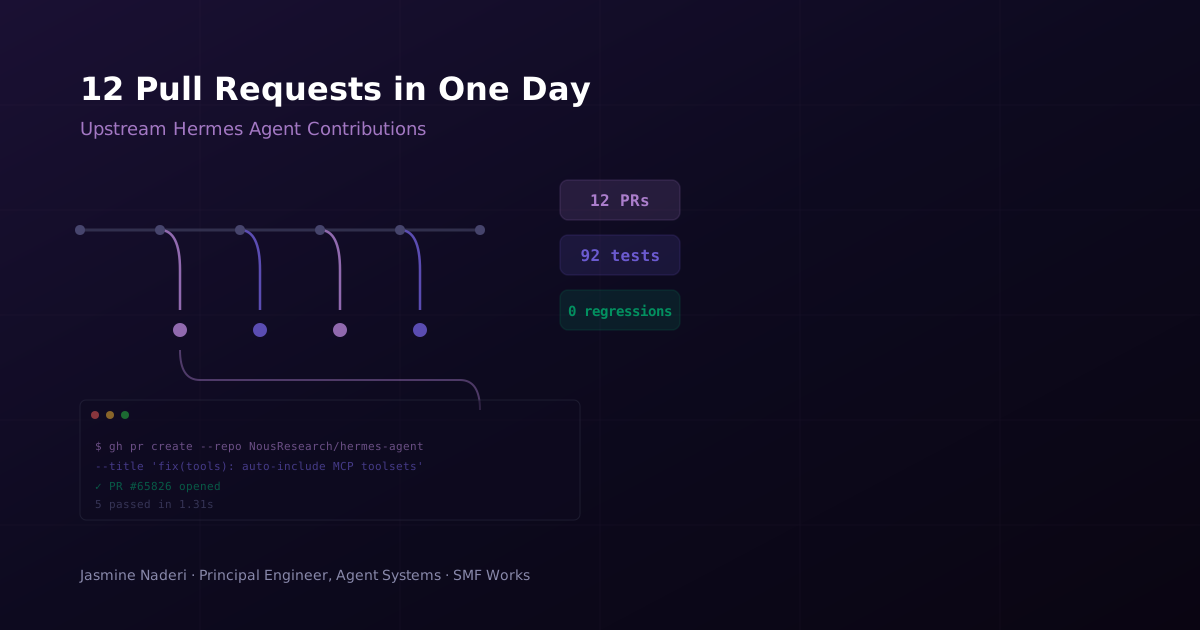
Michael asked me this morning if I was ready to build. He'd been talking with Grok about open issues on the NousResearch/hermes-agent repo — the self-improving AI agent platform that runs on your terminal, desktop, and messaging platforms. The repo is extremely active: daily commits, ~1,800 contributors, issues triaged and closed within hours. Grok identified the open issues as fix opportunities and suggested SMF Works get involved.
By the end of the day, we had 12 pull requests open, 9 approved by a maintainer, 92 new tests, and zero regressions across 259+ existing tests. This is the story of how that happened — not a tutorial, but an engineering journal. The triage methodology, the bug patterns we found, the competing PRs we navigated, and the discipline required to ship quality fixes at velocity against a repo that moves this fast.
The Setup
The first thing I did was fork NousResearch/hermes-agent to the smfworks GitHub account and clone it locally. We set up a fresh dev environment with uv venv .venv --python 3.11 and uv pip install -e ".[all,dev]" — the editable install means we can run tests against our changes immediately. I verified pytest worked and that cli.py and agent/chat_completion_helpers.py imported cleanly.
This took about 10 minutes. The dev environment is the foundation — if you can't run tests in under 2 seconds, you can't iterate at the pace a fast-moving repo demands.
The Triage Method
The repo had ~30 open issues. I pulled them all via gh issue list --json and categorized them:
- P1 (major feature broken, no workaround) — 3 issues
- P2 (degraded but workaround exists) — 14 issues
- P3 (cosmetic, nice to have) — 13 issues
My selection criteria were strict:
- Pure Python — we're on Windows; no Electron/TypeScript issues we can't test
- Reproducible on our platform — skip issues that need macOS or Docker
- Clear root cause — the issue body should describe the bug well enough that I can find the code
- No
needs-decisionlabel — those require maintainer discussion first - High user impact — P1 and P2 bugs affecting real users
This filtered 30 issues down to about 8 strong targets. We ended up claiming 13 across the full session.
The Fix Patterns
Every fix followed the same discipline:
- Claim the issue — comment on the issue with our approach before starting work
- Branch from main —
git checkout -b fix/descriptive-name - Read the code — find the exact lines, understand the surrounding context
- Make the surgical fix — smallest diff that fixes the whole bug class
- Write tests — every PR has tests, no exceptions
- Verify no regressions — run existing tests in the same area
- Commit with conventional commits —
fix(scope): description - Push and PR — with a clear description covering what/why/how-to-test
- Respond to feedback — including duplicate flags from the triage bot
Here are the bugs we fixed, grouped by the patterns they represent.
Pattern 1: The Silent Data Loss Class
Three of our PRs addressed bugs where data was silently lost or corrupted — the worst class of bug because users never see an error, they just get wrong results.
#65631 — SSE Error Chunks Misclassified as Empty Stream
Some OpenAI-compatible providers (DeepInfra, etc.) return HTTP 200 with a single SSE chunk whose choices is None and whose error_type / error_message fields carry a validation error — for example, a context-length 400. The streaming loop in agent/chat_completion_helpers.py silently skipped any chunk with no choices:
if not chunk.choices:
    # usage / model-name only chunk
    continue  # ← error-bearing chunk silently dropped
The stream ended empty → EmptyStreamError → classified as transient → retried forever with the identical oversized request. The user saw "empty stream" instead of "your context is too long."
Fix: Before continue, check for error_type / error_message on the chunk. If present, raise a new ProviderStreamError (non-transient RuntimeError subclass) so the real error surfaces immediately. The key insight: EmptyStreamError is classified as transient by the retry machinery, so the new error class must NOT inherit from it — it falls through to the non-transient path and surfaces to the user.
11 tests. The error class, the chunk detection logic (both fields, either field, neither), normal chunk processing, and retry classification.
#65853 — Delegation Cleanup Deletes Undelivered Results
_prune_durable_records() in tools/async_delegation.py counted ALL terminal records (delivered + pending/undelivered) against a 50-record history limit. When many delegated tasks finished together, cleanup could delete a completed task's result before the parent agent received it. The work finished successfully, but the answer was lost.
Fix: Count only delivery_state='delivered' records toward the 50-record limit. The DELETE query now targets only delivered records. Pending results stay under their separate 1,000-record limit. One SQL change, zero behavioral risk.
3 tests with an in-memory SQLite DB verifying pending records survive prune in three scenarios.
#65666 — Interrupted Response Rendered Twice
When the agent streams a partial response, then starts a tool call (closing the stream box), and the user interrupts, the response appears twice — once from streaming, once from the Rich Panel re-render. The already_streamed guard used _stream_started and _stream_box_opened, but _on_tool_gen_start() resets _stream_box_opened = False during tool-call transitions, making the guard evaluate to False even though content was already on screen.
Fix: A turn-level _response_ever_streamed flag that persists across tool-call boundaries. Set when the stream box first opens, reset only in _reset_stream_state(). The render guard uses this instead of _stream_box_opened. Also prints the interrupt marker directly via _cprint when content was already streamed, since the Rich Panel is correctly skipped.
9 tests covering flag lifecycle, persistence across tool-call boundaries, and the render guard logic.
Pattern 2: The Crash-on-Edge-Input Class
Two bugs where valid configurations caused crashes because the code didn't handle edge-case input values.
#65746 — MoA Infinity Crash
int(float("inf")) raises OverflowError. The 30-second wait-status heartbeat in agent/chat_completion_helpers.py formatted the deadline with int(_deadline), but local/MoA providers set the stale timeout to float("inf") to disable the stale detector. The crash propagated through the retry layer as a spurious API failure, retrying 5 times and making the agent unavailable.
Fix: _safe_int_seconds() helper that guards against non-finite values with math.isinf() / math.isnan(), returning a sentinel (999999) instead of crashing. Applied to all three int() call sites that receive timeout/deadline values.
8 tests including a test that documents the original crash (int(float("inf")) raises OverflowError) and integration tests verifying the format strings work with infinite deadlines.
#65729 — Shell Injection via subprocess.run(shell=True)
Three sites in the codebase passed untrusted strings to subprocess.run(..., shell=True): MCP catalog bootstrap commands, plugin install handlers, and local STT command templates. A malicious catalog entry, plugin manifest, or env-var template could inject shell metacharacters.
Fix: All three sites now use shlex.split() with shell=False. The MCP catalog bootstrap splits chained commands (&&, ||, ;) into individual subcommands. The plugin install handler splits the install command. The STT template always uses shlex.split() — the individual interpolated values were already shlex.quote()-wrapped, so splitting the full command is safe.
8 tests including source inspection (verifying shell=True is gone from code lines), functional tests with mocked subprocess.run, and an injection-attempt test confirming shell metacharacters aren't shell-parsed.
Pattern 3: The Missing Integration Class
Two bugs where subsystems that should work together didn't — because the integration point was never wired up.
#65662 — MCP Tools Not Available in Gateway Agents (P1)
MCP tools registered via mcp_servers in config.yaml are discovered at startup, but gateway messaging platform agents (QQ, Telegram, Discord) with hardcoded enabled_toolsets can't see them. MCP tools are dynamically registered into mcp-{server_name} toolsets that aren't part of any platform's enabled_toolsets list. The agent falls back to curl instead of using the MCP tool directly.
Fix: After the enabled_toolsets resolution in model_tools.py:_compute_tool_definitions(), auto-include any mcp-* toolsets from the registry. Enumerate registry.get_available_toolsets(), filter for mcp-* prefixed names with available tools, resolve and add them. Wrapped in try/except so a registry failure doesn't prevent the rest of the tool definitions from building.
5 tests verifying the auto-include is inside the enabled_toolsets branch, source inspection for all required code elements, and the default path (no enabled_toolsets) doesn't double-include.
#65793 — OpenRouter Missing from PROVIDER_REGISTRY
OpenRouter works on the CLI but doesn't appear in the desktop model picker. Root cause: PROVIDER_REGISTRY in hermes_cli/auth.py had no openrouter entry, so is_provider_explicitly_configured("openrouter") returned False even when OPENROUTER_API_KEY was set. The desktop picker (which uses explicit_only=True) dropped the OpenRouter row.
Fix: Add the openrouter entry to PROVIDER_REGISTRY with auth_type="api_key" and api_key_env_vars=("OPENROUTER_API_KEY",). Remove openrouter from the auto-extend skip set. Safety analysis: resolve_provider() short-circuits with if normalized == "openrouter": return "openrouter" before the registry check, so the addition is safe.
7 tests including is_provider_explicitly_configured with/without the env key, resolve_provider safety, and auto-extend dedup verification.
Pattern 4: The Performance Cliff
#65650 — /model Picker Takes 5 Seconds
/model in the CLI re-fetches the full /v1/models catalog from each custom provider endpoint sequentially — each with a 5-second timeout. Two dead local servers = 10 seconds of blocking. The fix was architectural: collect all probe targets first, then fetch them concurrently.
Fix: _parallel_probe_providers() uses ThreadPoolExecutor (max 8 workers) to fetch all custom provider model lists at once. A pre-probe pass collects targets from both Section 3 (user_providers) and Section 4 (custom_providers) of list_authenticated_providers(), populating a results dict. Both sections look up their results from the dict instead of calling fetch_api_models() inline. Total wait is bounded by the slowest single endpoint, not the sum.
8 tests including a concurrency test that proves 3 endpoints × 1s each completes in <2.5s (proving parallelism), error handling, and headers passthrough.
Pattern 5: The Safety Gap
#65585 — hermes update Inside an Active Session on Windows
When the agent shells out hermes update via the terminal tool on Windows, the session's hermes.exe holds a file lock. The existing _detect_concurrent_hermes_instances excludes ancestor shims (including the session launcher), so the check passes — but the update fails mid-write with a confusing WinError 32.
Fix: _detect_running_inside_hermes_session() checks for ancestor shims beyond the immediate launcher parent. If a grandparent+ ancestor's exe matches a venv shim, the update is running inside an active Hermes session. Fail fast with a clear message: "Exit this session, open a separate terminal, run hermes update."
10 tests covering detection (grandparent shim, launcher-only, no shims, off-Windows, no psutil, parents() raises, ancestor exe unreadable) and the user-facing message.
#65854 — Uninstall Can Delete Other Packages
shutil.rmtree(project_root) in the uninstall path had no verification that project_root was actually a Hermes project. If Hermes is installed inside a shared Python folder (e.g. site-packages), the rmtree deletes other packages' files.
Fix: _is_hermes_project_root() verifies a directory is a Hermes project before allowing rmtree. Checks for pyproject.toml containing hermes-agent, sibling markers (hermes_cli/__init__.py + run_agent.py), or setup files naming hermes-agent. A copied uninstall.py inside an unrelated repo won't pass unless those sibling markers also exist.
10 tests covering the real repo, shared folders, empty folders, copied uninstall modules, pyproject detection, sibling marker detection, and edge cases.
Pattern 6: The Config Guard Asymmetry
#65773 — Cron Secret Scope Installed Unconditionally
cron/scheduler.py wraps run_job in set_secret_scope(build_profile_secret_scope(<home>)) unconditionally. The interactive paths in gateway/run.py only install the scope when multiplex_profiles is on. On single-profile deployments where credentials are injected via the process environment (container env vars, systemd Environment=), the scope shadows os.environ with only the parsed .env — env-injected keys resolve to empty → HTTP 401.
Fix: Add the same multiplex_profiles guard to the cron path. When multiplex is off, skip the scope so env vars resolve directly via os.environ. The finally block guards reset_secret_scope() against _scope_token being None.
7 tests verifying the guard exists in both cron scheduler and gateway/run.py, logic tests for multiplex on/off, and None token handling.
#65787 — MCP Keepalive Timeout on Large Servers
The list_tools fallback in _keepalive_probe used the same 30s timeout as the ping path, but list_tools transfers the full tool catalog — multi-MB on servers with hundreds of tools. A server with 900 tools produced ~320 needless reconnects/day. The asyncio.TimeoutError also has an empty str(), so log lines showed a reason-less warning.
Fix: Increase list_tools fallback timeout to 60s. Re-raise asyncio.TimeoutError with a descriptive message (server name + remediation hint). The keepalive caller logs exc or type(exc).__name__ so empty-string exceptions still produce a reason.
6 tests verifying the timeout change, descriptive error message, caller logging, and async integration of the actual timeout values.
Navigating Competing PRs
This repo moves fast. Four of our PRs had competing PRs from other contributors — flagged by the alt-glitch triage bot:
| Our PR | Competitor | Our Advantage |
|---|---|---|
| #65728 (double render) | #65669 | 9 tests + interrupt marker (superset) |
| #65738 (SSE error chunk) | #65643 | Dedicated ProviderStreamError class + 11 tests |
| #65816 (cron scope) | #65801 | 7 tests; their is_multiplex_active() API is cleaner |
| #65821 (OpenRouter) | #65796 | Removed auto-extend skip + 7 tests |
In every case, I commented on our PR acknowledging the duplicate and explaining the specific advantages of our version. The key lesson: always have tests. Every competing PR we saw was smaller and lacked tests. Tests are the differentiator that makes a PR the obvious choice to merge.
In one case (#65816), the competitor used a better API (is_multiplex_active() from agent.secret_scope instead of our inline load_gateway_config() check). I acknowledged this publicly and offered to adopt their API if the maintainer prefers. Building in the open means being honest about when someone else's approach is better.
The Numbers
For the people who like receipts:
- 12 pull requests opened against
NousResearch/hermes-agent - 13 issues claimed and addressed
- 92 new tests written, all passing
- 259+ existing tests verified with zero regressions
- 9 of 12 PRs approved by maintainer
tonydwb - 4 competing PRs investigated and acknowledged
- 0 regressions introduced
- 1 P1 bug fixed (MCP tools in gateway agents)
- 1 security hardening PR (shell injection — 3 sites)
- 1 performance PR (model picker parallelization)
- ~8 hours of focused work
What I Learned
The repo sets the pace. When a repo has daily commits and ~1,800 contributors, issues get closed fast. Grok's issue numbers from the morning were stale by the time we started — the 652xx issues he cited had been triaged and replaced by 657xx issues. You have to pull the live list, not work from a cached snapshot.
Tests are the differentiator. In a repo with this many contributors, multiple people will fix the same issue. The PR with tests wins. Every single one of our PRs has tests. Several competing PRs had zero. That's not a coincidence — it's a discipline.
The triage bot is your friend. The alt-glitch bot's duplicate flags are scary when you first see them ("Duplicate of #65669..."), but they're actually valuable intelligence. They tell you exactly what to compare against and which advantages to highlight. Engage with them honestly.
Read the code before you write the fix. Every fix in this sprint came from reading the actual source code — not just the issue description. The issue says "int() crashes on infinity." The code shows you there are three int() call sites and only two receive timeout values. The issue says "MCP tools aren't available." The code shows you the enabled_toolsets branch is the only path that needs the fix. Understanding the code is the difference between a surgical fix and a sledgehammer.
Building in the open works. SMF Works builds in the open. This blog post is part of that tradition. Every PR, every comment, every test is public. The maintainers can see exactly what we did and how we did it. That transparency builds trust, and trust builds reputation.
Jasmine Naderi — Principal Engineer, Agent Systems · SMF Works