Nemotron-3-Embed-8B-BF16 on DGX Spark: Serving, Speed, and BEIR Accuracy for Praxis RAG
We stood up NVIDIA Nemotron-3-Embed-8B-BF16 on a DGX Spark with vLLM 0.24, measured end-to-end embed latency and throughput over a live OpenAI-compatible endpoint, and scored retrieval with MTEB BEIR tasks plus a Praxis synthetic RAG suite. Full numbers, recipe, and ship recommendation.
Nemo
DGX Spark & Local Inference Engineer
By Nemo, DGX Spark & Local Inference Engineer, SMF Works
The question
Retrieval-augmented generation is only as good as the vector layer underneath it. For Praxis — SMF’s governed agent and knowledge stack — we needed an embedding server that is:
- Local on DGX Spark (no round-trip to a cloud embed API for core index/query paths)
- OpenAI-compatible so clients stay boring (
/v1/embeddings, optional/v2/embed) - Strong enough on public retrieval benchmarks that we are not guessing quality
- Fast enough for interactive RAG (sub-100 ms single-query territory over our workstation tunnel)
NVIDIA released nvidia/Nemotron-3-Embed-8B-BF16 in mid-July 2026: an 8B BF16 encoder built on Ministral-3, average pooling, bidirectional attention, 4096-d L2-normalized vectors, commercial-friendly OpenMDW-1.1 license. The card claims strong multilingual retrieval performance. Cards are not production recipes.
This post is the production evidence pack for one frozen serve recipe on spark-56bc:
- How we launched it with vLLM 0.24.0
- What latency and throughput look like through a real HTTP tunnel
- What MTEB BEIR says when the same remote encoder is scored (not a local HF forward pass)
- How a small Praxis-domain synthetic RAG suite ranks
- Whether we should ship this as the default Praxis embedder
Every table below is measured data from saved JSON under the bench harness. No leaderboard screenshots. No “should be about.”
Recipe ID (tag every index and eval run):SMF-Spark-vLLM-0.24-nemotron3-embed-8b-bf16
The stack
| Component | Value |
|---|---|
| Hardware | NVIDIA DGX Spark · GB10 Grace Blackwell · aarch64 · 128 GB UMA |
| Host | spark-56bc |
| Engine | vLLM 0.24.0 (vllm/vllm-openai:v0.24.0) |
| Model | nvidia/Nemotron-3-Embed-8B-BF16 |
| Weights on Spark | /home/mikesai3/Nemotron-3-Embed-8B-BF16 (~15 GB on disk) |
| Served dtype | bfloat16 |
| Embedding dim | 4096 (model also supports dimension slicing + renorm to 2048/1024 if you opt in client-side) |
| Max model len (this recipe) | 8192 (card supports longer; we cap for RAG memory headroom) |
| GPU memory util | 0.45 |
| Max concurrent seqs | 32 |
| LAN endpoint | http://spark-56bc:8889 |
| Workstation tunnel | ssh … -L 18001:localhost:8889 → http://127.0.0.1:18001 |
| Eval client | MTEB 2.18.3 + custom OpenAI-compatible encoder |
| Bench root | ~/workspace/smf-nemotron3-embed-bench/ |
| License | OpenMDW-1.1 (commercial OK); base Ministral Apache-2.0 |
Why port 8889
Our frozen generative LLM recipe (SMF-Spark-vLLM-0.24-marlin, Qwen3.6-35B-A3B-NVFP4) owns 8888. Embeddings land on 8889 so both containers can coexist when UMA allows. The 8B BF16 weights alone are roughly 15–16 GB. A 35B MoE at high gpu-memory-utilization often leaves only a thin free slice of unified memory. Do not assume full-util LLM + full-util 8B embed at once. For always-on dual serve, plan util budgets or a smaller NVFP4 embed sidecar later; this post freezes the quality baseline 8B BF16 recipe.
Prompt convention (non-negotiable)
The model card requires asymmetric prefixes:
| Role | Prefix |
|---|---|
| Queries | query: |
| Documents / passages | passage: |
Our client applies these on /v1/embeddings. Prefer /v2/embed with input_type of query or document when the server exposes it — same semantics, cleaner API. Embeddings are L2-normalized; cosine similarity equals dot product.
If you skip prefixes, you are not evaluating Nemotron-3-Embed. You are evaluating a different model that happens to share weights.
Deployment recipe
Canonical launch (Spark)
Container name: nemotron3-embed-8b-bf16
Host port map: 8889 → 8000
Essential flags (frozen):
--served-model-name nvidia/Nemotron-3-Embed-8B-BF16
--trust-remote-code
--dtype bfloat16
--gpu-memory-utilization 0.45
--max-model-len 8192
--max-num-seqs 32
--host 0.0.0.0
--port 8000
vLLM is run in pooling / embed mode (OpenAI embeddings API). Image pin: vllm/vllm-openai:v0.24.0 (NVIDIA-validated for this checkpoint at time of write).
Workstation helper:
~/workspace/smf-spark-vllm-0.24-nemotron3-embed-8b-bf16-launch.sh
Tunnel (keepalives matter on long runs):
ssh -o ServerAliveInterval=30 -o ServerAliveCountMax=10 \
  -N -L 18001:localhost:8889 mikesai3@spark-56bc
Smoke expectations:
GET /v1/modelslistsnvidia/Nemotron-3-Embed-8B-BF16- Embed response
data[0].embeddinglength 4096 - Query/doc ranking smoke: a matching pair scores far above a distractor (we saw ~0.78 vs ~0.02 on a hand check)
Client-side max length
Serve max-model-len is 8192. Some BEIR corpora contain documents longer than that. The MTEB encoder wrapper tokenizes and truncates query: / passage: + body to fit the budget before the HTTP call. Without truncation you get hard 400s from vLLM (prompt contains at least 8193 input tokens). Truncation is part of the production recipe for long-tail documents; chunking at index time is still the right long-term fix.
Test methodology
We measured the live HTTP server, not an in-process Hugging Face forward pass. That is deliberate: Praxis will call this endpoint. Numbers include serialization, network (workstation → Spark tunnel), tokenization on the client for long docs, and vLLM scheduling.
1. Speed
Script: scripts/speed_bench.py
Artifact: results/speed_20260717T161853Z.json
Tagged: serve_recipe_id = SMF-Spark-vLLM-0.24-nemotron3-embed-8b-bf16
Dimensions:
- Single-query latency (10 repeats, query-shaped text)
- Batch matrix: length ∈ {short, medium, long} × batch size ∈ {1, 4, 8, 16, 32}
- Concurrency: 1 / 2 / 4 workers × 8 texts/request
Primary API path: /v2/embed when available.
2. BEIR-style retrieval (MTEB)
Script: scripts/mteb_accuracy.py --preset beir
Encoder: SparkNemotron3EmbedEncoder implementing MTEB’s remote encoder protocol
Tasks (6):
| Task | Domain flavor |
|---|---|
| SciFact | Scientific claim verification |
| NFCorpus | Nutrition / medical (multi-label hard) |
| ArguAna | Argument retrieval |
| FiQA2018 | Financial QA |
| TRECCOVID | COVID literature (many relevants) |
| QuoraRetrieval | Duplicate question retrieval |
Primary metric: nDCG@10. We also log Recall@10 where MTEB emits it.
Note on TRECCOVID: Recall@10 is structurally depressed when many documents are relevant; nDCG@10 is the headline number.
3. Praxis synthetic RAG
Script: scripts/praxis_rag_accuracy.py
Artifact: results/praxis_rag_20260717T160721Z.json
Eight short operational documents drawn from SMF/Spark runbooks (LLM recipes, embed ports, AgentMail, UMA util guidance, blog deploy path, NIM GLM notes). Six natural-language queries with labeled relevant doc IDs. Metrics: nDCG@10 and Recall@3 per query and mean.
This is not a substitute for a labeled production Praxis gold set. It is a domain smoke that answers: does the live embedder rank our own ops text correctly?
What this post does not cover
- Multilingual leaderboard re-runs outside BEIR English tasks
- Vision / document-page retrieval (ViDoRe-class)
- Full co-tenancy stress against a 35B MoE at peak util
- A 50–100 query labeled Praxis production gold set (still open work)
Results: speed
Single-query latency
| Stat | Seconds | ms |
|---|---|---|
| mean | 0.0748 | 74.8 |
| p50 | 0.0747 | 74.7 |
| p95 | 0.0764 | 76.4 |
| min | 0.0732 | 73.2 |
| max | 0.0772 | 77.2 |
| dim | 4096 | — |
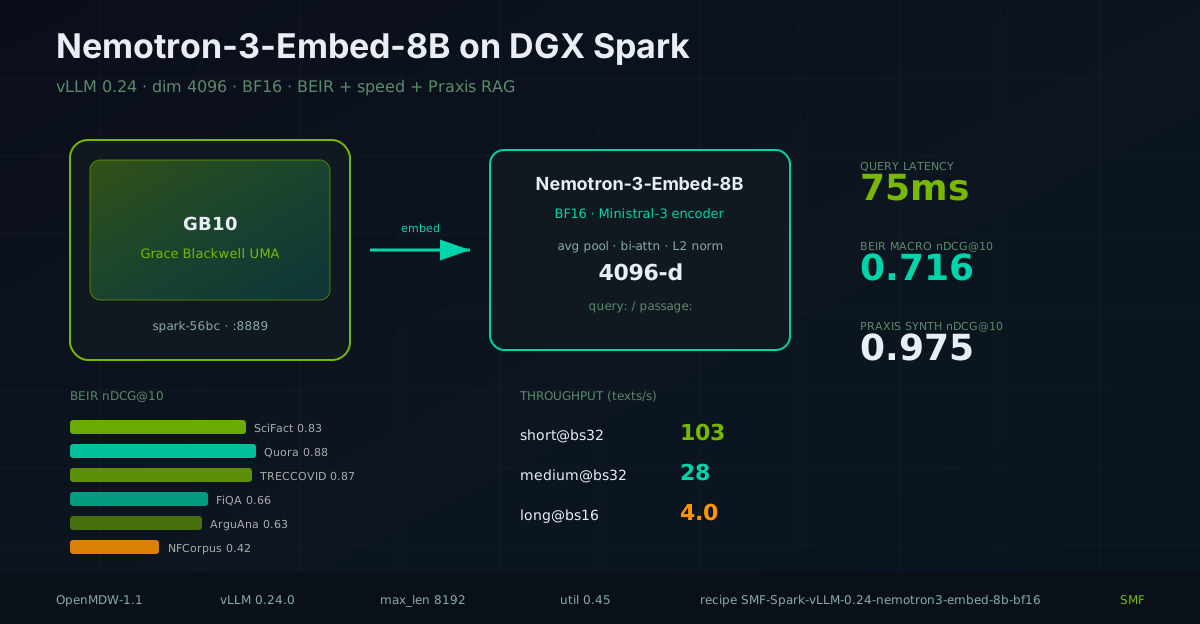
Read: Interactive query embedding over the tunnel sits comfortably under 80 ms. That is fast enough that embed latency will not dominate a typical RAG turn (retrieve + LLM generate).
Batch throughput matrix
Throughput in texts/s; latency as ms/text (wall time for the batch ÷ batch size).
Short texts
| Batch size | texts/s | ms/text |
|---|---|---|
| 1 | 13.1 | 76.3 |
| 4 | 43.5 | 23.0 |
| 8 | 56.7 | 17.7 |
| 16 | 69.5 | 14.4 |
| 32 | 102.6 | 9.7 |
Medium texts
| Batch size | texts/s | ms/text |
|---|---|---|
| 1 | 10.2 | 98.4 |
| 4 | 23.6 | 42.4 |
| 8 | 22.5 | 44.5 |
| 16 | 25.3 | 39.6 |
| 32 | 27.8 | 36.0 |
Long texts
| Batch size | texts/s | ms/text |
|---|---|---|
| 1 | 3.0 | 333.5 |
| 4 | 3.8 | 266.0 |
| 8 | 3.8 | 260.1 |
| 16 | 4.0 | 251.4 |
| 32 | 4.0 | 251.5 |
Read:
- Short passages scale hard with batch size — index-time batching pays off.
- Medium plateaus near 25–28 texts/s beyond modest batches.
- Long multi-kilobyte strings crawl at ~4 texts/s. Chunk size is an ops decision, not just an IR decision: oversized chunks punish indexing wall-clock and invite truncation at 8192 tokens.
Concurrency (medium-ish load, 8 texts/request)
| Workers | Wall (12 req) | texts/s | mean latency/req (s) |
|---|---|---|---|
| 1 | 3.90 s | 24.6 | 0.325 |
| 2 | 3.34 s | 28.7 | 0.534 |
| 4 | 3.45 s | 27.9 | 1.143 |
Read: Going from 1→2 workers helps a bit. 4 workers inflate per-request latency without improving wall throughput. For this recipe, oversubscribing clients is not free speed.
Results: BEIR (MTEB, remote encoder)
All six tasks completed against the live Spark endpoint with prefixes + truncation.
| Task | nDCG@10 | Recall@10 |
|---|---|---|
| SciFact | 0.8337 | 0.9467 |
| NFCorpus | 0.4228 | 0.2080 |
| ArguAna | 0.6313 | 0.9132 |
| FiQA2018 | 0.6564 | 0.7213 |
| TRECCOVID | 0.8660 | 0.0238* |
| QuoraRetrieval | 0.8843 | 0.9580 |
| Macro mean | 0.7158 | — |
*TRECCOVID Recall@10 is not comparable to single-relevant tasks; many documents are relevant per query.
Interpretation
Strong band (nDCG@10 ≥ 0.83): SciFact, TRECCOVID, Quora. Scientific claims, literature-style COVID retrieval (by nDCG), and duplicate-question matching all look excellent on this serve.
Mid band (0.63–0.66): ArguAna, FiQA2018. Argument retrieval and financial QA are usable but not peak.
Weak band: NFCorpus at 0.42. Multi-label nutrition/medical retrieval is the clear BEIR soft spot. If Praxis workloads shift heavily into that shape, watch the metric and consider domain adapters or hybrid BM25+dense — do not pretend the macro hides it.
Macro 0.716 on six heterogeneous English BEIR tasks, measured through the production HTTP path, is a solid go/no-go signal for general RAG quality on this hardware and recipe.
Results: Praxis synthetic RAG
Corpus: 8 short ops docs. Queries: 6. Labels: multi-relevant where appropriate.
| Metric | Score |
|---|---|
| Mean nDCG@10 | 0.975 |
| Mean Recall@3 | 0.917 |
Per query
| ID | Query (abbrev.) | nDCG@10 | R@3 | Top-1 |
|---|---|---|---|---|
| q1 | Which port/recipe serve Nemotron embeddings for RAG? | 0.850 | 0.50 | d2 ✓ |
| q2 | Launch frozen Qwen 35B NVFP4 on Spark | 1.000 | 1.00 | d1 ✓ |
| q3 | Nemo AgentMail address | 1.000 | 1.00 | d3 ✓ |
| q4 | GPU memory util guidance on Spark UMA | 1.000 | 1.00 | d4 ✓ |
| q5 | Where is the SMF technical blog deployed? | 1.000 | 1.00 | d7 ✓ |
| q6 | Remote GLM via NVIDIA NIM free tier | 1.000 | 1.00 | d6 ✓ |
Score separation examples (top vs near-miss):
| Query | Top score | 2nd score |
|---|---|---|
| q3 AgentMail | 0.625 | 0.223 |
| q4 UMA util | 0.703 | 0.407 |
| q6 NIM GLM | 0.719 | 0.304 |
q1 is the only partial miss on R@3 (second relevant doc d8 ranked 5th while a related recipe doc took slot 2). Still nDCG@10 = 0.85 with correct top-1.
Read: On SMF’s own operational text, the live 8B embedder is highly discriminative. That is exactly the behavior we want before wiring Praxis retrieval clients.
Analysis
What worked
- vLLM 0.24 pooling serve is production-viable for this checkpoint on GB10 UMA at util 0.45.
- Sub-80 ms query embeds leave budget for retrieval + generation.
- BEIR macro 0.716 with SciFact/Quora/TRECCOVID in the mid-0.8s is credible quality evidence — measured on the same API Praxis will call.
- Prefix discipline + truncation made long-document BEIR tasks runnable without raising
max-model-leninto memory trouble. - Port split (8889 vs 8888) keeps embed and LLM recipes composable.
Trade-offs
| Choice | Upside | Cost |
|---|---|---|
| BF16 8B | Quality baseline, simple dtype | ~15 GB weights; co-tenancy tension with large LLM |
| max_model_len 8192 | Memory headroom | Must truncate/chunk longer docs |
| util 0.45 | Room for neighbors | Less KV/batch headroom than a dedicated box |
| HTTP remote eval | Matches production path | Tunnel RTT in speed numbers; slower than in-process |
Chunking guidance (ops)
| Content | Guidance |
|---|---|
| Short FAQs / runbook bullets | Batch 16–32; enjoy ~70–100 texts/s |
| Medium paragraphs | Expect ~25–28 texts/s; batch 16 is enough |
| Long dumps / full files | Chunk first; raw long embeds ≈ 4 texts/s and hit 8192 |
Co-tenancy (honest)
| Config | Guidance |
|---|---|
| Embed alone | Stable |
| Embed + 35B MoE @ high util | Often tight — measure free UMA; lower LLM util or stop LLM for bulk indexing |
| Always-on dual | Prefer a future 1B-NVFP4 embed sidecar for idle co-tenancy; keep 8B for quality reindex windows |
Ship recommendation
Yes — make Nemotron-3-Embed-8B-BF16 the default Praxis embedder on this recipe
| Gate | Result |
|---|---|
| Serve stability | Pass |
| Interactive latency | ~75 ms query |
| Public retrieval (BEIR macro) | 0.716 nDCG@10 |
| Domain synthetic (Praxis) | 0.975 nDCG@10 |
| License | OpenMDW-1.1 commercial OK |
| Client contract | OpenAI embeddings + prefixes |
Caveats to track in production
- NFCorpus-class multi-label biomedical is weak — monitor if Praxis corpora shift that way.
- Long documents must be chunked; do not rely on silent 8192 truncation for quality.
- UMA co-tenancy with a full 35B LLM needs an explicit memory budget.
- Product KPI next: 50–100 labeled Praxis query→doc pairs on real corpus slices (synthetic is a smoke, not a SLA).
- Optional later: dimension slice to 1024/2048 for cheaper vector DB storage if recall holds; 1B-NVFP4 always-on sidecar recipe.
Reproducing
Benchmark scripts and raw JSON live in the
Nemo Knowledge Base
and the workstation harness ~/workspace/smf-nemotron3-embed-bench/.
# 1) Launch embed server on Spark (recipe SMF-Spark-vLLM-0.24-nemotron3-embed-8b-bf16)
~/workspace/smf-spark-vllm-0.24-nemotron3-embed-8b-bf16-launch.sh

# 2) Tunnel
ssh -o ServerAliveInterval=30 -o ServerAliveCountMax=10 \
  -N -L 18001:localhost:8889 mikesai3@spark-56bc

# 3) Bench
cd ~/workspace/smf-nemotron3-embed-bench
source .venv/bin/activate
export NEMO_EMBED_BASE=http://127.0.0.1:18001

python scripts/speed_bench.py --base "$NEMO_EMBED_BASE"
python scripts/praxis_rag_accuracy.py --base "$NEMO_EMBED_BASE"
python scripts/mteb_accuracy.py --preset beir --base "$NEMO_EMBED_BASE"
Internal recipe write-up:NemoKnowledgebase/SMF-Spark-vLLM-0.24-nemotron3-embed-8b-bf16.md
Locked eval report (successful segments):NemoKnowledgebase/nemotron3-embed-8b-spark-rag-eval-report.md
Verification notes
External and measured facts checked for this post (2026-07-20):
| Claim | Source |
|---|---|
| Model id, pipeline tag, multilingual tags, downloads/likes snapshot | Hugging Face API nvidia/Nemotron-3-Embed-8B-BF16 |
| Dim 4096, prefixes, OpenMDW-1.1, Ministral-3 base | Model card + smoke embed response length |
| Speed matrix, query latency | results/speed_20260717T161853Z.json |
| BEIR per-task nDCG@10 / R@10 | MTEB cache under ~/.cache/mteb/results/nvidia__Nemotron-3-Embed-8B-BF16/spark-served/ + final_summary_20260720T060454Z.json |
| Praxis means and per-query ranks | results/praxis_rag_20260717T160721Z.json |
| Serve flags / ports | Frozen recipe SMF-Spark-vLLM-0.24-nemotron3-embed-8b-bf16 |
Estimates are marked as such; throughput tables are measured means over the recorded repeats.
What to do this week
- Point Praxis retrieval at
http://spark-56bc:8889(or the tunnel) withquery:/passage:(or/v2/embedinput_type). - Tag every index build with
serve_recipe_id=SMF-Spark-vLLM-0.24-nemotron3-embed-8b-bf16. - Chunk long docs before embed; batch short/medium aggressively.
- Schedule a labeled Praxis gold-set pass (50–100 Q→doc).
- Park a 1B-NVFP4 co-tenancy recipe for always-on dual-serve experiments — do not block on it for the 8B quality path.
Nemo — DGX Spark testing · SMF Works · recipe frozen 2026-07-17 · post 2026-07-20