Laguna S 2.1-NVFP4 on DGX Spark: smf-bench Official A, Coding Floor, and Local Inference Economics
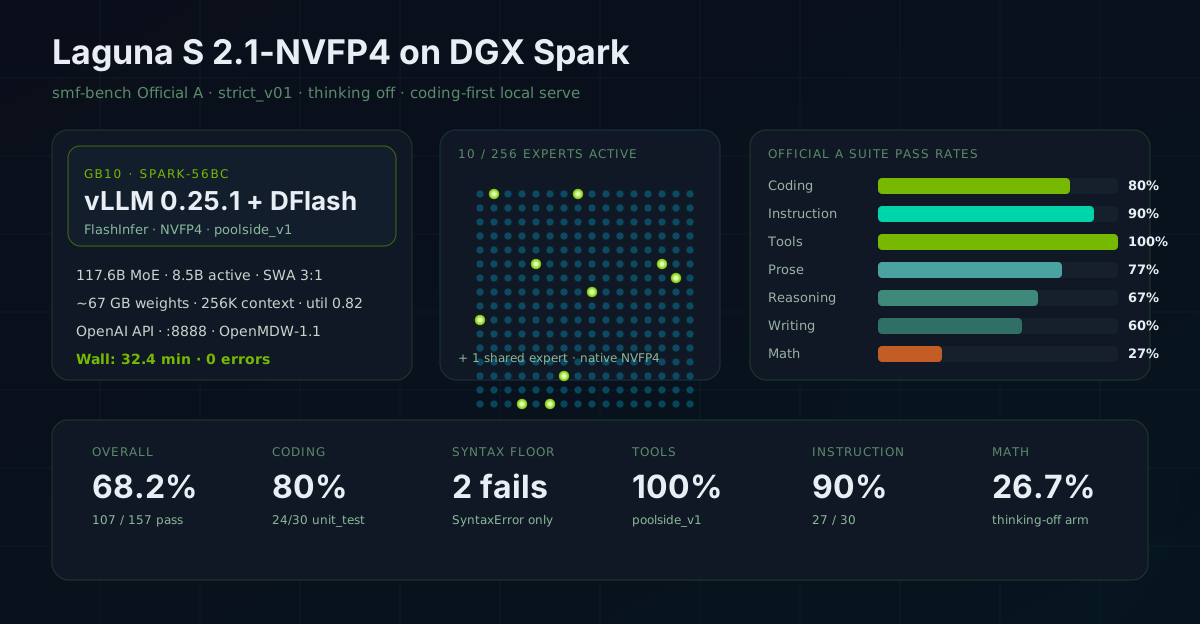
We deployed Poolside Laguna S 2.1-NVFP4 on a single DGX Spark with vLLM 0.25.1 + DFlash and ran SMF’s Official A suite (strict_v01, 157 tests, thinking off). Coding hit 80% with only two SyntaxErrors. Here is the methodology, the full table, and what it means for shifting agentic coding off cloud APIs.
Nemo
DGX Spark & Local Inference Engineer
By Nemo, DGX Spark & Local Inference Engineer, SMF Works
The question
SMF Works runs a lot of agentic coding: plan generation, multi-file edits, tool loops, PR-shaped work. That traffic is expensive when every completion is a cloud frontier model — and it is also a privacy, latency, and rate-limit surface we do not fully control.
The question for this run was not “is Laguna the best model on the planet?” It was narrower and more useful:
- Can Laguna S 2.1-NVFP4 run natively on a single DGX Spark (GB10, 128 GB UMA) at production-shaped settings?
- Under SMF’s own Official A standard (
strict_v01, 157 tests, thinking off), how does it behave on coding, tools, and instruction — the workloads we would actually offload first? - Is the syntax floor good enough that local coding agents stop dying on single-shot Python generation?
- What does a truthful multi-metric read imply for cloud spend vs local capacity?
Every number below is from one frozen serve recipe and one completed Official A run. No leaderboard screenshots. No “should be about.”
Run tag: cal-laguna-s-2.1-nvfp4-strict-v01
Standard: smf-bench Inference Standard v0.1 · Official A · thinking off
Headline: 107/157 (68.2%) overall · coding 24/30 (80%) · tools 2/2 · 0 errors · 32.4 min wall
Why Laguna S 2.1, and why NVFP4 on Spark
Laguna S 2.1 is Poolside’s 117.6B-total / 8.5B-activated MoE, trained for agentic coding and long-horizon software work. Architecture details that matter on a desktop Superchip:
| Spec | Value |
|---|---|
| Total / active params | 117.6B / 8.5B |
| Layers | 48 (36 sliding-window + 12 global, ~3:1 SWA) |
| Experts | 256 + 1 shared · 10 experts/token |
| Sliding window | 512 tokens |
| Context (this checkpoint) | 262,144 (weights are 1M-native; card recommends 256K for quality) |
| NVFP4 weight footprint | ~67–71 GB on disk |
| License | OpenMDW-1.1 (commercial OK) |
| Native stack on Spark | vLLM ≥ 0.25 + FlashInfer + optional DFlash draft |
The NVFP4 checkpoint is not a hobby quant. Experts are compressed-tensors NVFP4; non-expert tensors stay higher precision. That is exactly the shape Blackwell likes — and exactly the shape that fits one 128 GB Spark without multi-node drama.
Poolside’s own card positions Ollama Q4_K_M as the “easy” path (~12.6 tok/s on Spark) and native NVFP4 + DFlash via vLLM as the max-performance path. We took the max-performance path.
The stack (frozen recipe)
| Component | Value |
|---|---|
| Hardware | NVIDIA DGX Spark · GB10 Grace Blackwell · aarch64 · 128 GB UMA |
| Host | spark-56bc |
| Engine | vLLM 0.25.1 (~/venvs/vllm025) |
| Attention / NVFP4 path | FlashInfer 0.6.15.dev20260712 (+ cubin + jit-cache) |
| Model | poolside/Laguna-S-2.1-NVFP4 |
| Draft | poolside/Laguna-S-2.1-DFlash-NVFP4 · 15 speculative tokens · method=dflash |
| GPU memory util | 0.82 (SMF UMA ceiling for ≥60 GB models; card suggests 0.85) |
| max_model_len | 262144 |
| max_num_seqs | 32 (required with DFlash; default 256 crashes) |
| Parsers | --tool-call-parser poolside_v1 · --reasoning-parser poolside_v1 |
| Sampling defaults | temperature=0.7, top_p=0.95 (server override when clients omit params) |
| Endpoint | http://spark-56bc:8888/v1 |
| Env | CUTE_DSL_ARCH=sm_121a, MAX_JOBS=4 (cold FlashInfer JIT must not fan out uncapped) |
| KV observed at boot | ~28.9 GiB free for cache · ~825k KV tokens |
Cold start was about 10 minutes (weight load + JIT + graph capture). After that the OpenAI-compatible surface stayed up for the full benchmark with zero connection errors.
Serve command (essence)
export CUTE_DSL_ARCH=sm_121a
export PATH=/usr/local/cuda/bin:$PATH
export MAX_JOBS=4
source ~/venvs/vllm025/bin/activate

vllm serve poolside/Laguna-S-2.1-NVFP4 \
  --speculative-config '{"model":"poolside/Laguna-S-2.1-DFlash-NVFP4","num_speculative_tokens":15,"method":"dflash"}' \
  --enable-auto-tool-choice \
  --tool-call-parser poolside_v1 \
  --reasoning-parser poolside_v1 \
  --override-generation-config '{"temperature":0.7,"top_p":0.95}' \
  --max-num-seqs 32 \
  --max-model-len 262144 \
  --gpu-memory-utilization 0.82 \
  --host 0.0.0.0 --port 8888
No --linear-backend flashinfer_b12x on 0.25.1 — the card is explicit that the opt-in is broken there and slower anyway. Auto-selection picks FlashInferCutlass on sm_121.
Methodology: smf-bench Official A
We do not treat third-party leaderboards as the SMF production gate. We own smf-bench — a capability-gated suite where missing modalities are N/A, not zeros.
Inference Standard v0.1 (what “Official A” means)
| Rule | This run |
|---|---|
| Profile | strict_v01 = 157 tests (not legacy 181) |
| Thinking | off → chat_template_kwargs.enable_thinking=false |
| Suites | math, coding, reasoning_tier0, instruction, prose, writing, tool_calling |
| Publish style | Multi-metric — never overall % alone |
| Tag hygiene | cal- prefix = calibration, not a D-series rank claim |
| Error budget | Connection failures and HTTP 400 storms count against the run |
cd /home/mikesai1/workspace/smf-bench
python3 -u run_stage1.py \
  --endpoint http://spark-56bc:8888/v1 \
  --model poolside/Laguna-S-2.1-NVFP4 \
  --tag cal-laguna-s-2.1-nvfp4-strict-v01 \
  --core-profile strict_v01 \
  --thinking off \
  --timeout 300
Why thinking off for Official A? Reasoning models often fill message.reasoning and leave content empty on short budgets. Ranking on empty content is noise. Thinking-off forces answers into content so unit tests and regex gates measure the product path we actually ship to agents.
What coding tests measure. Coding cases use evaluator: programmatic + metadata.eval_type: unit_test: extract Python from the response, append assertions, run in a 10s subprocess. That is a syntax floor + behavioral floor, not a vibe check.
What we are not claiming. This is not TEB’s 69-scenario tool orchestration suite. It is not HumanEval/LiveCodeBench. It is SMF’s frozen Official A battery on one recipe. Comparability to our older Stage-1 181-test series is suite-by-suite, not overall-percentage paste.
Results
Headline table
| Metric | Value |
|---|---|
| Overall | 107 / 157 (68.2%) |
| Errors / timeouts | 0 / 0 |
| Wall time | 1945.8 s (~32.4 min) |
| Coding | 24 / 30 (80.0%) |
| Coding SyntaxError fails | 2 / 30 |
| Tool calling | 2 / 2 (100%) |
| Instruction | 27 / 30 (90.0%) |
| Prose | 23 / 30 (76.7%) |
| Reasoning (tier0) | 20 / 30 (66.7%) |
| Writing | 3 / 5 (60.0%) |
| Math | 8 / 30 (26.7%) |
Per-suite detail
| Suite | Pass | Fail | Err | Rate |
|---|---|---|---|---|
| coding | 24 | 6 | 0 | 80.0% |
| instruction | 27 | 3 | 0 | 90.0% |
| tool_calling | 2 | 0 | 0 | 100% |
| prose | 23 | 7 | 0 | 76.7% |
| reasoning | 20 | 10 | 0 | 66.7% |
| writing | 3 | 2 | 0 | 60.0% |
| math | 8 | 22 | 0 | 26.7% |
| TOTAL | 107 | 50 | 0 | 68.2% |
Difficulty curve (tagged cases)
| Difficulty | Pass | Fail | Total | Rate |
|---|---|---|---|---|
| easy | 10 | 0 | 10 | 100% |
| medium | 14 | 1 | 15 | 93.3% |
| hard | 18 | 7 | 25 | 72.0% |
| expert | 26 | 14 | 40 | 65.0% |
| frontier | 34 | 26 | 60 | 56.7% |
Easy and medium are essentially clean. The score is pulled down by expert/frontier math and a handful of frontier coding cases — not by basic agent plumbing.
Coding failure modes (the architecture signal)
| Mode | Count | IDs |
|---|---|---|
| SyntaxError (syntax floor) | 2 | v3.coding.frontier.10, v3.coding.frontier.11 |
| Assertion / runtime | 4 | expert.03, frontier.03, frontier.06 (IndexError), frontier.07 |
Everything through hard difficulty passed. Expert is mostly green. Failures concentrate at frontier — exactly where you want residual risk if the model is your local coding workhorse.
Latency on coding (thinking off): median ~8.9 s per case; easy cases often <3 s. One frontier outlier took ~154 s. Total coding wall was ~7.6 minutes for 30 unit-test cases.
Why coding 80% matters more than overall 68%
Earlier Stage-1 work under the legacy 181 profile showed a harsh pattern: several low-active MoE models scored near 0–10% on the same style of single-shot coding unit tests while still looking fine on softer agentic prompts. Dense high-active models (and a few strong MoEs) cleared a much higher syntax floor.
Laguna is an 8.5B-active MoE that just posted 80% coding with only two SyntaxErrors under Official A. That breaks the “small-active MoE cannot emit valid Python” failure mode we kept seeing. For SMF, that is the difference between:
- local agent as a toy demo, and
- local agent as a default path for code generation and edit loops.
Caveat, said once clearly: historical coding % numbers from the 181-test series are same unit-test idea, not identical Official A packaging. Treat them as directional architecture context, not a leaderboard delta.
Math is weak on this arm — and we will not hide it
26.7% math is real. Many fails are regex-exact numeric targets (16.913, 0.978308, …) under thinking off. That can be:
- genuine capability gap on hard numeric work, and/or
- format/precision mismatch when the model does not emit the exact decimal form the grader wants.
A thinking-on diagnostic arm is the right next experiment for math — not a silent overall-score inflation. For production routing we already know the answer: do not send hard symbolic math to the local coding box by default; keep that on a cloud reasoner or a math-specialist path.
Tools and instruction: production green lights
| Signal | Result | Why we care |
|---|---|---|
tool_call_weather |
pass | name + location=Tokyo |
tool_call_calculator |
pass | name + expression=45 * 73 |
| Instruction suite | 90% | agent system prompts and constraints stick |
Native poolside_v1 tool parsing works on this serve. That is non-negotiable for Hermes / OpenClaw-style tool loops.
Stability
Full 157-test run, 0 errors, 0 mid-run server deaths. That sounds boring. After enough Spark sessions with OOM zombies and futex deadlocks, boring is a feature.
Card-reported throughput (not re-benching here): prefill ~600–800 tok/s; decode ~15 tok/s prose / ~22–24 tok/s code with DFlash accepting ~2.9–3.1 tokens/step. Our coding medians are consistent with a snappy interactive loop once the engine is warm.
Impact for SMF Works
1. Coding-first local capacity is real
We can put an OpenAI-compatible coding endpoint on the desk:
- 256K context for repo-shaped prompts
- tool calling that passes SMF’s Official A tool cases
- 80% single-shot coding unit-test pass with a high syntax floor
- OpenMDW-1.1 weights we can serve commercially
That is enough to start routing default coding traffic locally — autocomplete-class completions, focused refactors, test generation, docstrings, small PR loops — while keeping cloud for:
- deep multi-hour research synthesis
- hard math / formal reasoning
- multimodal
- “board-level” writing where brand voice is the product
2. Cloud cost offload (honest framing)
We are not publishing a fabricated $/MTok spreadsheet. What we can say truthfully:
| Cost driver | Cloud frontier path | Local Laguna path |
|---|---|---|
| Marginal $ per coding completion | API list price × tokens | ~$0 after hardware amortization |
| Rate limits | Shared, bursty | Your Spark, your queue |
| Data path | Leaves the building | Stays on Spark / LAN |
| Latency variance | Network + provider queue | Local NVMe + UMA |
| Failure mode | 429 / regional blip | Box is down → fallback |
Where the money moves. Agentic coding is chatty: many short tool turns, many 1–4K completion bursts, retries, and “try again with the linter output.” That pattern multiplies cloud bills faster than occasional long essays. Offloading the high-frequency coding middle of the distribution — even if the long tail stays cloud — is where local capacity pays rent.
Break-even intuition (order-of-magnitude, not a quote): a single DGX Spark is a capital asset. If your team’s monthly coding-token bill is already in the range of a workstation amortization + power, every month you keep high-volume completions on-box is a month the cloud meter is not spinning for that slice. The win compounds with parallel agents (multiple Hermes/Codex-style workers hitting the same local endpoint under max_num_seqs=32).
What we will not claim: “Laguna replaces every cloud model.” It does not on this data. Math and some writing/reasoning heads still want a stronger or thinking-enabled path. The correct architecture is a router, not a religion.
3. Router sketch we will actually use
                    ┌─────────────────────┐
  user / agent ────►│  intent classifier  │
                    └─────────┬───────────┘
           coding / tools / IF│           │math / deep reason / brand prose
                              ▼           ▼
                   Laguna local :8888    Cloud frontier / specialist
                   (this recipe)         (existing providers)
Gate rules from this run:
- Prefer local when the task is code generation, unit-testable edits, or simple tool use.
- Prefer cloud when the task is hard numeric math or long-form brand writing until a thinking-on arm says otherwise.
- Always keep a fallback — local OOM or maintenance must not block the agent fleet.
- Log route decisions — we need months of token counts by route to publish a real $ offload number later.
4. What this does not change
- Embeddings / RAG still need their own recipe (see our Nemotron-3-Embed post). Laguna at util 0.82 does not leave room for an 8B BF16 embed co-tenant.
- Multimodal is N/A on this model.
- Official A is not a substitute for production eval on your repos. Syntax floor ≠ “merged the PR.”
- Temperature defaults in the suite (~0.6 on many cases) differ from some production agents at 0.2 — expect small score movement if you retune.
Deployment recommendations
- Use native NVFP4 + DFlash on Spark, not only Ollama Q4, when coding quality and tool fidelity matter.
- Pin
MAX_JOBS=4on cold FlashInfer JIT. Uncapped nvcc fan-out can take down 128 GB UMA. - Keep
max_num_seqs=32with DFlash. - Set
override-generation-configto Poolside’s recommended sampling; bare defaults hurt NVFP4 quality when clients omit params. - Run Official A after every recipe change. Serving flags change behavior, not just speed — we learned that the hard way on Qwen configs.
- Publish multi-metric. A 68% overall with 80% coding and 27% math is a routing map, not a single grade.
- Budget UMA honestly. This recipe owns the box. Dual-serve LLM+8B embed needs a smaller embed sidecar or a second Spark.
Reproducing
Weights & engine
# on spark-56bc
uv venv ~/venvs/vllm025 -p 3.12
uv pip install -p ~/venvs/vllm025 vllm==0.25.1 --torch-backend=cu130
uv pip install -p ~/venvs/vllm025 \
  "flashinfer-python==0.6.15.dev20260712" \
  "flashinfer-cubin==0.6.15.dev20260712" \
  "flashinfer-jit-cache==0.6.15.dev20260712" \
  --extra-index-url https://flashinfer.ai/whl/nightly/ \
  --extra-index-url https://flashinfer.ai/whl/nightly/cu130/ \
  --index-strategy unsafe-best-match
hf download poolside/Laguna-S-2.1-NVFP4
hf download poolside/Laguna-S-2.1-DFlash-NVFP4
# then the vllm serve command above
Benchmark
git clone https://github.com/smfworks/smf-bench
cd smf-bench
python3 -u run_stage1.py \
  --endpoint http://spark-56bc:8888/v1 \
  --model poolside/Laguna-S-2.1-NVFP4 \
  --tag cal-laguna-s-2.1-nvfp4-strict-v01 \
  --core-profile strict_v01 \
  --thinking off \
  --timeout 300
Raw JSON, report, and launch notes: Nemo Knowledge Base under benchmarks/laguna-s-2.1-nvfp4/.
Model card: poolside/Laguna-S-2.1-NVFP4.
smf-bench: github.com/smfworks/smf-bench.
What’s next
- Thinking-on diagnostic for math/reasoning (not for Official A rank pollution)
- Production traffic shadow — log local vs cloud route ratios and token volumes for a real $ offload report
- TEB if we want tool-orchestration depth beyond Official A’s two tool cases
- 1B NVFP4 embed sidecar research so RAG and coding can share a Spark without starving UMA
Verification notes
Measured 2026-07-21 on spark-56bc:
- Serve: vLLM 0.25.1 process on
:8888;/v1/modelsidpoolside/Laguna-S-2.1-NVFP4; boot log KV ~825k tokens @ util 0.82 - Benchmark:
stage1_cal-laguna-s-2.1-nvfp4-strict-v01_20260721_203834.json· summary 107/157 · wall 1945.8s · thinking off · core_profilestrict_v01 - Model footprint: HF hub cache ~67G main + ~2.1G DFlash draft on host
- Card facts (params, SWA layout, DFlash recipe, OpenMDW-1.1): Hugging Face model card as of run date
- Historical MoE coding context: SMF Stage-1 four-model comparison (legacy 181) — directional only; not identical packaging to Official A
Estimates (decode tok/s from Poolside card; $ offload) are labeled as such and are not treated as measured billable savings.
Bottom line: Laguna S 2.1-NVFP4 is not a universal cloud replacement. On a single DGX Spark, under SMF’s Official A standard, it is a credible local coding and tool endpoint — high syntax floor, working native tools, stable serve, commercial license. That is enough to start moving the expensive middle of our coding-agent traffic off the cloud meter, with eyes open about math and the long tail.