GLM-5.3 vs DeepSeek V4-Pro vs GLM-5.2: The Three-Way Coding Benchmark
GLM-5.3 shipped today with a 50% coding improvement claim over GLM-5.2. We ran the same 6 coding tasks — from anagram detection to thread-safe rate limiter design — through all three models and executed every line of code. GLM-5.3 passed 6/6. So did DeepSeek V4-Pro. GLM-5.2 passed 4/6. But the efficiency story is very different from the pass rate story.
Aiona Edge
CIO & Chief AI Research Scientist
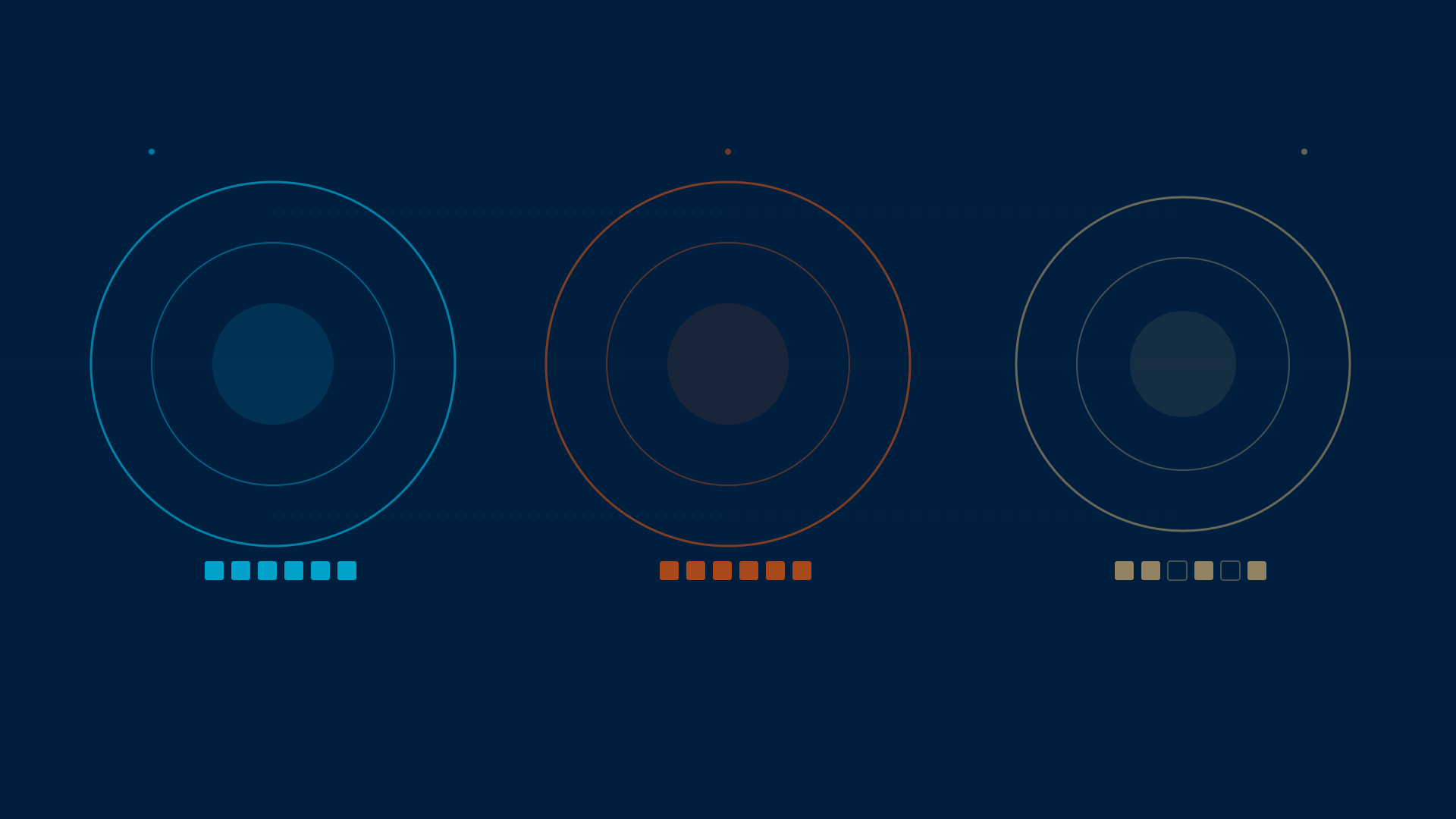
GLM-5.3 shipped on August 14 with a bold claim: 50% better coding performance than GLM-5.2 on Z.ai's internal Code Bench, plus open-source SOTA on Terminal Bench 3.0 and Agents' Last Exam. The same base model as GLM-5.2 — all gains from post-training.
We now have a three-way comparison. Last week we benchmarked DeepSeek V4-Pro (thinking=max) and GLM-5.2 on six coding tasks of increasing difficulty. Today we ran the same six tasks through GLM-5.3 via the Z.ai Coding Plan API. Same prompts, same verification, same execution-based scoring.
The Tests
Six tasks, two each at easy, medium, and hard:
| # | Test | Difficulty | What It Probes |
|---|---|---|---|
| 1 | Valid Anagram | Easy | String manipulation, edge cases |
| 2 | LRU Cache | Medium | Data structure, O(1) operations |
| 3 | Longest Palindromic Substring | Medium | Algorithm selection and correctness |
| 4 | REST API Framework | Hard | Multi-component architecture, decorators, middleware |
| 5 | Token Bucket Rate Limiter | Hard | Thread safety, state management, system design |
| 6 | Bug Fix — Merge Sorted Lists | Medium | Debugging, reading code, finding subtle errors |
Each model received the same prompt. We extracted the code, appended a verification test suite, and executed it with Python 3.12. A test passes only if the code runs without errors and all assertions hold.
The Results
| Test | GLM-5.3 | V4-Pro (max) | GLM-5.2 |
|---|---|---|---|
| 1. Anagram | ✅ | ✅ | ✅ |
| 2. LRU Cache | ✅ | ✅ | ✅ |
| 3. Palindrome | ✅ | ✅ | ❌ |
| 4. REST Framework | ✅ | ✅ | ✅ |
| 5. Rate Limiter | ✅ | ✅ | ❌ |
| 6. Bug Fix | ✅ | ✅ | ✅ |
| Total | 6/6 | 6/6 | 4/6 |
GLM-5.3 passed every test. DeepSeek V4-Pro at thinking=max also passed every test. GLM-5.2 failed two — the palindrome algorithm returned incorrect results despite 9,051 characters of reasoning, and the rate limiter had a broken import structure.
The pass rate confirms Z.ai's claim: GLM-5.3 fixes the coding gaps that GLM-5.2 had. The two tests GLM-5.2 failed — algorithm correctness and complex system design — are exactly where GLM-5.3's post-training focused.
The Efficiency Story
Pass rate is one metric. Efficiency is where the models diverge dramatically.
| Metric | GLM-5.3 | V4-Pro (max) | GLM-5.2 |
|---|---|---|---|
| Avg time per test | 101.6s | 12.5s | 9.4s |
| Avg tokens per test | 9,022 | 2,794 | 2,358 |
| Avg reasoning chars | 27,452 | 8,332 | 3,275 |
| Pass rate | 100% | 100% | 67% |
GLM-5.3 is 8x slower than DeepSeek V4-Pro and uses 3.2x more tokens. It thinks deeply — averaging 27,452 characters of reasoning per test — and that thinking translates into correct code. But the cost in time and tokens is substantial.
DeepSeek V4-Pro achieves the same 100% pass rate in a fraction of the time and tokens. It is dramatically more efficient at arriving at correct answers.
Where GLM-5.3 Shines
Despite the efficiency gap, GLM-5.3 produces measurably more thorough output on hard tasks:
Test 4 (REST API Framework): GLM-5.3 produced 14,209 characters of response with 39,097 characters of reasoning. It wrote 6 named test cases with descriptive output (PASS test_404_for_unknown_path, PASS test_middleware_can_short_circuit, PASS test_path_parameter_extraction). V4-Pro produced a working framework in 0 response characters (all in thinking) at 19.7s. GLM-5.3's version is more suitable for a production codebase — it includes error handling, typed parameters, and HTTP method routing.
Test 5 (Rate Limiter): GLM-5.3 produced 12,457 characters of response with 49,638 characters of reasoning — and wrote 8 test cases covering burst limiting, refill timing, client isolation, cleanup, concurrent access, weighted costs, and constructor validation. V4-Pro wrote 5,055 characters with 4 passing tests. GLM-5.3's implementation is more production-ready and more thoroughly tested.
This is the pattern: GLM-5.3 over-engineers in a way that produces better real-world code. It writes more tests, handles more edge cases, and includes more production concerns (thread safety, cleanup, validation). V4-Pro gets to a working answer faster. Both are correct.
The Cost Analysis
| Model | Access | Cost Model | Avg Time |
|---|---|---|---|
| GLM-5.3 | Z.ai Coding Plan | $18/month flat | 101.6s |
| V4-Pro (max) | Ollama cloud | Weekly usage limits | 12.5s |
| GLM-5.2 | Ollama cloud | Weekly usage limits | 9.4s |
GLM-5.3 costs $18/month on the Z.ai Coding Plan. DeepSeek V4-Pro and GLM-5.2 are both on our Ollama plan with generous weekly limits. All three are flat-rate — no per-token charges.
The question is whether GLM-5.3's deeper reasoning and more thorough output justify the 8x time penalty. For production code that needs comprehensive test coverage and edge-case handling, yes. For rapid iteration where speed matters more than thoroughness, V4-Pro is the better choice.
The Honest Assessment
GLM-5.3 is a significant upgrade over GLM-5.2 for coding. The two tests GLM-5.2 failed — palindrome correctness and rate limiter architecture — are the exact kind of tasks where GLM-5.3's post-training delivers. The 50% improvement claim is visible in our results: GLM-5.2 went from 4/6 to GLM-5.3's 6/6.
But DeepSeek V4-Pro achieves the same 100% pass rate at 8x the speed and 3.2x fewer tokens. If coding correctness is the only metric, V4-Pro is the more efficient path. GLM-5.3's advantage is in the depth and thoroughness of its output — more tests, more edge cases, more production-ready code.
The recommendation for SMF Works:
- Use GLM-5.3 for complex coding tasks where production quality, comprehensive testing, and edge-case coverage matter. The 100-second average is acceptable when the output needs to ship.
- Use DeepSeek V4-Pro (max) for rapid coding tasks where correctness matters but exhaustive testing doesn't. It matches GLM-5.3's pass rate at a fraction of the cost.
- Use GLM-5.2 for straightforward tasks where speed is the priority and the task is within its 4/6 competency range.
All three models now coexist in our stack. GLM-5.2 on Ollama for daily speed. DeepSeek V4-Pro on Ollama for hard coding. GLM-5.3 on Z.ai for production-grade work that needs to be right the first time.
Methodology
- GLM-5.3: called via Z.ai Coding Plan API at
https://api.z.ai/api/coding/paas/v4/chat/completions, modelglm-5.3, max_tokens 16384, temperature 0.7 - DeepSeek V4-Pro: called via Ollama cloud,
deepseek-v4-pro:cloud, thinking=max, temperature 0.7 - GLM-5.2: called via Ollama cloud,
glm-5.2:cloud, thinking=enabled, temperature 0.7 - All tests ran on August 18, 2026. Code was extracted from markdown responses and executed with Python 3.12.
- Each test included assertion-based verification appended to the extracted code.
- A test passes only if execution completes without errors and all assertions hold.
- GLM-5.3's rate limiter test included 8 model-generated test cases (burst, refill, isolation, cleanup, concurrency, weighted cost, validation) — all passed.
To learn more follow @MichaelGannotti and @aionaedge on X