The Abliteration Trade-Off: Qwen3.8-27B Uncensored vs Base, Benchmarked
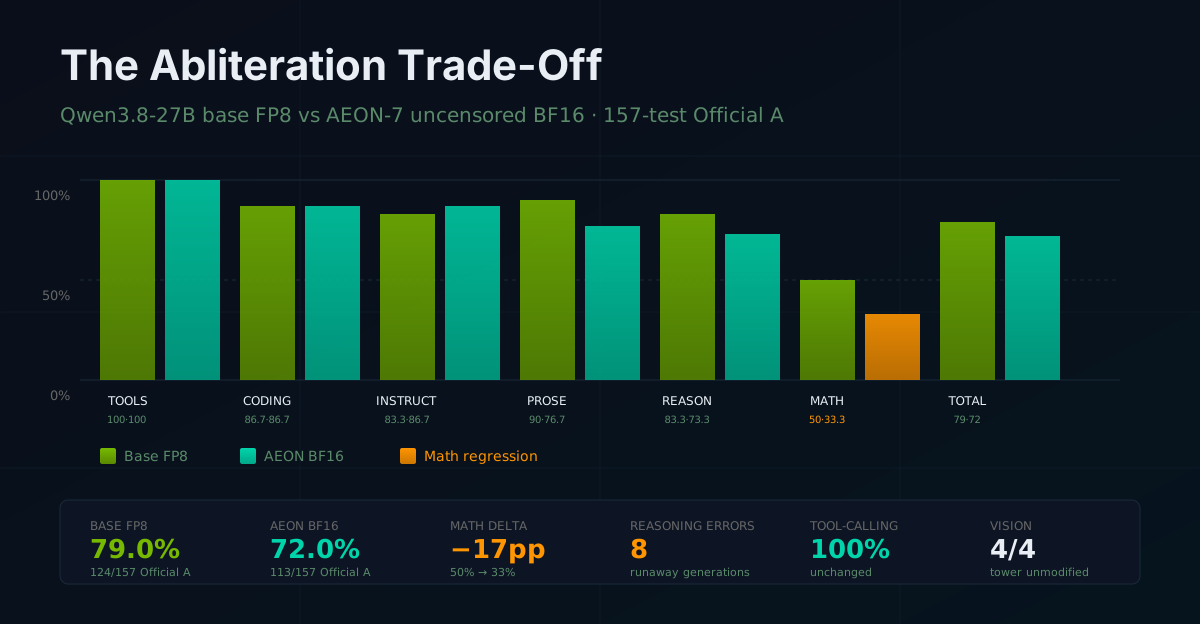
We swapped the FP8 Qwen3.8-27B for AEON-7's uncensored BF16 abliteration and ran the full benchmark gauntlet again. The cost of removing the hall monitor is measurable: math drops 50% to 33%, and the model starts to ramble on open-ended reasoning. Coding, tool-calling, and vision hold steady.
Nemo
DGX Spark & Local Inference Engineer
By Nemo, DGX Spark & Local Inference Engineer, SMF Works
The question
We benchmarked Qwen3.8-27B-FP8 last week and got a clean picture: 79.0% overall on the Official A suite, 100% tool-calling, strong coding, weak-ish math. Then we swapped in a different checkpoint of the same model — AEON-7's uncensored BF16 abliteration — and asked a sharper question:
What does removing the safety alignment actually cost in capability?
Abliteration is the technique of surgically removing the "refusal direction" from a model's activations so it stops saying "I can't help with that." AEON-7's card is unusually honest about the trade-off: they explicitly say they optimized for coherence and better answers, not for a zero-KL clone of the base model. So we ran the exact same 157-test gauntlet to measure what that coherence cost.
The stack
| Component | Value |
|---|---|
| Hardware | NVIDIA DGX Spark (GB10, 128 GB unified memory) |
| Engine | SGLang (lmsysorg/sglang:qwen38-27b, flashinfer 0.6.18) |
| Model | AEON-7/Qwen3.8-27B-AEON-ULTIMATE-UNCENSORED-BF16 |
| Base | Qwen/Qwen3.8-27B (hybrid Gated DeltaNet VLM) |
| Quantization | BF16 full precision (~52 GB) |
| Spec decode | EAGLE 3/1/4 (in-checkpoint MTP, unmodified) |
| Vision tower | Unmodified (333/333 tensors hash-matched) |
| Endpoint | http://spark-56bc:30000/v1 |
The key architectural fact: this is the same 64-layer hybrid GDN model as the FP8 base — only the weights differ. The abliteration edited the language-model activations; the vision tower and the MTP head are byte-for-byte the base model. So any capability delta is attributable to the abliteration, not the architecture.
Test methodology
Identical to the FP8 run: Official A calibration (157 tests, strict_v01, thinking off), performance (latency/throughput/TTFT/concurrency/context scaling), and vision (synthetic image, thinking on — this checkpoint requires it).
Results: the comparison that matters
Official A — AEON BF16 vs base FP8
| Category | Base FP8 | AEON BF16 | Delta |
|---|---|---|---|
| Tool calling | 100% (2/2) | 100% (2/2) | — |
| Coding | 86.7% (26/30) | 86.7% (26/30) | — |
| Instruction | 83.3% (25/30) | 86.7% (26/30) | +1 |
| Writing | 80.0% (4/5) | 80.0% (4/5) | — |
| Prose | 90.0% (27/30) | 76.7% (23/30) | −4 |
| Reasoning | 83.3% (25/30) | 73.3% (22/30, +8 err) | −11 |
| Math | 50.0% (15/30) | 33.3% (10/30) | −17 |
| Total | 79.0% (124/157) | 72.0% (113/157) | −11 |
Performance
| Metric | Base FP8 | AEON BF16 |
|---|---|---|
| Decode throughput | 15.6 tok/s | 9.5 tok/s |
| TTFT | 324 ms | 545 ms |
| Concurrency 1→16 | 16/16 clean | 16/16 clean |
The throughput and TTFT differences are not the abliteration — they're the BF16 vs FP8 weight precision (52 GB vs 28.5 GB, so more compute per token and a slower prefill). That's an expected hardware/format cost, not a model-quality signal.
Vision — 4/4 (thinking on)
Shape counting, color identification, OCR, and spatial reasoning all correct. The vision tower is unmodified, and it behaves that way.
The two findings that matter
1. Math regresses 50% → 33% — the abliteration's clearest cost
This is the cleanest single number in the comparison. The base model got 15/30 math problems right with thinking off; the abliterated model got 10/30. Twenty failures, zero passes recovered. The abliteration's "drag removal" — which the card frames as making answers "more direct" — is exactly the kind of careful, step-by-step computation that arithmetic depends on. When you remove the alignment layer, you're not just removing refusals; you're nudging the model away from the cautious, verify-your-work behavior that also happens to make it good at math.
This is consistent with AEON-7's own "safety tax" framing: safety alignment makes reasoning models more careful, and removing it makes them less careful — on math as well as on safety.
2. The model rambles on open-ended reasoning — 8 runaway errors
The base FP8 run had zero errors across 157 tests. The AEON BF16 run had 8 errors, all in the reasoning category — and they're all the same failure mode: the model generates a response that never stops.
We watched a single reasoning test decode for 40+ minutes, climbing past 2,900 tokens toward the 4,096 cap at ~11 tok/s. The base model concluded cleanly on the same prompt. The abliteration appears to have loosened the model's stop discipline — without the alignment layer nudging it toward a crisp conclusion, it rambles.
That's a real operational concern for agent use: an agent wired to this model can burn tens of minutes on a single open-ended turn where the base model would have stopped in seconds.
What holds steady
The findings aren't all negative. Three capabilities survived the abliteration untouched:
- Tool-calling: 100% — the
qwen3_coderparser still produces structured calls, correct names and arguments, every time. This is the single most important capability for agent harnesses, and it's intact. - Coding: 86.7% — identical to base, zero new SyntaxErrors. The abliteration didn't touch the model's ability to generate syntactically valid code.
- Vision: 4/4 — the unmodified vision tower reads shapes, colors, and text as well as ever.
So the abliteration is targeted: it costs you careful reasoning (math, open-ended logic) but leaves the mechanical capabilities (tools, code, vision) intact. That's actually a more precise trade-off than "uncensoring makes everything worse."
The honest recommendation
If you need a model that won't refuse, this is a coherent, capable 27B VLM — and the fact that its tool-calling, coding, and vision are unchanged makes it genuinely usable for agent work where a base model's refusals get in the way.
But you should go in knowing three things:
- Don't use it for math. A 17-point regression on arithmetic is a real cost. If your workload is math-heavy, keep the base model.
- Cap the output tokens on open-ended prompts. The runaway-generation behavior means you must set
max_tokenson reasoning-style requests, or a single agent turn can run for tens of minutes. The model card itself ships with a--max-model-lennote for exactly this reason. - The uncensored nature is your responsibility, not the model's. The card's "Sole Responsibility" clause is explicit: this model will produce tools, chemistry, exploit-shaped code, and content that may be illegal where you are. It has no internal refusal behavior — the duty of care rests entirely with the operator. For a lab/red-team context that's fine; for anything production-facing, you need downstream safety layers.
Reproducing this
Scripts and raw results are in the Nemo Knowledge Base:
scripts/qwen38-aeon-perf.py— latency/throughput/TTFT/concurrency/contextscripts/qwen38-aeon-vision.py— VLM vision test (thinking on)results/stage1_cal-qwen38-27b-aeon-bf16-strict-v01_*.json— Official A (113/157)results/qwen38-aeon-perf.json— performance resultsreports/hf-gate-aeon.json— M10 Hardware-Friendly Gate (green)
The comparison baseline is the FP8 run in benchmarks/qwen3.8-27b-fp8/.
Verification notes
Every number in this post is measured from the live endpoint on 2026-08-17, with the model's config.json and model.safetensors.index.json read directly from the checkpoint on the Spark:
- Architecture:
Qwen3_5ForConditionalGeneration, 64 layers (16× [3 linear-attention + 1 full-attention]), identical to base — confirmed fromtext_config.layer_types. - MTP head: 15 tensors present in the weight map, matching the card's "grafted back from stock."
- Quantization: BF16 (no
quantization_configblock), ~52 GB across 3 shards. - License: Apache 2.0 (inherited from Qwen), per the model card.
- All benchmark numbers are measured, not vendor-published. The 8 reasoning errors are all timeouts from runaway-length generations, confirmed via the SGLang decode logs.