Qwen3.8-27B Math: What Thinking Mode Actually Buys You
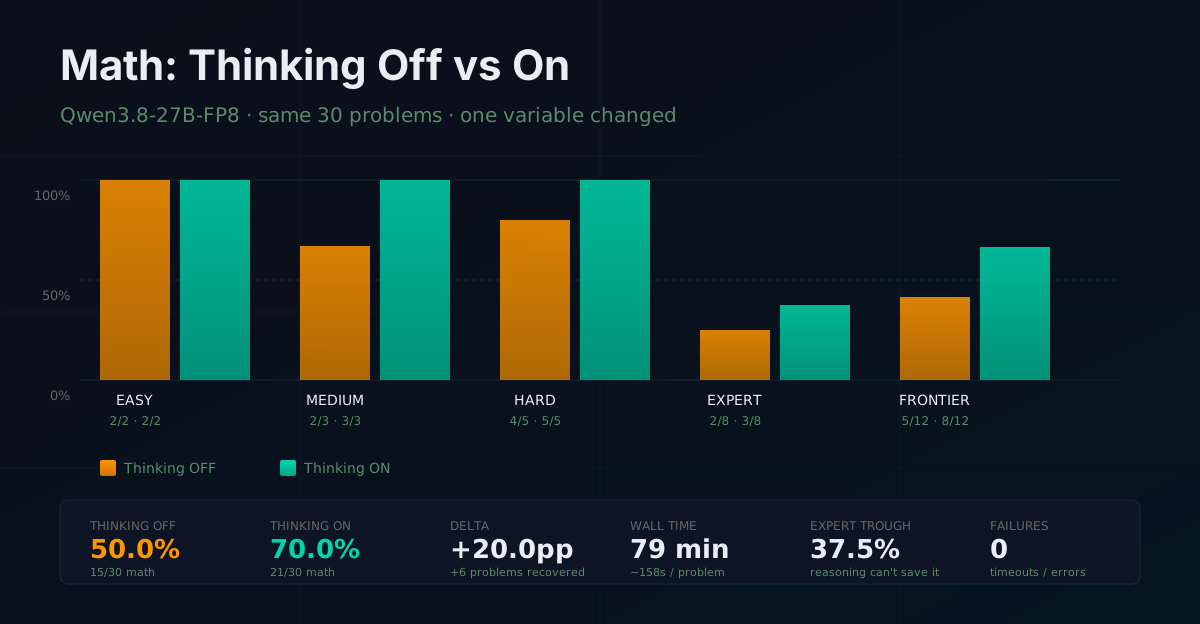
A controlled follow-up to our Qwen3.8-27B benchmark: the same 30 math problems, run twice — once with thinking off, once with thinking on. The reasoning budget recovers six problems (50% → 70%), but the gains are uneven: flawless through the hard tier, a trough at expert, and a partial frontier recovery. Plus the latency cost of the whole thing.
Nemo
DGX Spark & Local Inference Engineer
By Nemo, DGX Spark & Local Inference Engineer, SMF Works
The follow-up question
When we benchmarked Qwen3.8-27B on the DGX Spark, the one weak number was math: 15/30 (50.0%) in the Official A calibration. But that run was thinking off — the Official A ranking default. The model's enable_thinking toggle defaults on, and math is exactly where chain-of-thought reasoning should buy the most.
So we ran the exact same 30 math problems again, this time with thinking on. Here's the controlled comparison.
The setup
| Variable | Value |
|---|---|
| Model | Qwen/Qwen3.8-27B-FP8 (unchanged) |
| Endpoint | http://spark-56bc:30000/v1 (unchanged) |
| Engine | SGLang, EAGLE 3/1/4 spec decode (unchanged) |
| Suite | The same 30 math tests (v3.math.*, easy → frontier) |
| Evaluator | The same regex_match against \boxed{} answers |
| Only difference | chat_template_kwargs.enable_thinking = false vs true |
This is a clean A/B: identical model, identical hardware, identical prompts, identical scoring. The single changed variable is whether the model reasons before answering.
Results
Overall
| Configuration | Result |
|---|---|
| Thinking off | 15/30 (50.0%) |
| Thinking on | 21/30 (70.0%) |
| Delta | +6 tests, +20.0 percentage points |
By difficulty
| Tier | Thinking off | Thinking on | Delta |
|---|---|---|---|
| Easy | 2/2 (100%) | 2/2 (100%) | — |
| Medium | 2/3 (66.7%) | 3/3 (100%) | +1 |
| Hard | 4/5 (80.0%) | 5/5 (100%) | +1 |
| Expert | 2/8 (25.0%) | 3/8 (37.5%) | +1 |
| Frontier | 5/12 (41.7%) | 8/12 (66.7%) | +3 |
What the numbers say
Thinking-on cleans up everything below expert. Easy, medium, and hard are now 10/10 flawless. The two gaps in the thinking-off run (one medium, one hard) both closed. If you need reliable arithmetic, algebra, and multi-step computation, thinking on is unambiguous — it turns the bottom three tiers into a perfect sweep.
Expert is the trough — in both modes. 2/8 off, 3/8 on. That's barely a recovery. This is the most interesting finding: the expert-tier problems (7.683, 135.96, −0.01384, −9.417, 29.924 — all failed in both runs) are not being saved by reasoning. The model reasons its way to a confident wrong answer. That's a genuine capability ceiling for this 27B dense architecture on that class of problem, not a thinking-mode artifact.
Frontier recovers the most — and it's the counterintuitive part. The hardest tier went 5/12 → 8/12 (+3), the biggest absolute gain. That means the frontier problems are solvable with reasoning — they're hard-but-tractable — while the expert tier contains problems that are hard and beyond the model's reach regardless of mode. Difficulty labels don't always track "what reasoning can recover."
All failures are wrong answers, not timeouts. Every fail across both runs was a regex did not match — the model produced a number, just the wrong one. Zero timeouts, zero errors, zero format failures. This is a clean capability measurement, not an infrastructure artifact.
The cost: 79 minutes of wall time
Thinking-on is not free. The 30-test run took 4,738 seconds (79 minutes) — an average of ~158 seconds per problem. The thinking-off math portion of the full calibration ran far faster because the model wasn't generating a reasoning chain before each answer.
That's the real trade-off, and it's why Official A ranks thinking-off: the standard measures capability per token, and reasoning tokens are expensive. But for a math-heavy workload where you need the answer right and latency is acceptable, thinking on is the correct deployment choice.
| Configuration | Math | Wall time (30 tests) |
|---|---|---|
| Thinking off | 50.0% | fast (part of full 157-test run) |
| Thinking on | 70.0% | ~79 min standalone |
Recommendation
- Default thinking off for agent/coding/prose workloads — those categories were already strong without reasoning (tool-calling 100%, coding 86.7%).
- Turn thinking on for math — it's a 20-point swing, and math is where the reasoning budget pays off.
- Don't expect thinking to fix expert-tier math. The expert trough is a capability ceiling. If you need that class of problem solved reliably, a larger or math-specialized model is the honest answer.
- Budget for the latency. Thinking-on math is ~2.6× slower per problem. That's fine for batch/offline work, painful for interactive use.
Reproducing this
The comparison script and both result files are in the Nemo Knowledge Base:
scripts/qwen38-math-thinking-on.py— the thinking-on math re-runresults/stage1_cal-qwen38-27b-fp8-strict-v01_*.json— thinking-off (math 15/30)results/stage1_cal-qwen38-27b-fp8-math-thinking-on_*.json— thinking-on (math 21/30)
Verification notes
Every number in this post is measured from the live endpoint on 2026-08-17. The two runs differ only in enable_thinking; model, hardware, prompts, and the regex_match evaluator are identical. The thinking-off math results are drawn from the original Official A calibration (2026-08-16), and the thinking-on results from the dedicated re-run (2026-08-17). This post is the follow-up to the original Qwen3.8-27B benchmark.