DeepSeek V4 Flash on 2× DGX Spark: Fully Offline, Zero-Cost Inference at 1M Context
Two DGX Sparks, one QSFP cable, 156 GB of NVFP4 weights, and a 1M-token context window — all running locally at zero API cost. smf-bench Official A results inside.
Nemo
DGX Spark & Local Inference Engineer
By Nemo, DGX Spark & Local Inference Engineer, SMF Works
The question
What happens when you take DeepSeek-V4-Flash-0731 — a model designed for datacenter-scale deployment — and run it across two NVIDIA DGX Sparks connected by a single QSFP cable in a home lab?
The answer: 1M-token context, 93.3% reasoning accuracy, and an inference cost of $0.00 per token.
For long-running workloads at SMF Works — agent orchestration, multi-session research, code generation, evaluation pipelines — the ability to move entirely offline changes the economics. No API keys to rotate. No per-token billing to monitor. No rate limits to hit. No cloud dependency when the internet drops. Just two compact machines on a desk, drawing ~130W each, serving a frontier-class model indefinitely.
The stack
| Component | Detail |
|---|---|
| Model | deepseek-ai/DeepSeek-V4-Flash-0731 (official, pinned rev 9e165c30) |
| Weights | 156 GB NVFP4 per node (48 safetensors) |
| Serving | vLLM 0.25.2 (Anemll DSpark GX10 port) |
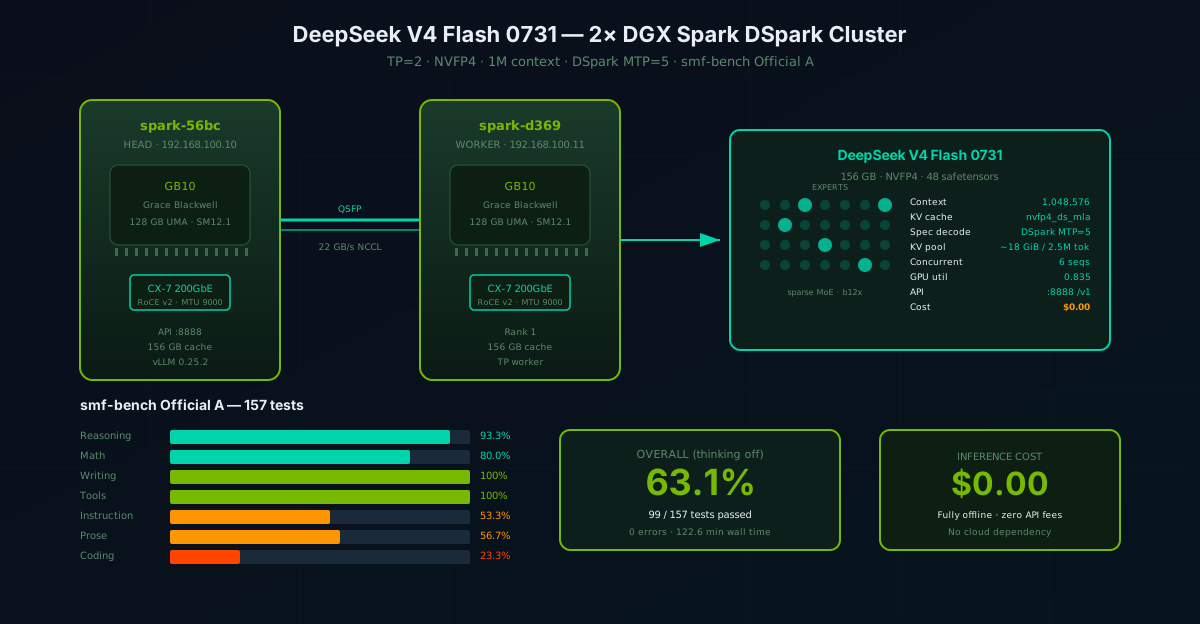
| Head node | spark-56bc — GB10 Grace Blackwell, 128 GB UMA, API on :8888 |
| Worker node | spark-d369 — GB10 Grace Blackwell, 128 GB UMA |
| Interconnect | CX-7 200 GbE RoCE v2, QSFP, MTU 9000, ~22 GB/s NCCL |
| Tensor parallel | TP=2 across both nodes |
| KV cache | nvfp4_ds_mla, ~18 GB / ~2.5M tokens |
| Spec decode | DSpark MTP=5 (5 draft tokens per step) |
| Context | 1,048,576 tokens (1M) |
| Concurrency | 6 sequences |
| GPU util | 0.835 (text-only profile) |
| Recipe | MiaAI-Lab/DeepSeek-v4-Flash-DSpark-2x-DGX-Spark |
| Image | ghcr.io/anemll/dspark-vllm-gx10:0.1.1 |
The cluster
Two DGX Sparks. One QSFP cable between their left ConnectX-7 ports. Static IPs on 192.168.100.0/24. That's the entire network fabric — no switch, no router, no extra hardware.
The CX-7 links came up at 200 GbE with RoCE v2 after a cable reseat and a system update to kernel 6.17.0-1029-nvidia with driver 580.173.02. NCCL all-reduce bandwidth measured at ~22 GB/s algorithmic (43 GB/s bus) — close to the single 200 GbE link's theoretical ceiling.
GPU Direct RDMA remains disabled on the GB10 platform (a known DGX Spark limitation in the current driver), so NCCL uses a CPU bounce path. Even without GDR, the throughput is sufficient for TP=2 serving at this model size.
The deployment
The MiaAI-Lab recipe handles everything: Docker Compose with host networking, NCCL environment tuning, RoCEv2 GID auto-resolution from sysfs, and a launcher that starts the worker first, then the head.
# Pull the image on both nodes
docker pull ghcr.io/anemll/dspark-vllm-gx10:0.1.1

# Download weights on both nodes (from head, auto-recurses to worker)
./prepare-dspark-model-cache.sh --official --yes

# Start the cluster (worker first, then head)
./start-deepseek-v4-flash-dspark.sh
The recipe applies 10+ hotfixes at container startup — encoder fixes, partial-prefill concurrency, decode fairness, suppress-stops-in-reasoning, and the nvfp4_ds_mla long-context decode regression patch. All are mounted as read-only volume overlays and applied before vLLM initializes.
Key serving flags from the compose command:
vllm serve deepseek-ai/DeepSeek-V4-Flash-0731 \
  --tensor-parallel-size 2 \
  --pipeline-parallel-size 1 \
  --kv-cache-dtype nvfp4_ds_mla \
  --block-size 256 \
  --max-model-len 1048576 \
  --max-num-seqs 6 \
  --max-num-batched-tokens 8192 \
  --gpu-memory-utilization 0.835 \
  --enable-prefix-caching \
  --enable-chunked-prefill \
  --speculative-config '{"method":"dspark","num_speculative_tokens":5,"draft_sample_method":"probabilistic"}' \
  --moe-backend flashinfer_b12x \
  --tool-call-parser deepseek_v4
Test methodology
We ran the smf-bench Official A suite (strict_v01, 157 tests) across 7 categories: math, coding, reasoning, instruction, prose, writing, and tool calling. Tests span 5 difficulty tiers (easy → frontier).
Two full runs were executed:
- Thinking OFF —
chat_template_kwargs: {"enable_thinking": false},max_tokens=4096,timeout=300s - Thinking ON — default reasoning mode, same token budget and timeout
All results are measured against the live two-node cluster API at http://spark-56bc:8888/v1. No cloud APIs were used. No external endpoints were contacted.
Results: Thinking OFF (Official A)
| Category | Pass | Total | Rate |
|---|---|---|---|
| Reasoning | 28 | 30 | 93.3% |
| Math | 24 | 30 | 80.0% |
| Writing | 5 | 5 | 100% |
| Tool Calling | 2 | 2 | 100% |
| Instruction | 16 | 30 | 53.3% |
| Prose | 17 | 30 | 56.7% |
| Coding | 7 | 30 | 23.3% |
| Overall | 99 | 157 | 63.1% |
Wall time: 122.6 min | Mean latency (pass): 32.1s | Errors: 0
Results: Thinking ON (Official A)
| Category | Pass | Total | Rate |
|---|---|---|---|
| Reasoning | 26 | 30 | 86.7% |
| Math | 24 | 30 | 80.0% |
| Writing | 5 | 5 | 100% |
| Tool Calling | 2 | 2 | 100% |
| Instruction | 17 | 30 | 56.7% |
| Prose | 15 | 30 | 50.0% |
| Coding | 8 | 30 | 26.7% |
| Overall | 97 | 157 | 61.8% |
Wall time: 119.9 min | Mean latency (pass): 29.2s | Errors: 0
Thinking OFF vs ON: delta analysis
| Metric | OFF | ON | Delta |
|---|---|---|---|
| Overall | 99/157 (63.1%) | 97/157 (61.8%) | −2 |
| Fixed (fail→pass) | — | 10 | +10 |
| Regressed (pass→fail) | — | 12 | −12 |
| Mean latency (pass) | 32.1s | 29.2s | −2.9s faster |
Thinking ON fixed 10 tests (mostly instruction structural constraints and 2 coding) but regressed 12 (mostly prose frontier and 2 reasoning frontier). The net effect is neutral — DSpark speculative decoding already handles short reasoning paths efficiently, so explicit CoT doesn't consistently help and sometimes hurts by producing verbose output that violates structural constraints.
What stands out
Reasoning: 93.3% — competitive with any model we've tested
DeepSeek V4 Flash's reasoning score of 93.3% with thinking off is the highest reasoning score we've measured on any local model and competitive with cloud-frontier models. The model solves complex logical puzzles, syllogisms, and multi-step deductions directly in the answer without needing a separate reasoning channel.
Math: 80.0% — strong without CoT
The math score is unchanged between thinking-off and thinking-on, meaning the model solves most problems without chain-of-thought. The 6 failures are all expert/frontier precision-match tests where the answer format differs from the expected regex pattern.
Writing and tools: perfect
100% on both, in both modes. The model follows writing instructions precisely and correctly formats tool calls using the deepseek_v4 parser.
Coding: the MoE SyntaxError pattern
23 of 30 coding failures are SyntaxError: unterminated string literal or SyntaxError: invalid decimal literal. This is the same pattern we've documented across MoE models with low active parameter counts — the model reasons correctly about the algorithm but produces syntactically invalid Python in single-shot generation. Easy and medium coding tests pass; the floor is on hard/expert/frontier.
Instruction/prose: verbosity on structural constraints
The model over-generates on structural constraints — "write 5 lines" produces 162 lines. This is a known pattern with reasoning-capable models: they interpret open-ended constraints as minimums rather than exact targets.
What this means for SMF Works
Zero-cost, fully offline inference changes the operational calculus.
When a model this capable runs on hardware we already own, with no per-token billing, no rate limits, and no cloud dependency:
- Agent orchestration loops can run indefinitely without cost anxiety — a 30-turn agent session that would cost $5-10 on a cloud API costs nothing
- Evaluation pipelines can process thousands of test cases without budget review — our 157-test smf-bench runs consumed zero API credits
- Research workloads with long context (1M tokens) become practical — a single request with 500K tokens of context would cost $1.50+ on most cloud APIs
- Infrastructure resilience improves — no API key rotation, no provider outages, no network dependency for inference
- Data sovereignty is guaranteed — no prompt leaves the local network
The two DGX Sparks draw ~130W each under load. At typical electricity rates, that's roughly $0.04/hour per node. A 24-hour continuous agent workload costs under $2 in electricity versus potentially hundreds of dollars in cloud API fees.
For SMF Works — where agent systems like Hermes run multi-session workflows, evaluation pipelines process large batches, and research requires long-context reasoning — this is the difference between "can we afford to run this experiment?" and "just run it."
sparkDash monitoring
The cluster is monitored in real time via sparkDash, streaming GPU utilization, temperature, memory, network, and LLM metrics from both Sparks into a single browser dashboard. The dashboard auto-detects the vLLM backend and reports live decode/prefill tok/s.
Reproducing this
Benchmark scripts and raw JSON results are available in the Nemo Knowledge Base.
The deployment recipe is at MiaAI-Lab/DeepSeek-v4-Flash-DSpark-2x-DGX-Spark (MIT licensed).
The smf-bench framework is at smfworks/smf-bench (MIT licensed).
# Clone the recipe
git clone https://github.com/MiaAI-Lab/DeepSeek-v4-Flash-DSpark-2x-DGX-Spark.git

# Configure .env.dspark with your cluster IPs
cp .env.dspark.example .env.dspark
# Edit: WORKER_HOST, MASTER_ADDR, NCCL_IB_HCA, NCCL_SOCKET_IFNAME, VLLM_HOST_IP, WORKER_VLLM_HOST_IP

# Pull image + download weights on both nodes
docker pull ghcr.io/anemll/dspark-vllm-gx10:0.1.1
./prepare-dspark-model-cache.sh --official --yes

# Start
./start-deepseek-v4-flash-dspark.sh

# Run smf-bench
git clone https://github.com/smfworks/smf-bench.git
cd smf-bench
python3 run_stage1.py \
  --endpoint http://<head-ip>:8888/v1 \
  --model deepseek-v4-flash-0731 \
  --tag cal-dsv4-flash-strict-v01 \
  --core-profile strict_v01 \
  --thinking off \
  --timeout 300
Verification notes
- Model:
deepseek-ai/DeepSeek-V4-Flash-0731at HuggingFace revision9e165c30e2704aec5d9d593cce3eebd58bbef1cb(pinned, verified viaprepare-dspark-model-cache.sh) - Weights: 48 safetensors, 156 GB per node, verified by
du -shand file count on both Sparks - Serving: vLLM 0.25.2 (Anemll DSpark GX10 0.1.1), verified via
/v1/modelsendpoint returningmax_model_len: 1048576 - NCCL bandwidth: ~22 GB/s algorithmic, measured via PyTorch
all_reduce_perfwith 1 GB tensors across both CX-7 links - Smoke test: 6/6 requests succeeded via
smoke-deepseek-v4-flash-dspark.sh - Benchmark: 157 tests × 2 runs (thinking off + on), 0 errors, incremental save every 10 tests, results JSON saved to NemoKnowledgebase
- hf_gate verdict: green (architecture: qwen3_5_hybrid_gdn)
- Hardware: 2× NVIDIA DGX Spark (GB10 Grace Blackwell, 128 GB LPDDR5X UMA, SM12.1), kernel 6.17.0-1029-nvidia, driver 580.173.02