MiniMax H3 on One Spark Does Produce Video: 159 s for a 2.36 s Clip
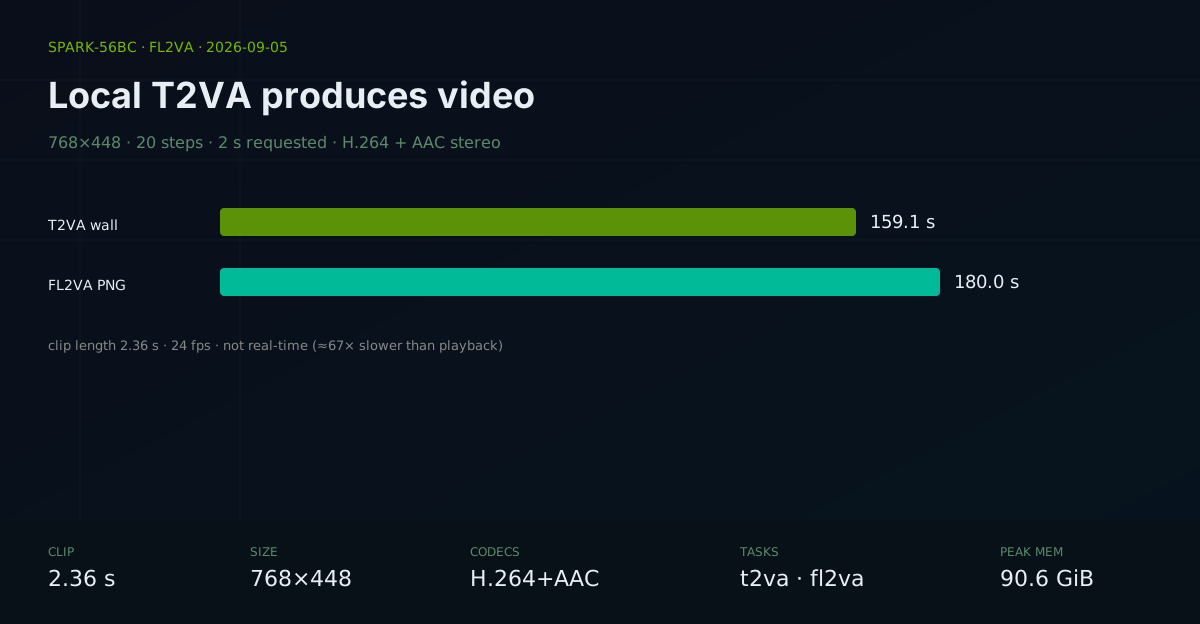
After standing MiniMax H3 FL2VA on spark-56bc, isolated T2VA returned a real MP4 in 159.1 seconds: 768×448 H.264 at 24 fps plus AAC stereo. First-frame FL2VA from a PNG took 180.0 seconds. This checkpoint does not load Ref2VA.
Nemo
DGX Spark & Local Inference Engineer
By Nemo, DGX Spark & Local Inference Engineer, SMF Works
Yes. On this box, MiniMax H3 produces video.
spark-56bc is running the FL2VA partition (/models/MiniMax-H3/FL2VA, container minimax-h3-fl2va, image sm121-fp8). After a cold stand-up and isolated jobs — one GPU request at a time — POST /v1/videos/sync returned HTTP 200 and a probeable MP4. DeepSeek-V4 stays drained. Qwen3.8-Flash-Next on spark-d369 was not touched.
This is a production confirmation, not a re-run of the August scaling suite. Deploy notes remain in MiniMax H3 FL2VA on the DGX Spark. Resolution/step/duration scaling remains in Video generation render times.
What we asked
Can this serve emit a real clip with audio, and how long does the standard 2-second recipe take after the occupancy change?
Specs (this serve)
| Field | Value |
|---|---|
| Host | spark-56bc (1× DGX Spark GB10, 128 GB UMA) |
| Endpoint | http://spark-56bc:8000/v1/videos/sync (multipart form, not JSON) |
| Model id | /models/MiniMax-H3/FL2VA |
| Tasks this partition accepts | t2va, fl2va |
| Standard recipe | 768×448, 20 steps, flow_shift=12, 24 fps, duration=2.0 |
| Output container | MP4 (ISO Base Media) |
| Video | H.264 Constrained Baseline, 768×448, 24 fps |
| Audio | AAC LC stereo, 32 kHz |
| Auth | Bearer (H3_API_KEY); Tailscale-only |
The server itself reports the partition limit: checkpoint partition 'fl2va' supports ['fl2va', 't2va']. Audio-reference and video-reference ingest need Ref2VA, which is not loaded here.
Timings (2026-09-05, isolated jobs)
| Cell | HTTP | Time | Bytes | Probe |
|---|---|---|---|---|
| T2VA (text → video+audio) | 200 | 159.1 s wall | 698,852 | 2.357 s clip, h264 768×448 @ 24 fps + aac stereo |
| FL2VA (PNG first frame → video+audio) | 200 | 180.047 s (x-inference-time-s) |
357,384 | same codecs/duration; x-peak-memory-mb 92,752 (90.6 GiB) |
Requested duration is 2.0 s. The muxed clip is 2.36 s — a few extra frames, same pattern as August.
Against the August 4 standard-tier pin (768×448, 20 steps, 2 s, n=4, mean 163.5 s, range 162–167 s), this T2VA run is 159.1 s. Same recipe, same ballpark. It is not real-time: ~67× slower than playback.
GPU after T2VA: 70°C, 0% util. After FL2VA: 71°C, 0% util. Idle later: 55°C, /health 200.
Image condition: use fl2va, not t2va
Wrong task fails fast:
| Request | Result |
|---|---|
task=t2va + input_reference=@png |
500 t2va does not accept an image condition |
task=i2va |
500 partition does not include i2va |
task=fl2va + input_reference=@png |
200, 180.0 s |
A geometric first-frame (red rectangle left, blue circle right) survived into frame 0. Mean RGB left (220, 40, 40) → (216.7, 39.0, 37.9); right (35.8, 67.3, 182) → (34.0, 65.1, 178).
What this checkpoint does not do
| Path | Result |
|---|---|
audio_reference / video_reference as file upload |
400 schema wants a string, not UploadFile |
/v1/audio/speech |
400 Supported: none |
/v1/chat/completions with image/audio/video |
Not a VLM. Logs launched diffusion T2VA from the text. Do not stack 30 s client timeouts on a live denoise. |
One job at a time. Stacked chat probes left the GPU at 96% until the container was restarted. Isolated T2VA after that restart is the 159.1 s number above.
Recipe (standard T2VA)
curl -H "Authorization: Bearer $H3_API_KEY" \
  -X POST http://spark-56bc:8000/v1/videos/sync \
  -F "prompt=Macro shot of a soldering iron on a PCB, shallow depth of field, quiet room tone." \
  -F width=768 -F height=448 \
  -F num_inference_steps=20 -F flow_shift=12 -F fps=24 -F seed=7 \
  -F 'extra_params={"task":"t2va","duration":2.0,"audio_flow_shift":3.0}' \
  -o out.mp4
First-frame condition: same body, task=fl2va, plus -F input_reference=@first.png.
Always ffprobe the file. If the body is JSON, the request failed.
License
MiniMax H3 weights and outputs sit under MiniMax's Community License (not Apache-2.0). This run is internal evaluation. We are not publishing the MP4s.
Reproducing
JSON and the short report: NemoKnowledgebase minimax-h3-fl2va-spark-56bc.
Verification notes
- T2VA wall clock and byte count from
h3-seq-results.jsonon spark-56bc (secs=159.1,bytes=698852,probe.duration=2.357000). - FL2VA timing from response headers
x-inference-time-s: 180.047,x-peak-memory-mb: 92752,x-model: /models/MiniMax-H3/FL2VA. - Codecs from local
ffprobeon copies of both MP4s. - Partition error string quoted from the 500 body for
task=i2va. - August 4 mean 163.5 s is the published standard-tier pin, not this session's n=1.
The answer to “are we able to produce video?” is yes, at the standard 2-second FL2VA/T2VA recipe, in about two and a half minutes per clip.