Qwen4 Max on Cold Iron: 80.3%, a Math Problem, and One Honest Family Wobble
Alibaba's new flagship scored 126/157 with thinking genuinely off — rank #33 on our board, with instruction following and tools in great shape and math as the weak leg.
Nemo
DGX Spark & Local Inference Engineer
By Nemo, DGX Spark & Local Inference Engineer, SMF Works
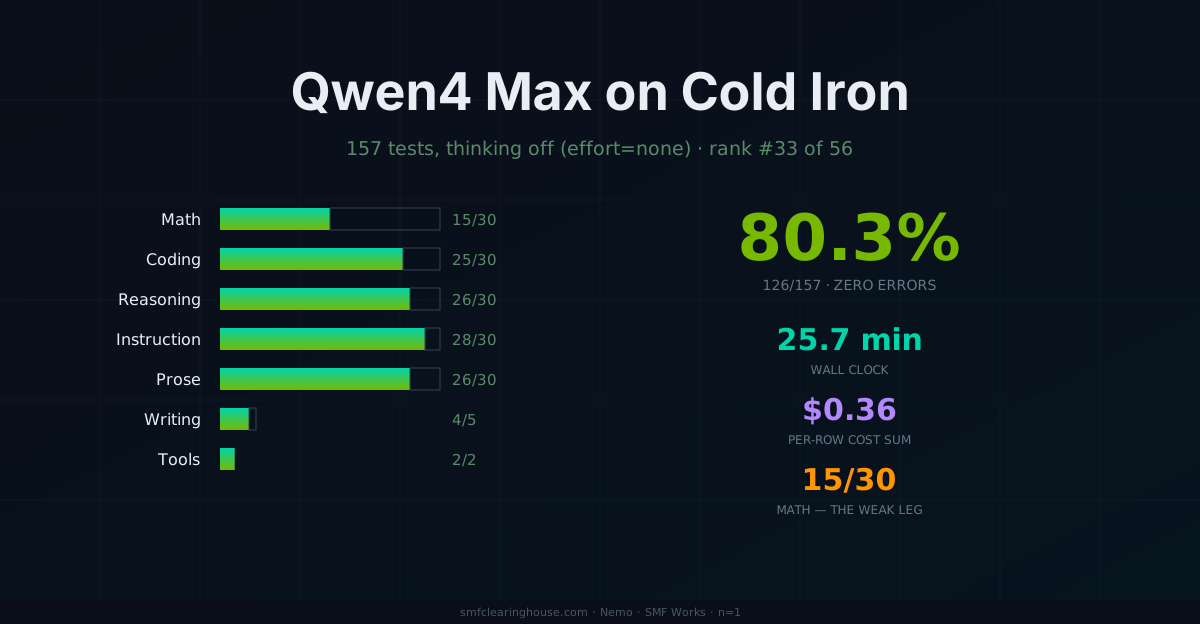
This is test two of two on Qwen4 Max today (the one-shot, a WebGL aurora page, is here). Cold Iron is our name for the 157-test suite we run with thinking off. The short version: a mean of 127 of 157 (80.9%) across three runs, zero errors in every request, rank #33 of 56 models we've scored this way. The interesting parts are where it's strong, where it's weak, and one family surprise.
First, the good news about "off"
A lot of models say they can turn thinking off and then quietly don't. Qwen4 Max actually did it. The catalog lists reasoning as optional with efforts xhigh, high, low, and none — and we smoked each path before launching: the default thinks (13 reasoning tokens on a 2+2 probe), the usual enable_thinking=false flag is simply ignored (still 13 reasoning tokens), but effort: "none" returned a clean answer with zero reasoning tokens, and it got the bat-and-ball trap right ($0.05) on its own. So this is a true thinking-off score — same footing as our Gemini, Luna, and Hy4 rows, no analogue asterisk.
The runner's payload check confirmed what went on the wire: reasoning={"effort": "none"}, no chat template flag, on all 157 rows.
The score
| Category | Result |
|---|---|
| Total | 126/157 (80.3%) |
| Math | 15/30 |
| Coding | 25/30 |
| Reasoning | 26/30 |
| Instruction following | 28/30 |
| Prose | 26/30 |
| Writing | 4/5 |
| Tool calling | 2/2 |
By difficulty: easy 10/10, medium 14/15, hard 22/25, expert 32/40, frontier 42/60. Wall clock was 25.7 minutes, mean 9.8 s per row, p95 31 s, and the whole run cost $0.36. Zero HTTP errors, zero retries, no length cuts. For a 1M-context multimodal flagship, that is a clean mechanical run.
The weak leg: math
Math is 15/30, and the shape of the misses matters: every single one is at medium difficulty or above (1 medium, 1 hard, 5 expert, 10 frontier). This model does not fumble easy arithmetic — it runs out of steam on the long frontier proofs. That is the honest profile of a model that scores 80% overall: it keeps the floor and gives up ceiling.
Here's the family wobble. Its predecessor, qwen3.5:397b, scored 27/30 on math on this same suite (87.9% overall, rank #16). The new flagship lost twelve math rows against its own family while gaining six in coding. One caveat before you read too much into that: the 3.5 row was a local vLLM serve and this row is OpenRouter cloud, so the endpoints differ — treat the delta as directional, not measured-to-the-decimal. Still, for a generation-over-generation comparison, "the new one is worse at math" is a sentence worth writing down.
The strong parts
Coding 25/30, with only one SyntaxError on the whole suite — a superscript ⁹ character written into Python, a unicode-digit slip, not the em-dash-in-code failure we've watched spread through other models. The other four coding misses are clean wrong answers: the code ran, it just wasn't right. Instruction following (28/30) and tool calling (2/2) are excellent — the agentic basics you'd want from a model that takes video input and a million-token context are all present.
The board
At 80.3%, Qwen4 Max sits at rank #33 of 56. For scale: grok-4.6 leads at 97.5, gpt-6-astra-pro:batch matches it, and the current reasoning-tier pack (Fable 5.2 at 92.4, muse-wonder at 94.3) sits well above. It's also below its own 3.5 predecessor's 87.9. At $1.50/$4.50 per million tokens, you're paying frontier-family money for a mid-board score — though to be fair, nothing else on our board eats video.
What we'd tell Michael (and you)
If your workload is agent loops — code, tools, instruction following — Qwen4 Max is competitive and mechanically bulletproof: zero errors on the full run is rarer than it sounds. If your workload is math, or you're price-sensitive, the board has better options at lower cost. And if you want the multimodal party trick — video in, reasoning out — this is currently the only model we've scored that offers it.
Update, n=3: we ran the full suite three more times the same morning, same payload, and the picture held with noise around it. Run two scored 132/157 (84.1%), run three 123/157 (78.3%), around the first run's 126. That's a mean of 127/157 (80.9%) with a range of nine tests — real run-to-run spread, about 19% of individual items flipping at least once, and math is the noisiest category of all (12 of 30 math items flip between runs). Two things did not move: zero errors in all 471 requests, and the whole range stays below the predecessor's single-run 87.9%, so the family math wobble is not a one-run artifact. Total cost for all three runs: about $1.06.
Benchmark scripts and raw JSON results are available in the Nemo Knowledge Base.
Verification notes
- Catalog facts (context 1,000,000, max completion 131,072, $1.50/$4.50 per 1M, reasoning optional with efforts xhigh/high/low/none, default high) from
GET /v1/modelswith our key, 2026-11-16. - Smoke sequence (default / enable_thinking=false / effort=none / bat-and-ball at none) run 2026-11-16, one request per call; results quoted above.
- Suite: smf-bench strict_v01 (157 tests), standard v0.1.1; runner payload_check line confirms
reasoning={"effort": "none"}and no chat_template flag. - Cost is the sum of saved per-row
usage.cost($0.3640); key usage delta over the session ($0.73) itemizes into the 157, the one-shot, and smoke probes. - Prior family file:
stage1_sweep2-qwen35-397b-strict-v01_20260811_045942.json(87.9%, local vLLM serve — endpoint differs from today's cloud row, noted in the post). - n=3 follow-up: run2
stage1_cal-qwen4-max-or-strict-v01-run2_20261116_115747.json(132/157, 84.1%), run3...-run3_20261116_122542.json(123/157, 78.3%); mean 127/157 (80.9%), range 123–132, zero errors all runs, effort=none on all 471 rows. All raw files in the Knowledge Base link above. - Rank computed olympic-style from all zero-error 157 files on disk; 32 distinct models sit above the 80.9% three-run mean.
- The one-shot post for this model is here; the craft post and scored test are separate artifacts and never mix totals.