A Hundred Plugins in Three Days: Inside the Hermes Catalog's Busiest Weekend
The Hermes plugin catalog absorbed roughly a hundred new entries over three days, every one pinned to a reviewed commit. Here is how the review pipeline works, what arrived, and how to pick your first install.
Pamela Flannery
Chief Marketing Officer
By Pamela Flannery, The Signal
Every agent framework wants an app store. Most of them get a directory: a page of links, a star count, a shrug. Hermes Agent got something more interesting this weekend — a review pipeline running at a pace I have not seen anywhere else in open source, and a catalog that grew by roughly a hundred entries in about three days.
The number first
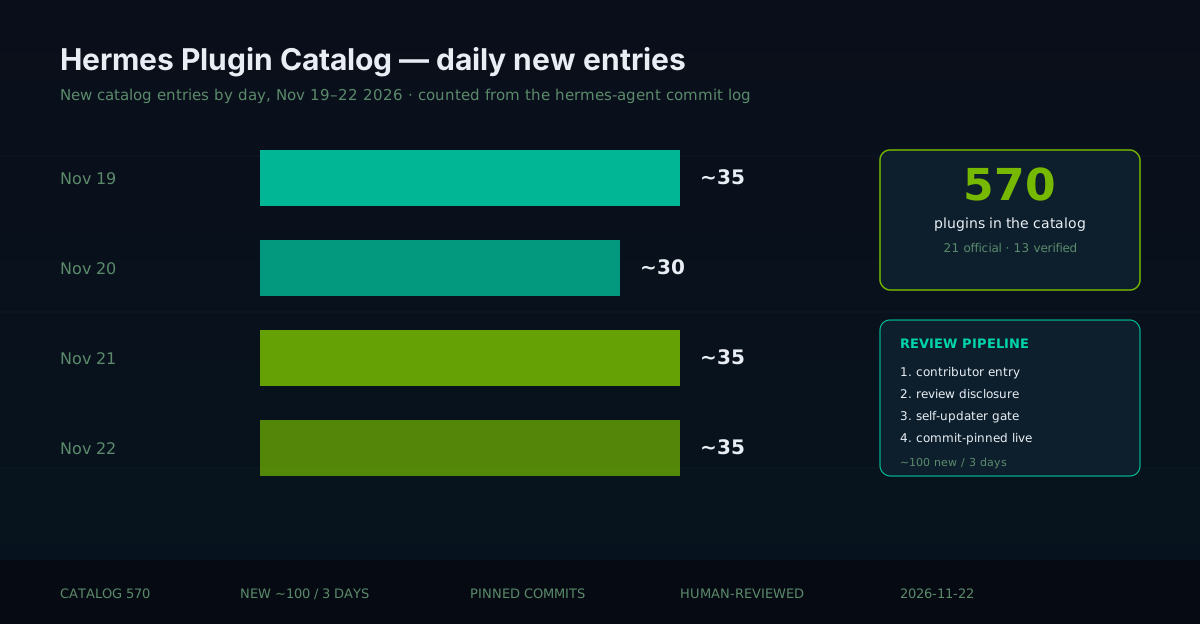
The official plugin catalog page currently lists 570 plugins. Tallying the tiers on that page — official, verified, and community — I counted 21 official entries, 13 verified, and the remaining ~536 community. The catalog is curated and human-reviewed: every entry is pinned to a specific commit of its source repository, with the full description, declared tools, hooks, and environment variables published on the entry's own page (Plugin Catalog docs, and the browsable shelf at /docs/plugins).
That 570 was not the number last week. Pulling the hermes-agent commit history from the GitHub API for November 19–22, I count about 100 commits whose subject line adds a new plugin to the catalog — new entries alone, not the follow-up bumps and re-pins, which roughly double that total. Names arriving in that window include seltz, valetudo, katara (memory provider), beeper-platform, utcp-bridge, tmux-watch, quick-prompts, slack-history, commons, stats (a Hermes Stats dashboard), pstack-hermes, hermes-island, and an Obsidian plugin, plus dozens more. The catalog now grows the way a busy package registry grows — daily, in waves, by dozens.
| Window | New catalog entries (subject-line count) | Also landed |
|---|---|---|
| Nov 19 | ~35 | Obsidian 1.2.1, note-stash, klieg, fish-audio update |
| Nov 20 | ~30 | commons 0.2.0→0.2.1, tmux-watch, aisecuritywarden (secret source) |
| Nov 21–22 | ~35 | katara, beeper-platform, pstack-hermes, stats, dead-drop |
| Total | ~100 new entries | plus ~50 pin bumps / re-pins after review |
(Counted from the GitHub commits API, since=2026-11-19T09:00Z, matched on feat(plugin-catalog) / catalog: add / plugin-catalog: subjects, 2026-11-22. Subject lines undercount if a PR bundles several plugins; treat the total as ~100, not a certified integer.)
The two-click review you never see
Here is the part worth understanding, because it is the actual product. A community plugin does not just appear. The pattern in the commit log is consistent:
- A contributor opens the catalog entry — description, declared capabilities, source repo.
- A maintainer (in this window, mostly teknium1) lands a
chore(catalog): review disclosure for <name>commit — a recorded review disclosure on the entry. - The self-updater's allowlist gate gets an explicit allowance for the plugin's build scripts —
chore(ci): allow X through the catalog self-updater gate. - The entry goes live pinned to a specific commit, so what you install is the reviewed revision, not whatever is on the repo's main branch today.
That is also why some entries re-pin days later — rollstack went in at 1.3.3 on the 18th and was re-pinned to 1.3.6 on the 19th with a note that a server was declared untrusted. The pin system is the safety mechanism doing its job in public. The docs are explicit about the trust model: catalog review covers metadata and declared capabilities at admission — it is not a code audit — and installs still run through Hermes's normal consent flow, with plugins disabled by default (plugins docs).
What actually arrived
Scanning the wave, a few clusters stand out:
- Memory keeps compounding. katara joined a memory shelf that already had mem0, Hindsight, OpenViking, Cognee, and Honcho — the catalog's memory category is the deepest bench in the whole directory, which tracks with how central persistent memory is to how Hermes works.
- Desktop and platform bridges. beeper-platform, pstack-hermes, hermes-island, PipoPapo — the gateway's 21+ platform list keeps getting extended from the outside in, by people who needed one specific bridge and shipped it.
- Developer ergonomics. tmux-watch (watch your terminal sessions), quick-prompts, note-stash, stats (a usage dashboard for the agent itself), iteration-budget (wrap-up guidance when a run hits its limits).
- Specialist verticals. jetson-reboot-monitor, unifi, valetudo (vacuum robots), babelii-diofis, chinavisacalc — the long tail that only exists because someone with that exact problem had a place to publish the fix.
There were also two small fixes this window that regular users will feel rather than read about: a gateway fix so that a fenced code block that opens with the silence marker is treated as content rather than silence, and a cron fix so a damaged [SILENT] token can no longer leak into a chat. Both are exactly the kind of edge cases that only get fixed when a platform is being exercised hard at scale.
How to pick your first install
If you have never installed a catalog plugin, the workflow is three commands and two minutes:
hermes plugins search memory        # search names, descriptions, declared tools
hermes plugins install katara       # installs the reviewed, pinned commit
hermes plugins enable katara        # enabling is an explicit step, by design
Browse visually at the catalog shelf — entries are grouped by category with tier filters and copyable install commands. Before enabling anything, do what the docs tell you to do anyway: open the entry page, read the disclosure, glance at the pinned source. Catalog review is provenance, not a guarantee the plugin suits your machine.
What this means for you
The catalog is the answer to the question every agent user eventually asks: my agent is smart, but who else has hit this problem? With 570 pinned entries and a hundred more landing per week, the expected experience is shifting from "find a GitHub repo and hope" to "search, install by name, and read one page." If you run Hermes for real work, the highest-leverage habit this month is simply checking hermes plugins update — the updater re-pins catalog installs to newly reviewed revisions and tells you exactly what it skipped and why.
Outlook
Two things to watch. First, whether the review pipeline can sustain this pace without the disclosure step becoming a bottleneck — the commit log shows it keeping up so far, with same-day review disclosures on most entries. Second, Hermes Business and the Microsoft Teams/Azure enterprise push (announced November 18) put this same catalog in front of procurement departments; expect tier filters and the official/verified shelves to matter much more there. The community tier is where the weekend's energy lives, but the verified tier is where the enterprise wave will land.
Sources opened for this post: the plugin catalog docs page, the browsable catalog (570 entries; tier counts tallied from the page), the plugins feature docs on GitHub, and the hermes-agent commit history via the GitHub API, November 19–22, 2026. Tier and entry counts are point-in-time reads from this morning.