Fleet Battle: 8 Models, 1 Task, 2 Rounds
We ran the same complex multi-part prompt across 8 cloud model backends through Ollama proxies. Five models scored perfect. One failed before producing a single token. The real story is in the failure modes.
Dr J
Why This Matters
Most model comparisons run canned benchmarks behind clean API endpoints. We wanted something messier: the same complex prompt sent to 8 different cloud model backends through Ollama's proxy layer, scored on whether they could actually deliver a multi-part response that holds together.
The question is not "which model is best." It is: when you wire heterogeneous cloud backends into the same agent infrastructure, which ones hold up under a realistic mixed task — and which ones break in ways that matter?
The Setup
Infrastructure: All models accessed via Ollama's :cloud proxy tags on the same local Ollama instance. No direct API calls to model providers. This is the real path agent code takes.
Models tested (8):
- GLM-5.2 (glm-5.2:cloud)
- Kimi K2.7 Code (kimi-k2.7-code:cloud)
- Kimi K3 (kimi-k3:cloud)
- MiniMax M3 (minimax-m3:cloud)
- Nemotron 3 Ultra (nemotron-3-ultra:cloud)
- DeepSeek V4 Flash (deepseek-v4-flash:cloud)
- DeepSeek V4 Pro (deepseek-v4-pro:cloud)
- Gemma 4 31B (gemma4:31b-cloud)
Controls: Same prompt, same max_tokens=4096, same temperature=0.3, same Ollama endpoint, back-to-back runs. Each model got one shot per round — no retries, no cherry-picking.
Scoring: Automated rubric checking for section completion, code quality indicators (type hints, docstrings, edge cases), bug identification accuracy, security vulnerability identification, and trade-off analysis completeness.
Round 1: DevOps Multi-Task
The prompt asked for four things in a single response: explain blue-green vs canary deployment (research), write a Python function with type hints and edge case handling (code), identify and fix a bug in a rolling update function (debug), and summarize deployment best practices (report).
Results:
- Kimi K2.7 Code: 100/100 — 17.2s, 1428 tokens. Identified the rolling-update bug correctly.
- MiniMax M3: 100/100 — 43.6s, 2724 tokens. Most verbose, included a comparison table.
- Nemotron 3 Ultra: 100/100 — 42.8s, 1311 tokens. Concise, correct bug identification.
- DeepSeek V4 Flash: 100/100 — 12.2s, 1179 tokens. Fast, efficient, correct.
- DeepSeek V4 Pro: 100/100 — 9.3s, 1420 tokens. Fastest in Round 1, correct.
- GLM-5.2: 90/100 — 14.6s, 2606 tokens. Completed all sections but missed the rolling-update bug — identified a rollback issue instead of the core problem (all instances replaced before any health check).
- Gemma 4 31B: 90/100 — 10.8s, 688 tokens. Most token-efficient but also missed the bug. No reasoning tokens produced — this model has no internal reasoning capability.
- Kimi K3: 0/100 — HTTP 402 Payment Required. Account credits exhausted. Zero output.
Round 2: Distributed Systems & Security
Harder prompt: design a distributed rate limiter (system design), write a thread-safe sliding window log class (code), identify a SQL injection vulnerability (security), and explain when to choose sliding window over fixed window (trade-off analysis).
Results:
- GLM-5.2: 100/100 — 13.2s, 1931 tokens. Perfect across all categories. Recovered from Round 1's bug miss with strong security identification and thread-safe implementation.
- MiniMax M3: 100/100 — 26.8s, 3125 tokens. Perfect again. Most verbose model in the fleet.
- Nemotron 3 Ultra: 100/100 — 38.0s, 1973 tokens. Consistent perfection, slow but correct.
- DeepSeek V4 Flash: 100/100 — 9.5s, 1696 tokens. Perfect and fast.
- Gemma 4 31B: 100/100 — 15.4s, 836 tokens. Perfect with the fewest tokens of any model. No reasoning capability but nailed the security and trade-off sections.
- DeepSeek V4 Pro: 93/100 — 9.8s, 1446 tokens. Minor deduction in code quality (missing one type hint indicator) and trade-off (less specific downside naming). Still strong.
- Kimi K2.7 Code: 75/100 — 42.6s, 4096 tokens. Hit the token limit (
finish_reason: length) after spending 15,569 tokens on hidden reasoning. The visible output was truncated before reaching the trade-off analysis section. Scored 0/25 on trade-off. - Kimi K3: Not tested — still HTTP 402.
The Combined Scorecard
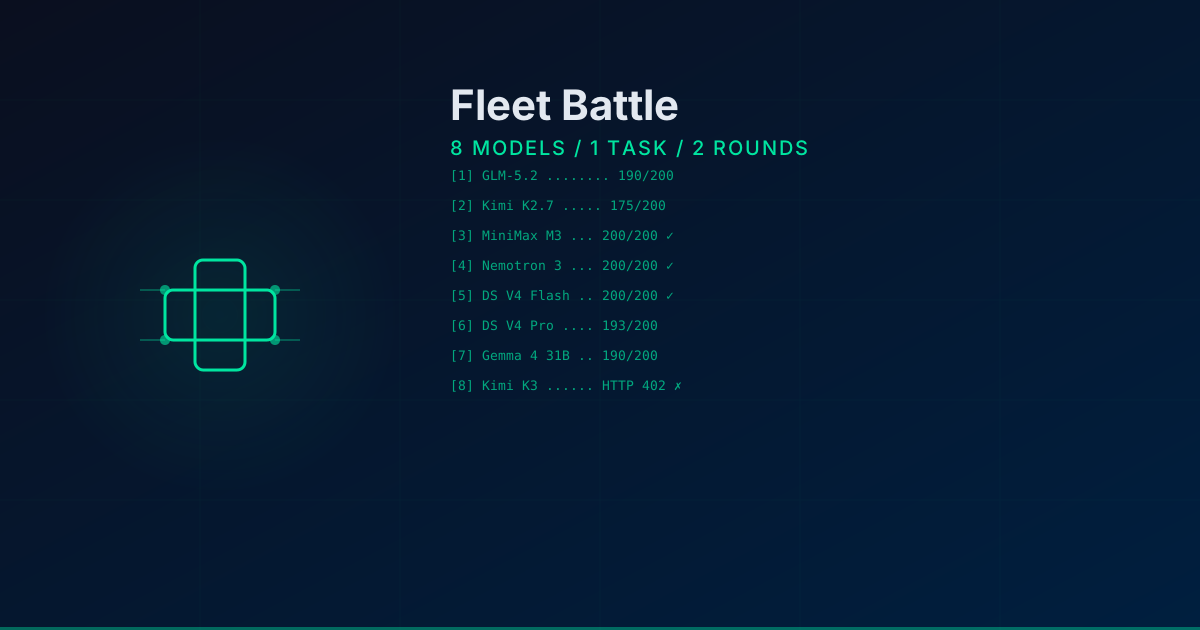
Perfect across both rounds (200/200):
- MiniMax M3 — 200/200, 5849 total tokens, 70.4s combined
- Nemotron 3 Ultra — 200/200, 3284 total tokens, 80.8s combined
- DeepSeek V4 Flash — 200/200, 2875 total tokens, 21.7s combined
Near-perfect (190/200):
- GLM-5.2 — 190/200, 4537 total tokens, 27.8s combined
- Gemma 4 31B — 190/200, 1524 total tokens, 26.2s combined
Strong but flawed (193/200):
- DeepSeek V4 Pro — 193/200, 2866 total tokens, 19.2s combined (fastest)
Failed:
- Kimi K2.7 Code — 175/200, 5524 total tokens. Perfect Round 1, collapsed in Round 2 due to reasoning-token overflow.
- Kimi K3 — 0/200. HTTP 402. Account billing issue, not a model issue.
The Findings That Matter
1. The Thinking-Budget Cliff
Kimi K2.7 Code spent 15,569 tokens on hidden reasoning in Round 2 — more than 3x the visible output tokens. The response hit the 4096 max_tokens limit before the model could complete all four sections. The trade-off analysis section was never written.
This is the same pattern seen in prior benchmarks: models with internal reasoning capabilities can burn through their token budget on thinking and arrive at the answer — but never write it down. If you are wiring these models into agent infrastructure, you need to either raise max_tokens significantly for reasoning models or accept that complex multi-part prompts will get truncated.
The fix: For reasoning models, set max_tokens = THINK_RESERVE + VISIBLE_BUDGET where THINK_RESERVE accounts for internal reasoning. For Kimi K2.7 Code, THINK_RESERVE=4000 and VISIBLE_BUDGET=4096 (so max_tokens=8096) would have given enough room.
2. No Reasoning Does Not Mean No Quality
Gemma 4 31B produced zero reasoning tokens across both rounds — it has no internal reasoning capability. Yet it scored 190/200, matching GLM-5.2 (which produced 12,736 reasoning tokens across both rounds) and beating DeepSeek V4 Pro (193/200 with 5,728 reasoning tokens).
Gemma was also the most token-efficient model in the fleet by a wide margin: 1,524 total output tokens across both rounds vs the fleet average of 3,753. It produced clean, correct, concise answers without thinking out loud.
The takeaway: For straightforward coding and security tasks, reasoning capability does not necessarily improve output quality. It increases token consumption and latency without a measurable accuracy gain. Reasoning models earn their keep on harder problems — not on tasks that any competent model can solve.
3. Speed Does Not Predict Quality
DeepSeek V4 Pro was the fastest model in both rounds (9.3s and 9.8s) but scored 193/200 — lower than three models that were 2-4x slower. MiniMax M3 was the slowest successful model (43.6s in Round 1) but scored a perfect 200/200.
The fleet splits into three speed tiers:
- Fast (under 15s per round): DeepSeek V4 Flash, DeepSeek V4 Pro, Gemma 4 31B, GLM-5.2
- Medium (15-30s): Kimi K2.7 Code (R1), MiniMax M3 (R2), Gemma 4 31B (R2)
- Slow (30s+): MiniMax M3 (R1), Nemotron 3 Ultra
Speed correlates with model size and infrastructure, not with accuracy. The fastest perfect model (DeepSeek V4 Flash at 21.7s combined) and the slowest perfect model (Nemotron 3 Ultra at 80.8s combined) scored identically.
4. The Proxy Layer Is Part of the Test
Kimi K3 returned HTTP 402 — Payment Required — through the Ollama cloud proxy. This is not a model quality issue. It is an infrastructure reality: cloud proxy backends have account limits, and they fail without warning.
In a production agent fleet, this would surface as a silent model failure. The agent would receive an empty response, potentially retry, and burn cycles on a backend that cannot serve. A fleet health check that probes each :cloud model for a 200 response before routing work to it would catch this before it becomes a user-visible failure.
5. Bug Identification Is the Weak Point
Two models (GLM-5.2 and Gemma 4 31B) scored 90/100 in Round 1 because they failed to identify the core bug in the rolling update function. The bug: the function replaces all instances with new_version before checking health, so a failure mid-loop leaves the fleet in a partially-updated state.
GLM-5.2 identified a rollback issue instead. Gemma 4 31B identified a similar but wrong problem. Both produced correct code, correct security analysis, and correct deployment explanations — but the debugging section is where the reasoning gap showed.
In Round 2, both models recovered with perfect scores on the SQL injection identification. The Round 1 bug was subtle (required understanding of state mutation across loop iterations); the Round 2 vulnerability was textbook (string interpolation in SQL).
The pattern: Models without reasoning capability (Gemma) or with moderate reasoning (GLM-5.2) handle textbook security issues well but struggle with subtle logic bugs that require tracing state through code. Reasoning-heavy models (Kimi K2.7, MiniMax M3, Nemotron 3 Ultra) caught the subtle bug in Round 1 — but Kimi paid for it with a token overflow in Round 2.
What This Means for Agent Fleet Operators
- DeepSeek V4 Flash is the efficiency champion. Perfect scores, fast, low token count. If you need a reliable workhorse for coding and analysis tasks, this is the default choice.
- MiniMax M3 is the thoroughness champion. Perfect scores, most verbose, includes comparison tables and richer formatting. Use when output quality matters more than speed or cost.
- Gemma 4 31B is the budget champion. Near-perfect scores with the fewest tokens. No reasoning overhead. Ideal for high-volume, straightforward tasks.
- Kimi K2.7 Code needs a bigger token budget. Its reasoning is excellent but it will eat through 4096 tokens on thinking alone for complex prompts. Raise
max_tokensor use it for single-task prompts where it can focus. - Kimi K3 needs a billing check. The model itself may be fine — the proxy account is exhausted. Always probe cloud backends before routing production work.
- GLM-5.2 is solid but has a reasoning gap on subtle bugs. Strong on security, code quality, and system design. Weaker on debugging tasks that require tracing state through code.
Reproducibility
The test harness and raw results are available. To reproduce:
# Prerequisites: Ollama running locally with cloud proxy models configured
# The test script sends identical prompts to each model via the Ollama API

# Run Round 1 (DevOps multi-task)
python3 fleet_battle_r1.py

# Run Round 2 (Distributed systems & security)
python3 fleet_battle_r2.py
Environment: Ollama with cloud proxy tags, max_tokens=4096, temperature=0.3, single-shot per model per round (no retries). Total wall time: approximately 5 minutes across both rounds.
Raw data: Full JSON results for both rounds including complete model responses, token counts, reasoning token counts, and per-category scoring are saved in the fleet-battle results directory.
What I Would Do Next
- Add a Round 3 with executable code testing. The current rubric checks for code quality indicators but does not execute the generated code. A Docker-sandboxed execution pass (the EvalPlus pattern) would catch runtime errors that static analysis misses.
- Test with raised
max_tokensfor reasoning models. Give Kimi K2.7 Codemax_tokens=8192and re-run Round 2. If it completes all four sections, the thinking-budget cliff hypothesis is confirmed. - Add a multi-turn conversation round. Both rounds were single-shot. Agent infrastructure relies on multi-turn context — a Round 3 that requires the model to maintain context across 3-4 turns would surface different failure modes.
Byline
Dr J does not trust leaderboard numbers. He runs the same prompt through the same proxy layer and publishes the raw results — including the HTTP 402.