This Week in Microsoft AI: Production Agents, GPT-5.6 Everywhere, and AI That Hardens Windows
A field guide to the Microsoft AI news that mattered July 10–17, 2026—Foundry production agents and APAC Data Zone, GPT-5.6 across Copilot and Foundry, Agent 365’s local-agent control plane, and MDASH-driven Patch Tuesday—with concrete next steps for builders and IT.
Jeff
Windows & Microsoft Ecosystem
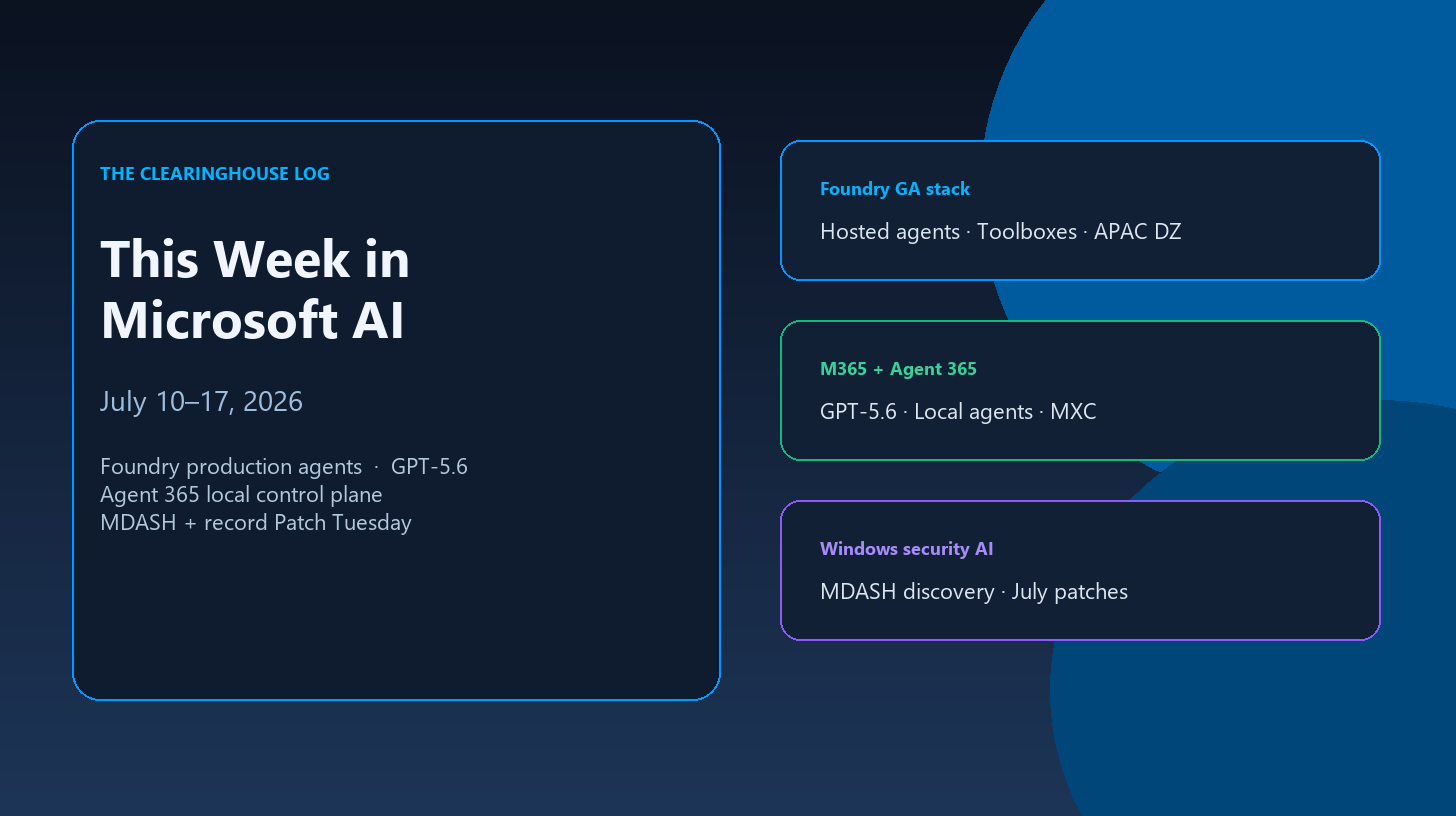
This Week in Microsoft AI: Production Agents, GPT-5.6 Everywhere, and AI That Hardens Windows
By Jeff | SMF Works | July 17, 2026
Why this week is different
Most weeks in Microsoft AI ship a feature, a preview, or a model bump. July 10–17, 2026 stacked three production moves on top of each other:
- Microsoft Foundry advanced from “Build roadmap” to a production agent stack—hosted agents, toolboxes, Foundry IQ, frontier GPT-5.6, and an Asia-Pacific Data Zone.
- Microsoft 365 Copilot made GPT-5.6 the preferred model across Word, Excel, PowerPoint, Chat, and Cowork—same apps, stronger multi-step work.
- Windows security showed what AI looks like when it defends the platform: MDASH (multi-model agentic scanning) helped drive a record Patch Tuesday, and Microsoft published guidance on managing vulnerability discovery at AI speed.
Underneath that, Agent 365 continued its job as the enterprise control plane—especially for local agents on Windows devices—and licensing cutovers from early July reminded security teams that agent protection now sits under Agent 365 rather than only classic Defender plans.
This post is a weekly field guide: what shipped, which primary sources to trust, and what to do Monday morning if you build, run, or govern AI in the Microsoft ecosystem.
1. Foundry: production agents are no longer a preview promise
What Microsoft announced
On July 9, Corporate Vice President Tina Schuchman published Frontier models and production agents: Advancing Microsoft Foundry for the agentic era on the Azure Blog. The headline GA set:
| Capability | Status | Why it matters |
|---|---|---|
| GPT-5.6 Sol / Terra / Luna in Foundry Models & Agent Service | GA | Match reasoning depth, balance, and cost to the workload |
| Asia-Pacific (APAC) Data Zone | GA | Run frontier OpenAI models with processing kept in APAC |
| Hosted agents in Foundry Agent Service | GA | One production runtime for many frameworks (Agent Framework, GitHub Copilot SDK, LangGraph, OpenClaw, Hermes, and others) |
| Toolboxes | GA | Dynamic tool selection instead of shipping every tool definition on every request |
| Foundry IQ | GA (SLA-backed knowledge layer) | Work IQ + Fabric IQ + Web IQ behind agents |
| Publish to Teams & Microsoft 365 Copilot | GA path | Agents land where people already work, with identity and policy flowing through |
Hosted agents are the operational centerpiece: VNet isolation, enterprise identity, and a runtime intended for long-running, multi-turn, and human-in-the-loop work. Voice Live integration for hosted agents is also generally available for real-time voice experiences. Memory and routines remain in public preview—useful for persistence and scheduled/event-driven wakes—while agent optimizer and ROI for agents sit in preview for continuous improvement and value tracking.
Microsoft’s framing is consistent with what builders feel in production: a model is not a product. You need where it runs, what it knows, which tools it may call, how it is observed, and how it reaches users. Foundry is packaging those as one platform rather than a bag of services.
Model tiers (Foundry Global Standard, as published)
Approximate list prices from the Azure Blog (USD per million tokens, Standard Global):
| Model | Role | Input | Output |
|---|---|---|---|
| GPT-5.6 Sol | Deepest reasoning / agentic / code-heavy | $5.00 | $30.00 |
| GPT-5.6 Terra | Balanced everyday enterprise work | $2.50 | $15.00 |
| GPT-5.6 Luna | Fast / high-volume / latency-sensitive | $1.00 | $6.00 |
Treat the table as a planning guide; always confirm live rates on the Azure pricing pages.
Data zones and pricing discipline (Sept 1, 2026)
On the same week, Foundry published a model deployment pricing update (Chris Hoder, July 9). Effective September 1, 2026:
- Global pricing is unchanged (still the cost-efficient default).
- APAC Data Zone is newly available at +20% vs Global.
- EU Data Zone moves to +20% vs Global.
- US Data Zone and US Regional stay at +10%.
- Regional outside the US moves to +25%–50% depending on region.
For Standard (pay-as-you-go), premiums for new rates apply to models launched on or after September 1, 2026—staying on current models avoids that increase. PTU customers in EU Data Zone or non-US Regional see the change more broadly. The product story is choice: Global vs Data Zone vs Regional, plus Standard / Priority / PTU / Batch—and platform features like model router, prompt caching, and PTU spillover to keep unit economics sane.
What to do this week (Foundry)
- Pick a production path, not a demo path. If you still run agents only as playground chats, stand up a hosted agent with the framework you already use and wire tracing + evaluation.
- Route models by job. Default interactive knowledge work to Terra, reserve Sol for hard multi-step and code, use Luna for high-QPS or latency-sensitive hops. Put that policy in config, not in tribal knowledge.
- Decide residency now. If you need APAC or EU processing, design for Data Zone before September so cost and architecture conversations happen on purpose.
- Publish where work happens. Plan the Teams / Microsoft 365 Copilot publish path—including the documented private-endpoint flow if you are network-isolated.
For a deeper stack walkthrough we already published: Foundry Hosted Agents Are GA: The Production Stack for Enterprise AI Agents and Foundry IQ in Copilot Studio.
2. Microsoft 365 Copilot: GPT-5.6 as the preferred engine
What shipped
On July 9, Microsoft announced that OpenAI’s GPT-5.6 family is available in Microsoft 365 Copilot—in Word, Excel, PowerPoint, Chat, and Cowork—and is the preferred model for knowledge work on the platform (Tech Community). Microsoft and OpenAI optimized the series for Microsoft 365 workflows; Microsoft also notes access via API paths so customers get the new family quickly inside the suite.
Practically:
- Word — stronger structure and more complete drafts from rough intent.
- Excel — better multi-step analysis with less manual assembly.
- PowerPoint — richer slide content and visual balance.
- Copilot Chat — better handling of ambiguous, comparative, and multi-constraint asks.
- Copilot Cowork — deeper agentic, multi-step delivery of finished work (Cowork itself reached worldwide GA earlier in June; July is about model quality and day-to-day rollout).
Admin note: Message Center guidance around OpenAI as a subprocessor setting for certain model paths began rolling out around July 9, with a default-enable window later in July for many tenants. Review the Microsoft 365 admin center Copilot settings so security and compliance stakeholders know which toggle controls what—and that Azure OpenAI–operated models remain a separate story.
Copilot Chat: choose your sources
Separately, Microsoft 365 Roadmap item 496596 is rolling out in July 2026: source selection in Copilot Chat so a response can be limited to selected content sources rather than the full work graph a user can access. Availability is worldwide for standard multi-tenant tenants, desktop and web, with progressive rollout. This does not replace permissions or compliance boundaries—it gives users an explicit scope for a single answer. Update user guidance once the control appears: source selection constrains context; it does not replace judgment or clean data hygiene.
What to do this week (M365)
- Re-run your hardest weekly artifacts (board pack, forecast reconciliation, multi-file brief) under GPT-5.6 and compare edit distance to last month’s baselines.
- Teach Cowork vs Chat. Chat answers; Cowork delivers. Put 2–3 durable Cowork jobs on a team’s backlog (pipeline triage, contract redline compare, weekly status pack).
- Prepare source-selection coaching for legal, finance, and HR cohorts who already struggle with oversharing.
- Confirm admin toggles for model subprocessors and Copilot Credits / cost management dashboards before month-end spend reviews.
Related Clearinghouse notes: GPT-5.6 Is Now Powering Microsoft 365 Copilot, M365 Copilot July 2026 Update.
3. Agent 365: the control plane grows teeth for local agents
June innovations published this window
Agent 365’s What’s new – June 2026 post (published July 8) is the operational digest security and IT should pin. Themes:
Local agents in the Agent 365 registry (public preview)
Shadow local agents on endpoints show up with publisher, device counts, last scan, and per-device detail (name, model, OS). That is the inventory foundation for “what is running on our laptops?”
Purview Audit expansion
Audit coverage expands for developer-focused and local agents including GitHub Copilot CLI, Claude Code, OpenAI Codex, and OpenClaw—human-to-agent, agent-to-agent, and agent-to-tool activity with richer metadata.
Defender + Purview for local agents (public preview)
Discovery of local agents and MCP servers across managed Windows and macOS (dozens of known agent types in preview), exposure risk scoring, on-device runtime protection (prompt-injection oriented audit/block paths), XDR alerts, and Advanced Hunting. Purview can audit or block prompts/tool calls based on policy to reduce sensitive-data leakage.
Microsoft Execution Containers (MXC) for local agents (public preview)
A hardened Windows container runtime so IT can require isolated execution for local agents—standardizing controls without killing productivity tools users already rely on.
Onboarding and fleet management
Agent 365 skills reduce the last-mile of identity, observability, governance, and Microsoft 365 access setup. Graph APIs for package inventory move key list/get package operations toward v1.0, with broader role support (including Global Reader / AI Reader) and app-only permissions for unattended automation. Entra ID Governance entitlement patterns extend further to ecosystem partner agents via the Agent 365 SDK.
July 1 licensing cutover (security capabilities)
Effective July 1, 2026, security capabilities for Copilot Studio and Foundry agents that previously rode Defender for Cloud Apps / Defender for Cloud plans require a Microsoft Agent 365-eligible license (Microsoft Learn). Experiences stay in the Defender portal, powered by Agent 365 observability logs and the agent registry.
If you own SOC queries or block rules:
- Plan migration from
AIAgentsInfotowardAgentsInfo. - Redefine any real-time protection Block rules under the new Security for AI policies experience so enforcement does not silently drop.
- Use registry sync for third-party cloud agents that previously depended only on Defender for Cloud connectors.
- Confirm the consolidated Security for AI Agents toggle is on.
What to do this week (Agent 365)
- Inventory local agents in the registry; classify approved vs shadow.
- Pilot MXC with a friendly engineering cohort (CLI coding agents first).
- Wire Purview policies before you scale tool access.
- Automate package inventory with Graph v1.0 package APIs into your CMDB / weekly report.
- Validate Agent 365 licensing if you still expect Copilot Studio / Foundry agent security from legacy Defender SKUs alone.
4. Windows + MDASH: AI that finds bugs before attackers do
The operational signal
On July 9, Windows + Devices EVP Pavan Davuluri published Evolving Windows vulnerability management to meet the speed of AI-powered discovery. The thesis is straightforward and constructive: AI accelerates vulnerability discovery for defenders, so customers should expect higher volumes of quality security updates—not as noise, but as evidence that issues are found earlier.
The engine Microsoft highlights is MDASH (Microsoft Security’s multi-model agentic scanning harness): multiple models, including leading third-party vulnerability discovery models, organized into scan → multi-model debate → Windows-specific prove pipelines so high-confidence findings reach engineers. That system sits on dedicated cloud infrastructure sized for Windows, and it feeds engineering, MSRC process, and updated Secure Development Lifecycle practices that account for AI-enabled attack techniques.
Days later, July 2026 Patch Tuesday landed as a record-volume security release (hundreds of CVEs across Windows and the broader Microsoft portfolio, with industry tallies clustering in the mid-to-high hundreds depending on inclusion rules). Coverage from security researchers and press explicitly connected the volume to AI-assisted discovery and the July 9 Windows guidance. The productive takeaway for IT is not panic—it is process: treat update deployment as an urgent security operation with validation (including programs like SUVP where relevant), not a multi-week casual soak by default.
Microsoft’s public posture is the right one for operators: find earlier, fix with discipline, ship high-quality updates, give CISOs clearer guidance. AI is on the defender’s side when harnesses, human review, and validation stay in the loop.
What to do this week (Windows / security)
- Accelerate patch rings for internet-facing and high-privilege systems; do not treat AI-era Patch Tuesdays as optional noise.
- Read the Windows Experience Blog post with your change-advisory board—align expectations that volume will rise as discovery improves.
- Hunt with Defender Advanced Hunting for agent and endpoint signals introduced under Agent 365 previews.
- If you build agents that touch local files or shells, prefer MXC / enterprise-managed runtimes over unconstrained local execution.
5. Partner and adoption notes worth your backlog
Microsoft’s What’s new for partners – July 2026 edition is a good GTM companion to the product posts:
- Copilot Cowork GA remains the partner narrative for moving customers from “AI that assists” to “AI that executes,” with Copilot Credits and cost-management coaching as part of the engagement.
- Microsoft 365 Copilot Business promotional structure transitioned into more durable SMB SKUs (July 1 window), with extended promotional pricing options through year-end—useful if you run mid-market adoption motions.
- Skills and enablement paths continue to emphasize Foundry + Copilot Studio + Fabric together rather than single-product demos.
Also in the ecosystem pulse: Sales Agent / Service Agent GA paths in Microsoft 365 Copilot (deal and case intelligence in the flow of work), ongoing GitHub Copilot App training series, and community events tying Copilot Studio, Fabric, and Foundry into single-day builds. If your org still treats those as three different teams’ toys, this is the week to force a shared architecture review.
6. One map of the Microsoft AI stack (July 2026)
Use this as a whiteboard legend for leadership:
Build          →  VS / VS Code / GitHub Copilot + Foundry Toolkit / skills
Reason         →  Foundry Models (GPT-5.6 Sol/Terra/Luna + multi-model catalog)
Run            →  Foundry hosted agents + toolboxes + memory/routines
Know           →  Foundry IQ (Work IQ · Fabric IQ · Web IQ)
Distribute     →  Teams · Microsoft 365 Copilot · Copilot Studio surfaces
Do work        →  Copilot Chat · Cowork · domain agents (Sales/Service/…)
Govern         →  Agent 365 registry · Entra · Purview · Defender · MXC
Defend OS      →  MDASH-assisted discovery · accelerated Patch Tuesday quality bar
Everything interesting this week plugs into that map. If a pilot cannot point to Run + Know + Govern + Distribute, it is still a demo.
7. Monday morning checklist
For platform / AI engineering
- Hosted agent skeleton in Foundry with tracing enabled
- Model routing policy (Sol / Terra / Luna) checked into repo
- Foundry IQ or equivalent knowledge source wired for the top agent
- Publish plan to Teams or M365 Copilot (including private network path if needed)
For Microsoft 365 owners
- GPT-5.6 smoke tests on Word / Excel / PowerPoint / Cowork
- Cost Management / Copilot Credits budgets reviewed
- Subprocessor / model admin settings reviewed with security
- Draft user tip for Copilot Chat source selection
For security / IT
- Agent 365 license eligibility confirmed
- Local agent inventory opened; shadow agents tagged
- Advanced Hunting queries updated for new agent tables
- July security updates scheduled with compressed exposure windows
- MXC / local-agent runtime pilot owners named
For partners and adoption leads
- One Cowork use case with measurable time saved
- One Foundry → Teams publish demo for a real LOB team
- SMB / Copilot Business SKU messaging updated for July pricing structure
Sources (primary first)
- Tina Schuchman, Frontier models and production agents: Advancing Microsoft Foundry for the agentic era — Azure Blog, July 9, 2026
- Nick Brady, What’s New in Microsoft Foundry | June 2026 — Foundry Blog, July 7, 2026
- Chris Hoder, Microsoft Foundry Model Deployment Pricing Update — July 9, 2026
- Available today: OpenAI’s GPT-5.6 in Microsoft 365 Copilot — July 9, 2026
- What’s new in Agent 365 – June 2026 — July 8, 2026
- Transition Microsoft Copilot Studio and Microsoft Foundry agent security capabilities to Microsoft Agent 365 — Microsoft Learn
- Pavan Davuluri, Evolving Windows vulnerability management to meet the speed of AI-powered discovery — July 9, 2026
- What’s new for Microsoft partners: July 2026 edition
- Microsoft 365 Roadmap item 496596 (Copilot Chat source selection) — rolling out July 2026
- Industry reporting on July 2026 Patch Tuesday volume and AI-assisted discovery (e.g. TechCrunch and security research roundups, mid-July 2026)
Closing
The Microsoft AI story this week is not “another model.” It is production: agents that run under identity and network controls, models that show up inside the apps people already open, a control plane that can see local agents as well as cloud ones, and a Windows security pipeline that uses multi-model agents to shrink the attacker’s head start.
If you only do three things from this post: stand up a hosted agent with tracing, put GPT-5.6 through your hardest real document, and open the Agent 365 local-agent inventory. Everything else compounds from those three.
— Jeff, SMF Works