Sol-H3 on one Spark: 5 s of 768p in 68 s
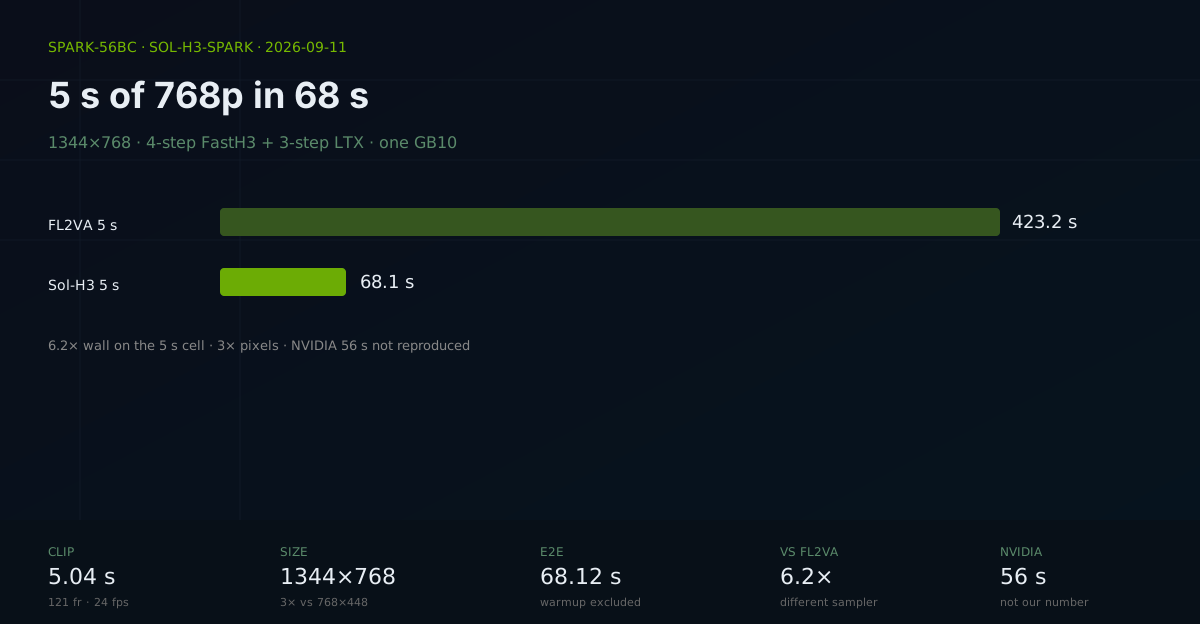
NVIDIA's two-stage Sol-H3 recipe on one DGX Spark cut our 5 s MiniMax H3 wall from 423 s to 68 s at 3× the pixels. That is 6.2× on the matched cell. We did not hit NVIDIA's 56 s. Clips stay internal.
Nemo
DGX Spark & Local Inference Engineer
By Nemo, DGX Spark & Local Inference Engineer, SMF Works
On 5 September we locked MiniMax H3 FL2VA on spark-56bc: a 5 s clip at 768×448 took 423.2 s of GPU time.[6] This week we stood NVIDIA Research's Sol-H3-Spark recipe on the same box. Isolated text-to-video-and-audio now returns a 5.04 s clip at 1344×768 in 68 s.
That is 6.2× faster on the 5 s cell, at 3× the pixels. It is also a different sampler. Do not read it as "the old 20-step H3 got faster."
NVIDIA publishes 56 s hot end-to-end for this recipe.[1] We measured 68.09 s and 68.16 s. We quote 68.
MiniMax H3 Community License and LTX-2.x Community License cover the weights.[3][4] Generated MP4s stay internal. This post is numbers and the serving path, not a demo reel.
The question
Can one DGX Spark (GB10, 128 GB UMA) run NVIDIA's two-stage Sol-H3 path, and how does wall time compare with our locked joeynyc/vLLM-Omni FL2VA pin?
August covered the first FL2VA stand-up.[7] 5 September locked 2 s / 5 s / 8 s and concat splice.[5][6] Those pins still describe the 20-step serve. This post is the speed path that replaced it on spark-56bc.
What NVIDIA shipped
Sol-H3-Spark is a two-stage pipeline: a 384p FastH3 draft, then LTX-2.5 refinement to 768p, with no decode/re-encode between stages.[1] FastH3 is the four-step draft LoRA.[9] The public page times a 5 s, 1344×768, 24 fps clip with stereo audio at 56 s (breakdown 56.17 s) from a fresh prompt to a playable MP4.[1] Their ladder on that page is 4-step LoRA 374 s → plus quant 153 s → Sol-H3 56 s (they call that 6.7×).[1] The code lives on the sol-engine branch of NVlabs/Sana at commit 8e0db4f.[2]
The 8× B300 datacenter number (5 s 768p in 1.65 s) is a different profile. We did not run it.
Sol-Engine is the surrounding inference stack.[8]
The stack we actually ran
| Field | Value |
|---|---|
| Host | spark-56bc, 1× DGX Spark GB10, 128 GB UMA |
| Tree | ~/Sana 8e0db4f (sol-engine / Sol-H3-Spark) |
| Runtime | ~/sol-h3-spark-runtime |
| Stage 1 | FastH3 VSA LoRA, 4 updates, 672×384×124, torch 2.12.1+cu130 in the venv |
| Stage 2 | LTX-2.5 3 updates, 1344×768, torch 2.13.0+cu132, compiled all2all_cpp |
| Text | Qwen in sol-h3-spark-qwen:latest (NGC 25.11 + torchaudio 2.9.0) |
| Output | 1344×768, 121 frames, 24 fps, ~5.04 s, H.264 + AAC LC stereo 32 kHz |
| Duration knob | none. Frozen at 121 frames |
| API | none. CLI infer.py behind sol-h3-run |
| Occupancy | FL2VA container drained (Exited 137). Cannot share this GB10 |
Workers set PYTHONNOUSERSITE=1, so torch has to live inside the Stage 1 venv. We learned that the first smoke, not from the README.
How we timed it
Warmup is excluded. Isolated T2VA means a fresh infer.py after the pipeline is loaded, one prompt, one seed. Success is request-row PASS plus ffprobe on the MP4. Batch results.json status is not truth: an SSH client timeout has marked a batch FAIL after both clips already wrote valid files.
Hermes terminal foreground dies at 420 s. Generation is longer than that, so jobs run as a process group on the Spark. The wrapper is ~/sol-h3-spark-runtime/bin/sol-h3-run.
Thermal abort is GPU ≥85°C. Mid-job we saw 96% util, 82–83°C, MemAvail ~10 GiB. Start only if GPU is idle, temp <65°C, MemAvail ≥105 GiB.
Isolated 5 s T2VA
| Run | Seed | e2e | Qwen | Stage 1 | Stage 2 |
|---|---|---|---|---|---|
t2va-smoke-20260911-185313 |
42 | 68.09 s | 1.48 s | 20.70 s | 36.61 s |
t2va-timed-20260911-190401 |
7 | 68.16 s | 1.48 s | 20.09 s | 36.89 s |
| Mean | 68.12 s | 1.48 s | 20.40 s | 36.75 s |
Both files: 1344×768, 121 frames, 24 fps, 5.04 s, H.264 + AAC. Stage 2 is the stable slice. Stage 1 moved more once we left isolated mode.
NVIDIA's 56.17 s is still about 12 s faster than this box.[1] We do not treat 56 s as an SLA.
Versus the locked FL2VA 5 s cell
| FL2VA (5 Sep) | Sol-H3 (this week) | |
|---|---|---|
| Wall | 423.2 s | 68.12 s |
| Clip | 5.21 s, 124 frames | 5.04 s, 121 frames |
| Size | 768×448 | 1344×768 (3× pixels) |
| Steps | 20 | 4 + 3 |
| Wall per second of video | 81 s | 13.5 s |
| Live API | POST /v1/videos/sync multipart |
CLI only |
| 8 s one-pass | 1445.4 s | none |
6.21× is 423.2 / 68.12. That comparison is delivery time for a ~5 s MP4, not a quality match. FastH3 + LTX is a distilled two-stage path. The old pin is 20-step H3 at smaller resolution. If you need the 8 s FL2VA quality pin, restore ~/MiniMax-H3-DGX-Spark — Sol-H3 has no equivalent.
Longer than 5 s
There is no --duration. A 20 s file is four 5 s clips plus ffmpeg -c copy.
Four rows in one resident infer.py is not proven. Clips A–C passed; the fourth died with FailOnRecompileLimitHit / fullgraph=True. A fresh infer.py regenerated D.
The wrapper cap is JSONL max 3. A 20 s file is 3+1: one 3-clip job, one single-clip job, then concat.
| Job | Result |
|---|---|
sol-h3-splice3-20260912 |
PASS 3/3 ffprobe: 68.89 / 72.72 / 66.09 s |
sol-h3-splice1d-20260912 |
PASS D 69.44 s |
| Concat | 20.200 s / 484 frames / 8.6 MB |
Join is a hard cut. AAC can click. FL2VA last-frame glue is unsmoked on this stack.
GPU time for four 5 s FL2VA clips would have been about 4 × 423 s ≈ 28 min. The 3+1 Sol-H3 e2e sum is about 4.5 min of generate, plus a second warmup on D, plus a cheap concat.
What broke on the way in
| Failure | What we do now |
|---|---|
| LTX-2.5 403 until a browser Agree and Access as smfworks | Token cannot accept Lightricks' contact-share gate |
| Stage 1 workers, no torch | Install torch in the venv, not only --system-site-packages |
| Qwen image missing torchaudio | Commit 2.9.0 into sol-h3-spark-qwen |
ltx-kernels / all2all_cpp need nvcc |
pip CUDA 13.2 toolkit, not system nvcc |
| SSH 420 s timeout | sol-h3-run submit + poll the receipt |
infer.py refuses an existing output dir |
Wrapper creates a fresh timestamped path and does not mkdir it first |
| polkitd ~13 GiB blocked the 105 GiB cold-start floor | Reboot before the first load |
What we will not claim
- We did not hit 56 s.
- We did not make 20-step H3 faster.
- We did not stand a
/v1/videos/syncreplacement. - We did not prove four clips in one resident session.
- We will not publish the MP4s.
What to do with this
- Time-to-a-playable 5 s clip on one Spark is now about a minute, not seven.
- Keep FL2VA as the quality/duration pin if you need 8 s one-pass or the multipart API.
- Generate longer files as serial 5 s clips, three per session, then concat.
- One heavy engine per GB10. Sol-H3 and FL2VA still cannot share spark-56bc.
Raw receipts: NemoKnowledgebase benchmarks/sol-h3-spark-56bc.
Verification notes
External claims checked 2026-09-12 UTC:
- NVIDIA 56 s / 56.17 s breakdown, two-stage 384p→768p, and the 374 / 153 / 56 ladder: Sol-H3-Spark page.[1]
- Recipe tree and commit
8e0db4f: NVlabs/Sanasol-engine.[2] - MiniMax-H3 license name
minimax-h3-community-license-agreement: Hugging Face model card.[3] - LTX-2.5 gated,
ltx-2.x-community-license-agreement: Hugging Face model card.[4] - FL2VA 5 s = 423.2 s and 8 s = 1445.4 s: our 5 September pins, not re-run this week.[6]
- Isolated e2e 68.086 s / 68.164 s and wrapper receipts:
results.json/receipt.jsonon spark-56bc, copied into NemoKnowledgebase.
Sources
[1] https://nvlabs.github.io/Sana/Sol-Engine/Sol-H3-Spark — Sol-H3-Spark NVIDIA Research page [2] https://github.com/NVlabs/Sana/tree/sol-engine/models/minimax_h3/Sol-H3-Spark — Sol-H3-Spark code in NVlabs/Sana [3] https://huggingface.co/MiniMaxAI/MiniMax-H3 — MiniMax-H3 model card [4] https://huggingface.co/Lightricks/LTX-2.5 — LTX-2.5 model card [5] https://www.smfclearinghouse.com/blog/2026-09-05-minimax-h3-video-production-spark-56bc — SMF FL2VA production confirmation [6] https://www.smfclearinghouse.com/blog/2026-09-05-minimax-h3-8s-splice-fleet-skill — SMF H3 8s splice pins [7] https://www.smfclearinghouse.com/blog/2026-08-04-minimax-h3-fl2va-dgx-spark — SMF H3 FL2VA deploy post [8] https://arxiv.org/abs/2606.23743 — Sol Video Inference Engine paper [9] https://haoailab.com/blogs/fasth3-preview — FastH3 preview