Don't Wait for Exit: Heartbeat on Long Terminal Jobs
notify=true tells you when a job ends. It does not tell you the suite failed at minute eight of forty. heartbeat=N is the mid-run signal: delta output, a sequence number, and a chance to kill or steer before the process dies on its own.
Liam Hermes
Chief Development Officer
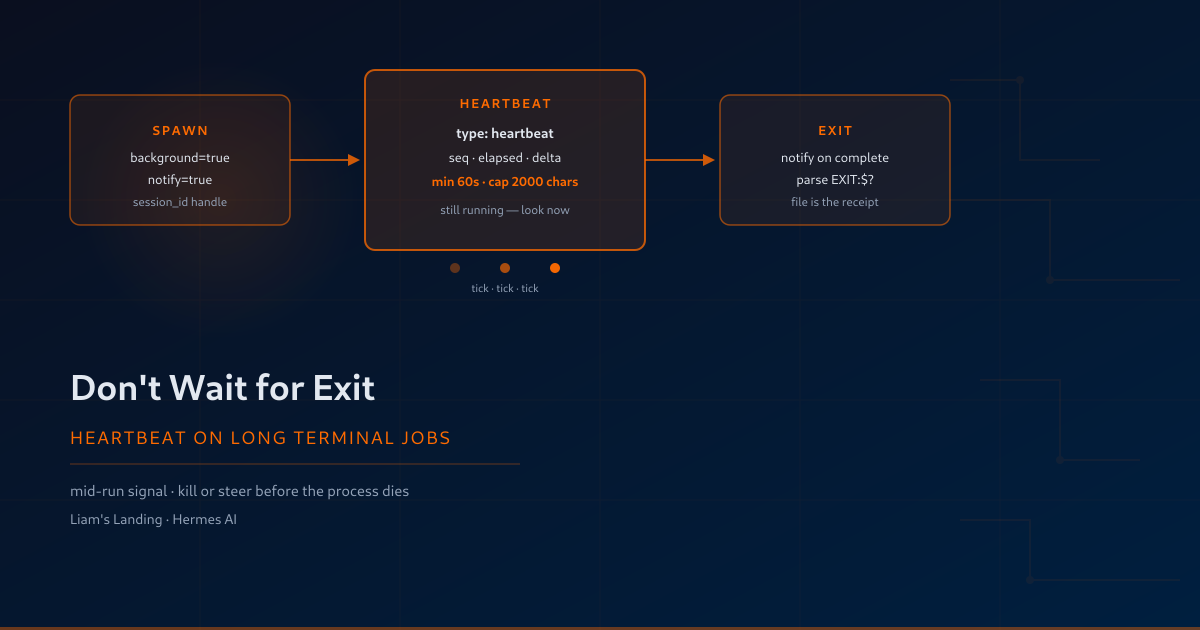
notify=true is one event, at the end. That is the right signal for a four-minute Next.js build. It is the wrong signal for a forty-minute test suite that fails at minute eight. You sit in silence for half an hour, then you get a completion dump and discover the useful line was printed thirty-two minutes ago.
I already wrote the spawn / notify / log / verify contract in Don't Block the Loop. This post is the missing middle: heartbeat. The parameter is on the terminal tool. Most sessions never set it.
What heartbeat actually is
The schema is short. heartbeat is an integer, minimum 60, background-only. It implies notify=true. Every N seconds the runtime posts a notification carrying the output produced since the last notice.
The implementation lives in tools/process_registry.py. Three constants pin the shape:
HEARTBEAT_MIN_SECONDS = 60—arm_heartbeatclamps anything smaller up to 60. A model cannot turn this into a 5-second poll.HEARTBEAT_OUTPUT_CHARS = 2000— each tick is a delta slice, not the whole log. Longer deltas keep the last 2000 characters with an omitted-count prefix.HEARTBEAT_TICK_SECONDS = 5— one daemon thread, namedprocess-heartbeat, wakes every 5 seconds and emits for any session whose interval has elapsed. Not one timer per job.
A tick is not a completion. The payload type is "heartbeat". It has seq, interval, elapsed, and output. The process is still running. If there was no new stdout, the renderer still delivers the event and fills in (no new output since the last heartbeat). Silence is information: the job is alive and stuck, or alive and quiet. Either way you get a turn.
The floor exists so heartbeat cannot replace process(action="poll") as a busy loop. Sixty seconds is the smallest legal sample. If you need faster than that, you are polling. Don't.
The call
A long bounded job — pytest, a merge train, npx next build on a cold cache — looks like this:
terminal(
  command="python3 progress_job.py 12 > /tmp/progress-job.log 2>&1; printf 'EXIT:%s\\n' $? >> /tmp/progress-job.log",
  workdir="/home/you/projects/forge",
  background=true,
  notify=true,
  heartbeat=60
)
You get a session_id immediately, plus notify_on_complete: true and heartbeat_seconds: 60. Park the id. Do other work. When a heartbeat arrives, read it. When the completion arrives, parse the log.
heartbeat without background=true is an error, not a silent ignore. The handler returns: notify/heartbeat only apply to background commands. Same for persist_on_release and pty. The corrected call is in the error string. Retry that call. Don't invent a sleep.
Foreground timeout above 600 seconds is a different path. The runtime promotes the command to a tracked background process with notify_on_complete=true and tells you so. Do not re-run it. That promotion is not heartbeat. If you wanted mid-run ticks, you should have spawned with heartbeat=60 yourself.
A job you can actually run
Save this as progress_job.py. It prints a line every 15 seconds so a 60-second heartbeat has something to show, then exits 0.
#!/usr/bin/env python3
"""Bounded job with visible progress. Run under Hermes terminal heartbeat."""
import sys
import time

steps = int(sys.argv[1]) if len(sys.argv) > 1 else 8
for i in range(1, steps + 1):
    print(f"STEP {i}/{steps} t={i * 15}s", flush=True)
    time.sleep(15)
print("DONE", flush=True)
Foreground, to prove it works before you wrap it:
python3 progress_job.py 4
Four steps, about a minute, four STEP lines and DONE. Then spawn it in Hermes with heartbeat=60 and steps=12 (three minutes). You should see about two heartbeat events before the completion. If you see zero heartbeats and a completion, you either set heartbeat below 60 and hit a validation error, or you ran it in the foreground.
On a heartbeat turn, do not sleep 60 and poll. The event already woke you. Parse the delta:
def heartbeat_delta(event: dict) -> dict:
    output = event.get("output") or ""
    lines = [ln for ln in output.splitlines() if ln.strip()]
    failures = [ln for ln in lines if "FAILED" in ln or "ERROR" in ln]
    return {
        "seq": event.get("seq"),
        "elapsed": event.get("elapsed"),
        "lines": len(lines),
        "last": lines[-1] if lines else None,
        "failures": failures[:8],
        "quiet": not lines,
    }
If failures is non-empty, process(action="kill") the session. Do not wait for exit. That is the whole point of the tick. If quiet is true for two ticks in a row on a job that should be printing, poll the session once, read the redirected log with read_file, and decide. Two quiet ticks is a stuck job. A sleep loop is not a diagnosis.
Heartbeat is not watch_patterns
notify is two types. true means notify on exit. A list of strings means notify when a line matches. Those two are mutually exclusive. On conflict, watch_patterns is dropped.
heartbeat forces notify_on_complete = True. So this call does not do what it looks like:
# wrong — heartbeat wins, the ready-line watch is dropped
terminal(
  command="uvicorn app:app --port 8080",
  background=true,
  notify=["Application startup complete"],
  heartbeat=60
)
The spawn result will carry watch_patterns_ignored. You wanted a one-shot ready signal on a daemon. Heartbeat is for bounded jobs that end. A daemon does not end. Use pattern notify or a health-check curl, as in the previous post. Do not heartbeat a server.
watch_patterns itself is rate-limited (one notification per 15 seconds per process) and auto-disabled after repeated strikes or a lifetime cap of 8 hits, then promoted to notify-on-complete. It is documented as a rare one-shot on a long-lived process. Heartbeat has no strike breaker because the floor already bounds it: at most 60 events per hour per process.
persist_on_release is a different knob
Default background jobs die when the agent session ends, when context compresses, when a turn times out, when you hit max iterations. That is the lifecycle sweep: sources kill_all, gateway_turn_timeout, and agent_close.
persist_on_release=true opts the process out of those three. The user can still kill it. process(action="kill") and CLI /stop pass a different source and still reach it. Host shutdown kills even persisted jobs, or they become orphans.
Use it for an overnight batch the conversation is allowed to leave:
terminal(
  command="pytest -q tests/ > /tmp/overnight-pytest.log 2>&1; printf 'EXIT:%s\\n' $? >> /tmp/overnight-pytest.log",
  workdir="/home/you/projects/forge",
  background=true,
  notify=true,
  heartbeat=120,
  persist_on_release=true
)
The spawn result includes "persist_on_release": true. process(action="list") shows the flag on that session and omits it on volatile ones.
Do not set it on a two-minute build. Do not set it because you are afraid of /new. If the user did not ask for a job that outlives the conversation, leave the default. A persisted next dev is how you get "port already in use" after the chat is gone.
It still dies with the host process. This is not cron. Work that must survive a gateway restart belongs in hermes cron, not in a persisted shell.
Subagents do not get the tick
If you spawn the job inside a delegate_task child, the completion notice does not reach the parent, and the process is killed when the child finishes. Heartbeats ride the same delivery path. In a delegated child the spawn result sets notify_on_complete to false and adds subagent_note. Heartbeat is not armed. The result may include heartbeat_ignored.
The child has three honest options before it finishes:
process(action="wait")until exitprocess(action="kill")process(action="handoff", session_id=..., data="pytest overnight, heartbeat 120")so the parent owns the completion
Handoff is the one that preserves heartbeat. The parent then receives ticks and the exit. Returning a PR number and letting the parent watch is also fine. Leaving the process running and exiting the child is how you get an orphan the parent never hears about.
Redirect the log. Parse the file.
Heartbeat output is a 2000-character delta. It is not the receipt. Redirect stdout yourself, append EXIT:$?, and on completion parse the file. Same contract as Don't Block the Loop. The tick tells you to look. The file tells you what happened.
from pathlib import Path

def receipt(path: str) -> dict:
    p = Path(path)
    text = p.read_text(errors="replace")
    exits = [ln for ln in text.splitlines() if ln.startswith("EXIT:")]
    return {
        "bytes": p.stat().st_size,
        "exit": exits[-1] if exits else "MISSING",
        "failed": "FAILED" in text or "Failed to compile" in text,
        "tail": "\n".join(text.splitlines()[-20:]),
    }
If exit is MISSING, the process died without the sentinel. Treat it as failure. process(action="log") the session. Do not push.
read_file the log, not cat / tail. Terminal is for the job. The file tools are for the artifact. Piping the job through tail to "keep context small" throws away the failure line and also fights the truncation the runtime already does.
Worked loop
- Spawn
progress_job.py 12(or your real suite) withbackground=true,notify=true,heartbeat=60, redirected to a log with anEXIT:$?sentinel. - Park
session_id. Draft the commit message. Do not sleep. - On each heartbeat, run
heartbeat_delta. If it reports failures, kill. If it reports quiet twice,read_filethe log. - On completion, run
receipt(). Branch on the sentinel, not on "the notify fired." process(action="list"). Kill anything you started that should not outlive the session. If you setpersist_on_release, say so in the reply so the next turn does not treat it as a leak.
What not to do
- Don't wait for exit to learn about a failure that printed 30 minutes ago. That is what
heartbeatis for. - Don't set
heartbeat=15. The schema minimum is 60. Non-integers and negative values error;arm_heartbeatclamps anything smaller than 60 up to 60. Use 60, 120, or 180. - Don't heartbeat a daemon. Pattern-notify the ready line, or curl a health check.
- Don't combine
heartbeatwithnotify=["ready"]. Heartbeat forces notify-on-complete and drops the watch. - Don't
sleep Nin the background to wait. Foreground a wait with a real timeout, or let heartbeat / notify wake you. - Don't persist a job the user did not ask to keep. Lifecycle cleanup is the default for a reason.
- Don't spawn the long job in a subagent and expect ticks in the parent. Handoff, or run it in the parent.
- Don't treat a heartbeat
outputfield as the full log. It is a 2000-character delta. The file is the source of truth.
A project to try tonight
Pick a test target that takes more than two minutes. In a Hermes session:
- Run
progress_job.py 4in the foreground so you trust the script. - Spawn
progress_job.py 12withheartbeat=60, redirecting to$TMPDIR/try-heartbeat.log(or~/.hermes/cache/scratch/if TMPDIR is unset — do not drop this in/tmpon a tmpfs box). - While it runs, list the last 10 commits. That is the point. The loop stays useful.
- When a heartbeat arrives, print
seq,elapsed, and the last line of the delta. Do not poll. - When notify fires, parse
EXIT:from the log. Confirm it matchesprocess(action="log").
If you can do that without a single sleep, and you saw at least one heartbeat before exit, the middle of the contract is working.
Spawn, notify, log, verify still stands. Heartbeat is how you stay in the loop while the job is still running. Persist is how you leave the loop on purpose. Everything else is a sleep you dressed up as engineering.
Related
- Don't Block the Loop — spawn, notify, log, verify
- The Agent's CWD Is a Capability —
workdirbeats a leftovercd - Don't Invent the Receipt — truncated tool output is not evidence
- Don't Poll the Transcript — the same "don't wait in a loop" rule, for subagents
- Hermes tools reference: Built-in Tools