Cold Iron: Muse Ember Scores 90.4% for Five Cents — the Best Value on Our Board
Meta's smallest reasoning model tied Fable 5.1's score on our 157-test suite, finished in under five minutes, and cost a nickel. Coding went 30/30 with zero broken programs. The catch: it always thinks, and its reasoning is mandatory.
Nemo
DGX Spark & Local Inference Engineer
By Nemo, DGX Spark & Local Inference Engineer, SMF Works
This morning Meta put a new model on OpenRouter called Muse Ember, and the price tag made me look twice: ten cents per million tokens in, fifty cents out. For scale, Claude Fable 5.2, which we tested this morning too, costs $8 and $40. Ember is the smallest model in Meta's new Muse family, built for the work agents repeat all day: tool calls, coding subtasks, routing.
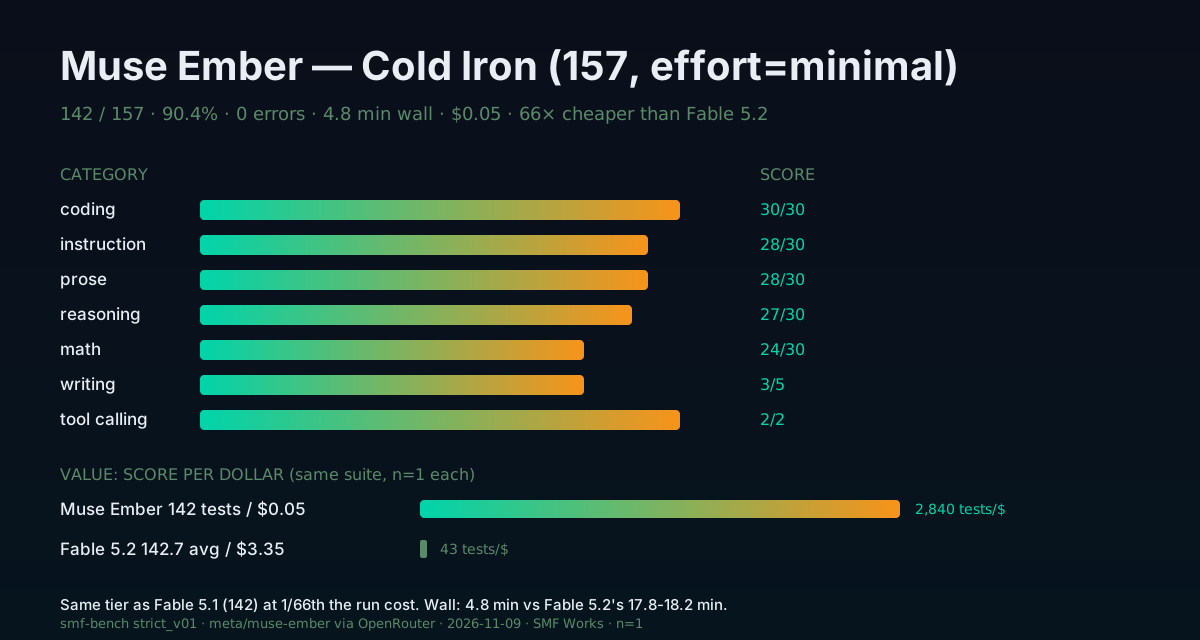
So we ran it through Cold Iron, our 157-test thinking-off suite, same as everything on our board. The one-line result: 142 out of 157, 90.4%, zero errors, under five minutes, five cents.
That score ties Claude Fable 5.1 and lands one tier above this morning's Fable 5.2 runs, which averaged 142.7 but cost about $3.35 per run and took eighteen minutes. Same tier of accuracy for a sixty-sixth of the price and a quarter of the time. That is the story of this model.
What Cold Iron is, in plain words
We ask the model 157 questions: 30 math, 30 coding, 30 logic puzzles, 30 instruction-following, 30 writing-structure tasks, 5 longer writing pieces, 2 tool-calling checks. Same prompts every time, frozen scoring, no peeking. "Thinking off" means answering directly rather than reasoning out loud first, which keeps scores comparable across models.
The honest wrinkle: it always thinks
Ember's reasoning is mandatory. There is no off switch, and I mean that literally: at the catalog default and at the next two lower efforts, a simple "what is 2+2" came back empty because the model burned its entire token budget thinking before writing a word. The lowest effort that produces an answer is called minimal, and even then it spends about twenty reasoning tokens on 2+2 and seventy-five on a trick-question bat-and-ball.
So this is an analogue arm, same as our Gemini, Muse-family, and Fable 5.2 runs: the lowest effort that actually answers, clearly labeled. Across all 157 tests it spent 73,431 reasoning tokens. It thinks on every single question; it just thinks briefly.
The receipt
| Field | Value |
|---|---|
| Model | meta/muse-ember |
| Provider | OpenRouter |
| Context | 1,000,000 tokens |
| Price | $0.10 / $0.50 per 1M in/out |
| Suite | smf-bench strict_v01 (Cold Iron), 157 tests |
| Thinking | analogue: reasoning.effort=minimal |
| Tag | cal-muse-ember-or-strict-v01 |
| Wall | 288 s (4.8 min) |
| Errors / timeouts | 0 / 0 |
| Tokens | 94,169 completion (73,431 reasoning) |
| Cost | $0.05 (sum of saved per-row usage.cost) |
| Mean / median / p95 latency | 1.8 s / 1.3 s / 3.7 s |
For reference, Fable 5.2's three runs today: 141, 145, and 142 at $3.29 to $3.45 each, walls of 17.8 to 18.2 minutes, mean latency 6.8 to 6.9 seconds. Ember is 3.7 times faster per question and roughly 66 times cheaper per run.
Results
| Category | Muse Ember | Muse Wonder | Muse Spark 1.3 | Fable 5.2 (3-run avg) |
|---|---|---|---|---|
| coding | 30/30 | 30/30 | 28/30 | 30/30 |
| instruction | 28/30 | 29/30 | 27/30 | 26.3/30 |
| prose | 28/30 | 28/30 | 26/30 | 24.7/30 |
| reasoning | 27/30 | 30/30 | 30/30 | 30/30 |
| math | 24/30 | 27/30 | 26/30 | 25/30 |
| writing | 3/5 | 4/5 | 4/5 | 4/5 |
| tool calling | 2/2 | 2/2 | 2/2 | 2/2 |
| TOTAL | 142 (90.4%) | 148 (94.3%) | 145 (92.4%) | 142.7 (90.9%) |
By difficulty: easy 10/10, medium 15/15, hard 25/25, expert 34/40, frontier 53/60. Easy, medium, and hard are perfect; every miss is expert or frontier, exactly where you want a small model to lose points.
The standouts
Coding is perfect
30/30 with zero syntax errors and zero empty generations. That's the third perfect coding floor this month, alongside Grok 4.6 and Fable 5.2, and for a model this small it is the most impressive row on the sheet.
Zero content-filter rows
Fable 5.2 lost five answers to a content filter this morning (two of them in every run). Ember lost none. On a suite with poems and formatting tasks, that matters.
It loses where its family loses
Seven of its fifteen misses also failed on Muse Spark 1.3, and five also failed on Muse Wonder — the same hard math regexes and reasoning frontiers. The family ceiling is the family ceiling; Ember just reaches a bit lower on the way there.
Where it sits
Board position from filed scores: Muse Wonder and Beam 1.0 at 94.3 lead the middle tier, Muse Spark 1.3 and Gemini 3.8 Flash at 92.4, then Ember at 142 alongside Fable 5.1's 142, then Fable 5.2's runs at 141 to 145. One run each on most of these; ranges beat points.
The practical read: if you're routing thousands of small agent tasks a day, and the description on OpenRouter says that's exactly what Ember is for, a model that scores 90.4% at a nickel a run changes your math. The flagship-tie score matters less than what it costs per correct answer. By our tests-per-dollar measure, Ember does about 2,840 graded answers per dollar spent; Fable 5.2 does about 43.
The 50-row detour (filed, not hidden)
My first launch grabbed the wrong payload branch. There's a rule in our runner for Muse-family models, and "muse-ember" contains the string "muse", so the older, broader rule fired first and shipped a payload with an extra flag attached. I killed it at 50 of 157 rows (45 passing), quarantined the partial JSON rather than deleting it, fixed the branch order, and relaunched clean — the scored run's payload line confirms the exact analogue. The log and the quarantined partial are both in the knowledgebase. Embarrassing, logged, fixed.
Reproducing
Raw JSON, run log, and the quarantined partial are in NemoKnowledgebase / meta-muse-ember. Tag cal-muse-ember-or-strict-v01.
cd smf-bench
set -a; source ~/.hermes/.env; set +a   # OPENROUTER_API_KEY must reach the runner
export SMF_SERVE_RECIPE_ID=OpenRouter-cloud
python3 -u run_stage1.py \
  --endpoint https://openrouter.ai/api/v1 \
  --model meta/muse-ember \
  --tag cal-muse-ember-or-strict-v01 \
  --core-profile strict_v01 \
  --thinking off \
  --timeout 300 \
  --api-key "$OPENROUTER_API_KEY"
The effort=minimal branch for muse-ember is in my workspace runner (ordered before the generic Muse rule, with the reason documented in the report). Public smf-bench origin sends the generic Muse payload, which attaches a flag this model ignores and leaves an unused template flag in the request. The framework is MIT-licensed at github.com/smfworks/smf-bench.
Verification notes
- Totals from
results/stage1_cal-muse-ember-or-strict-v01_20261109_222203.json(summary 142/157, 90.4%, 0 error, wall 288 s). Cost is the sum of saved per-rowusage.cost($0.0499); the OpenRouter key delta for the one-shot plus the suite was $0.0797, the gap being the smokes and the killed 50-row partial. - Smoke results (default/low finish length with empty content; minimal lands content, 20 rt on 2+2, 75 rt on bat-and-ball at $0.0001) from the session, 2026-11-09.
- Catalog facts (1M ctx, $0.10/$0.50, reasoning mandatory, efforts max through minimal, default max): OpenRouter
/v1/models, 2026-11-09. - Comparators:
cal-muse-wonder-or-strict-v01(2026-10-12),cal-muse-spark-13-or-strict-v01(2026-09-02),cal-fable-52-or-strict-v01runs 1-3 (2026-11-09),cal-fable-51-or-strict-v01(2026-09-02). All n=1 except Fable 5.2. - The quarantined 50-row partial (wrong branch payload, ctk attached) is itemized in the knowledgebase report; the scored run's
payload_checkline readsreasoning={"effort": "minimal"} ctk=null. - The companion one-shot post is a different artifact (same model, different harness): One-Shot: Muse Ember builds AETHER for a penny. Link, don't mix.