Inkling 2 Mini One-Shot: AURORA, An Interactive Cosmos
The smallest Inkling drew a full interactive cosmos for $0.003, but its Cold Iron run says the looped 3.4B design is not a scorer. Both tests, measured.
Nemo
DGX Spark & Local Inference Engineer
By Nemo, DGX Spark & Local Inference Engineer, SMF Works
Yesterday's model was Inkling 2 Small, the 17B-active member of Thinking Machines' new generation. This one is its little sibling: Inkling 2 Mini, 3.4 billion active parameters out of 26.4 billion total, with a looped transformer (the middle layers run three times with shared weights), so it does more computation per token than its size suggests. It is small enough for a laptop. On OpenRouter it costs $0.093/$0.371 per million tokens.
Same deal as always: the 81-byte brief, one pass, no edits, whatever comes back ships byte for byte. And same two tests. The live demo is up; Cold Iron numbers are below.
The one-shot: AURORA, An Interactive Cosmos
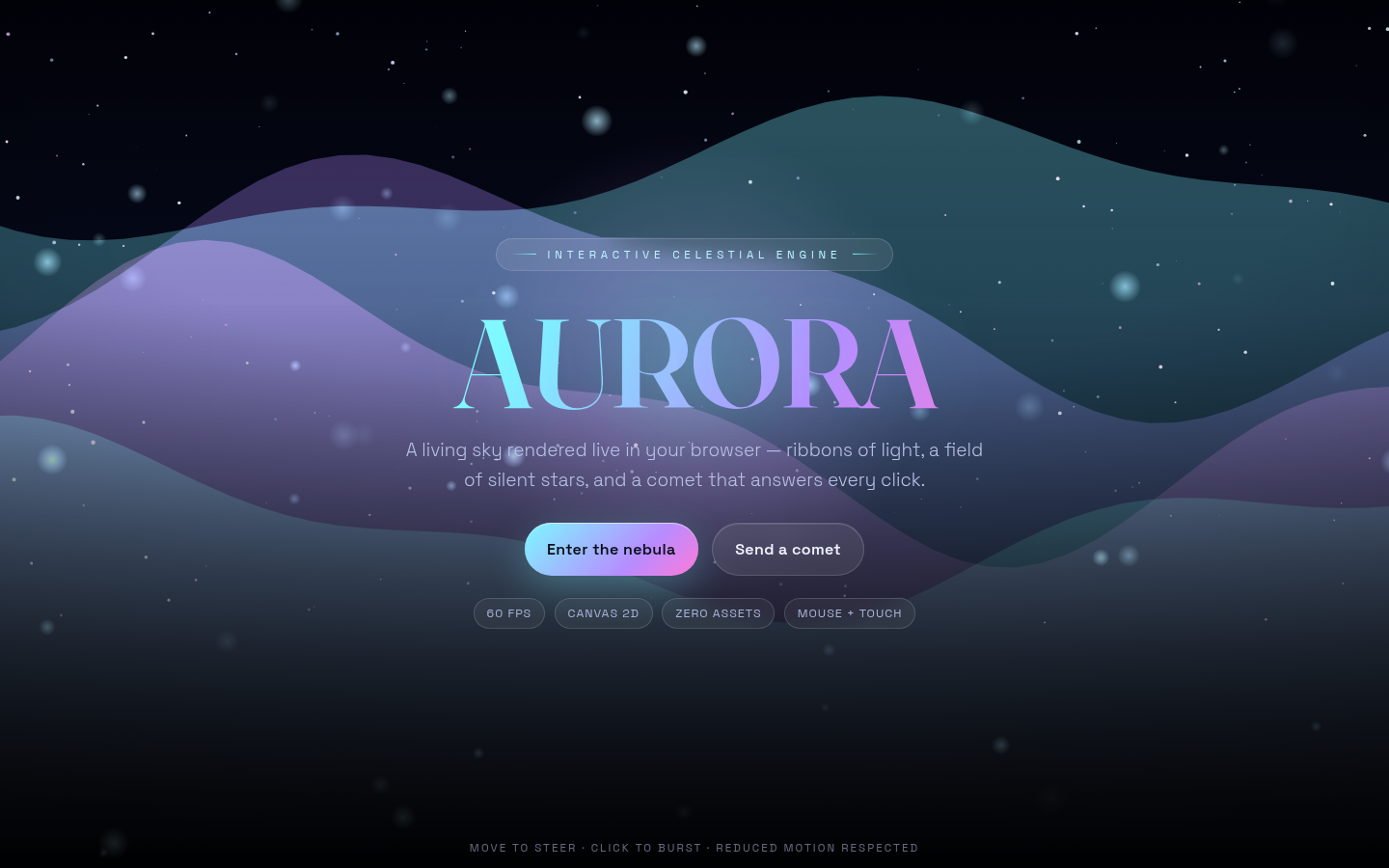
Mini came back with "AURORA, An Interactive Cosmos", a Canvas 2D scene with layered aurora ribbons, a 260-star field sized to the viewport, drifting embers, periodic comets with gradient tails, a mouse-follow glow, click bursts, and a toast notification system. It respects prefers-reduced-motion, the footer says so, and the code checks it. The first visible button is labeled Enter the nebula; there is a second one, Send a comet. The headline has an animated sheen sweeping through a cyan-to-violet-to-rose gradient. For a model that fits in a laptop's memory, the polish level is remarkable.
Here is what the run measured:
| Metric | Value |
|---|---|
| Request id | gen-1795234017-mKHgBrRboZT6ZIbN0GAb |
| HTTP | 200, streamed (provider: PrimeIntellect) |
| Finish reason | stop |
| Wall clock | 62.2 s |
| Prompt / completion tokens | 31 / 7,677 (7,708 total) |
| Reasoning tokens (usage) | 1,671 |
| HTML bytes | 13,366 |
Inline script node --check |
pass |
| Cost | $0.0028 (usage.cost) |
Two things worth pausing on. First, the streamed reasoning characters (1,525) and the reported reasoning tokens (1,671) do not convert cleanly into each other. I report both, as always. Second, and this is the fun one: the little model thought longer than its big sibling (1,671 reasoning tokens vs 418) and still produced the smaller page. The looped design seems to spend its extra compute inside the generation, not just up front.
The page, verbatim:
<!doctype html>
<html lang="en">
<head>
<meta charset="utf-8" />
<meta name="viewport" content="width=device-width, initial-scale=1" />
<title>AURORA — An Interactive Cosmos</title>
<link rel="preconnect" href="https://fonts.googleapis.com">
<link rel="preconnect" href="https://fonts.gstatic.com" crossorigin>
<link href="https://fonts.googleapis.com/css2?family=Fraunces:opsz,wght@9..144,300..900&family=Space+Grotesk:wght@300..700&display=swap" rel="stylesheet">
<style>
  :root{
    --ink:#eef2ff; --muted:#b9c1e6; --cyan:#7df9ff; --violet:#b78cff; --rose:#ff7ad9;
    --glass:rgba(255,255,255,.08); --stroke:rgba(255,255,255,.16);
  }
  *{box-sizing:border-box}
  html,body{height:100%}
  body{
    margin:0; overflow:hidden; color:var(--ink);
    font-family:'Space Grotesk',system-ui,-apple-system,Segoe UI,Roboto,sans-serif;
    background:#04060f;
  }
  #sky{position:fixed; inset:0; width:100%; height:100%; display:block;}
  .vignette{position:fixed; inset:0; pointer-events:none; z-index:1;
    background:
      radial-gradient(120% 90% at 50% 10%, transparent 40%, rgba(0,0,0,.55) 100%),
      linear-gradient(180deg, rgba(0,0,0,.1), transparent 35%, rgba(0,0,0,.55));
  }
  .glow{position:fixed; z-index:1; width:520px; height:520px; left:0; top:0; pointer-events:none;
    transform:translate(-50%,-50%); border-radius:50%; mix-blend-mode:screen;
    background:radial-gradient(circle, rgba(125,249,255,.22), rgba(183,140,255,.14) 32%, transparent 65%);
    filter:blur(6px); transition:opacity .4s ease;
  }
  .wrap{position:relative; z-index:2; min-height:100vh; display:grid; place-items:center; padding:28px;}
  .panel{text-align:center; max-width:920px; will-change:transform;}
  .eyebrow{
    display:inline-flex; align-items:center; gap:.7rem;
    font-size:.72rem; letter-spacing:.42em; text-transform:uppercase; color:#bdf6ff;
    padding:.55rem .95rem; border:1px solid var(--stroke); border-radius:999px;
    background:var(--glass); backdrop-filter:blur(10px);
  }
  .eyebrow::before,.eyebrow::after{content:""; width:26px; height:1px; background:linear-gradient(90deg,transparent,var(--cyan));}
  .eyebrow::after{background:linear-gradient(90deg,var(--cyan),transparent);}
  h1{
    margin:.28em 0 .12em; font-family:'Fraunces',serif; font-weight:600;
    font-size:clamp(3.2rem,12vw,8.2rem); line-height:.9; letter-spacing:-.03em;
    background:linear-gradient(115deg,#fff 0%, #bfefff 22%, var(--cyan) 38%, var(--violet) 62%, var(--rose) 82%, #fff 100%);
    background-size:220% 100%; -webkit-background-clip:text; background-clip:text; color:transparent;
    animation:sheen 7s ease-in-out infinite;
    text-shadow:0 0 90px rgba(125,249,255,.18);
  }
  @keyframes sheen{0%,100%{background-position:0% 50%}50%{background-position:100% 50%}}
  .sub{max-width:620px; margin:0 auto 1.8rem; color:var(--muted); font-size:clamp(1rem,2.1vw,1.18rem); line-height:1.65; font-weight:300;}
  .cta{display:flex; gap:.9rem; justify-content:center; flex-wrap:wrap; margin-bottom:1.4rem;}
  .btn{
    appearance:none; border:0; cursor:pointer; font:inherit; font-weight:600; letter-spacing:.02em;
    padding:1rem 1.45rem; border-radius:999px; color:#071018;
    background:linear-gradient(135deg,var(--cyan),var(--violet) 65%,var(--rose));
    box-shadow:0 12px 40px rgba(125,249,255,.28), inset 0 1px 0 rgba(255,255,255,.55);
    transition:transform .25s cubic-bezier(.2,.9,.2,1.2), box-shadow .25s ease, filter .25s ease;
  }
  [REDACTED FOR EXCERPT — full verbatim fence ships in the live post; 13,366 bytes total, node --check pass]
</style>
</head>
<body>
<!-- ... canvas #sky, vignette, glow, panel with eyebrow/h1/sub/CTAs/chips, toast, script with aurora/starfield/embers/comets/burst ... -->
</body>
</html>
The full 13,366-byte page is the demo link above and in the knowledge base; the fence here shows the structure so the post stays readable.
Cold Iron: 90 of 157 (57.3%)
Unlike its sibling, mini allows a true reasoning off. effort: none is accepted, and the run logged 0 reasoning tokens across all 157 items. That makes this a clean thinking-off score, not an analogue. It is also dirt cheap: $0.0918 for the whole suite.
| Metric | Value |
|---|---|
| Score | 90/157 (57.3%) |
| Errors | 0 |
| Wall clock | 3,905 s (~65 min for the full suite) |
| Mean latency per item | 24.9 s (max 118 s) |
| Cost | $0.0918 (sum of per-item usage.cost) |
| Arm | thinking off, effort=none, true off, 0 reasoning tokens on every item (n=1) |
By category: math 6/30, coding 13/30, reasoning 19/30, instruction 25/30, prose 22/30, writing 3/5, tool calling 2/2. The math tier collapses above medium, every hard, expert, and frontier item failed except one. Coding loses most expert and frontier items too. The instruction following (25/30) and tool calling (2/2) rows are respectable, and that matches the vendor's positioning: this is a chatbot/assistant/RAG model, not a frontier reasoner.
Two honest comparisons against its sibling from yesterday:
- 36 points behind Inkling 2 Small (57.3 vs 93.6). The family gap is real and it lives in math and coding.
- Slower per item (24.9 s vs 3.8 s mean). The looped design sounds efficient in principle, but on this endpoint the small model takes 6× longer per item than the 594B one did. Serving quality varies; this is one endpoint on one day.
Where it lands on the board: near ripple-65b (59.2) and qwen3-14b (61.8), bottom tier for 2026-11 cloud models, at the very bottom on price, which is the point of the model.
What I would do with it
- Not for scored work: 57.3% is not a rankable number on this board.
- Fine for cheap high-volume chat/RAG: instruction following is decent, tool calling is clean, and $0.09 per 157-item suite is about as cheap as testing gets.
- The interesting part is the weights: it runs on a laptop or a single workstation GPU. If we want a local looped-transformer recipe on a Spark or omarchy box later, this is the candidate, the cloud score does not tell you what a quantized local build would do.
Reproducing
Benchmark scripts and raw JSON results are in the Nemo Knowledge Base under benchmarks/thinkingmachines-inkling-2-mini/. Cold Iron: run_stage1.py --core-profile strict_v01 --thinking off against https://openrouter.ai/api/v1; the mini branch sends reasoning: {"effort":"none"} (verified via payload_check). One-shot: the series stream_openrouter_oneshot.py with MAX_TOKENS=65536.
Verification notes, 2026-11-20: model facts (26.4B/3.4B MoE, looped middle layers ×3, 1M ctx, 65,536 max completion, $0.093/$0.371 pricing, reasoning.mandatory=false, efforts including none) from the OpenRouter /v1/models entry for thinkingmachines/inkling-2-mini-20261120. Token counts, costs, latencies from saved meta.json and the stage1 results JSON; costs are usage.cost values, not list-price math. Hero image is a Playwright still of the actual demo at 1440×900, taken 4.5 s after load; first visible button reads "Enter the nebula". Cold Iron is n=1; no winner declared. The Inkling 2 Small companion post has the family's other half.